
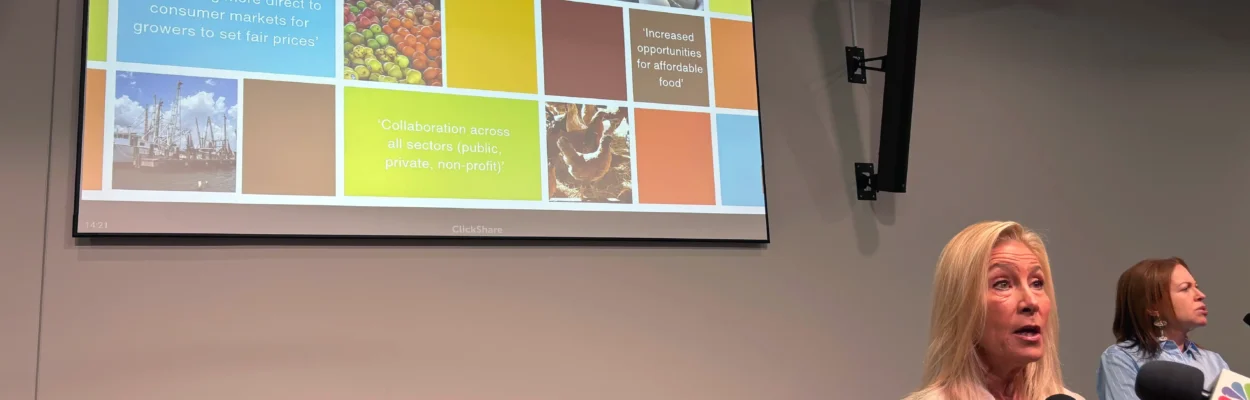
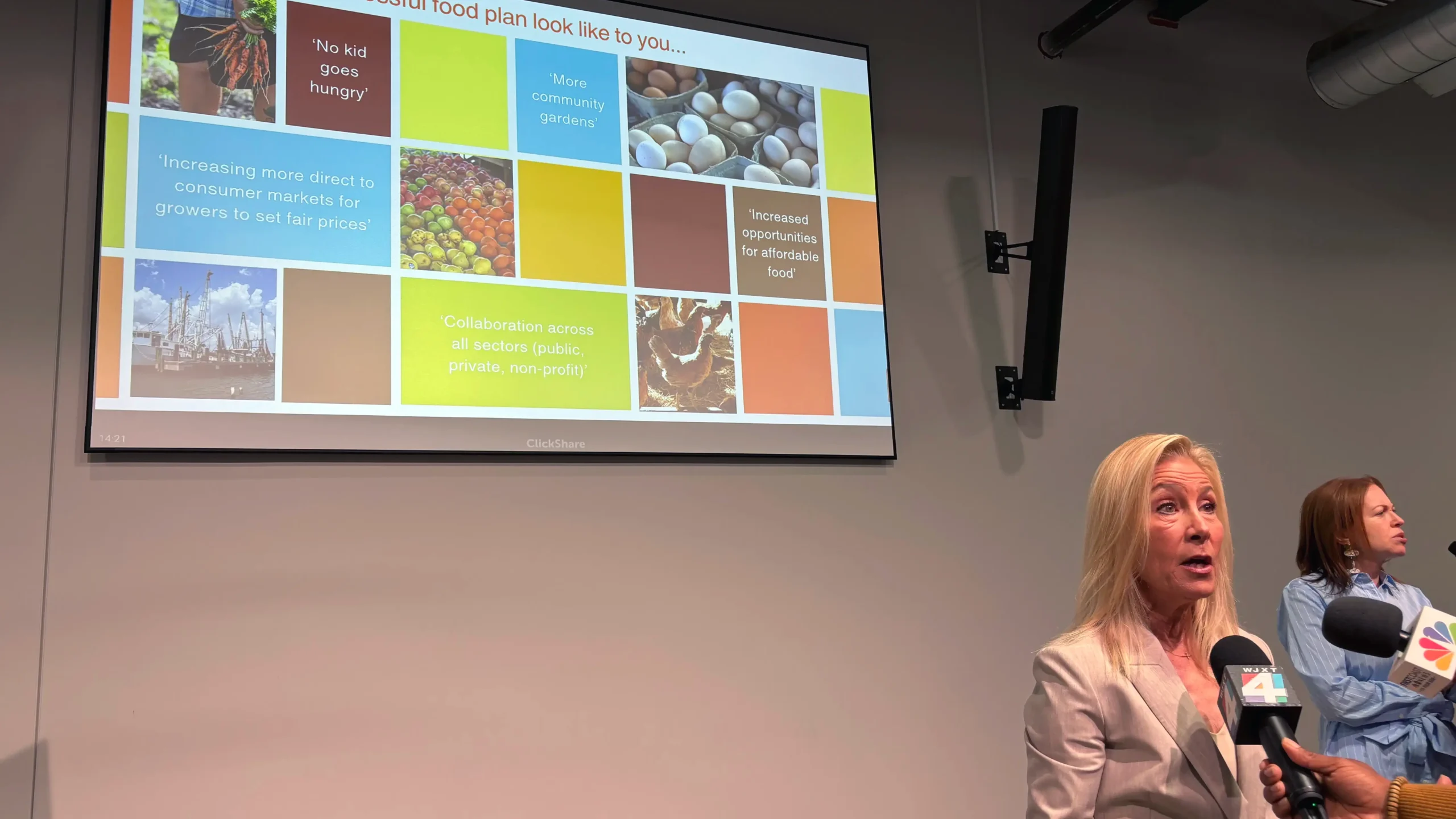
Mayor Donna Deegan answers questions at the presentation of Jacksonville's first comprehensive food plan | Simone Endress, Jacksonville Today
Published on October 26, 2026 at 4:34 pm
Free local news and info, in your inbox at 6 a.m. M-F. Sign up for the Jacksonville Today newsletter.
Jacksonville leaders presented the city’s first comprehensive food plan Monday in an attempt to ensure access to fresh, affordable and nutritious food for every resident.
The plan is an assessment of Jacksonville’s current “food system” — a network of every person, activity and policy involved in food across four stages: production, distribution, access and recovery.
Jacksonville Today thanks our sponsors. Become one.
About 15% of Jacksonville’s residents deal with food insecurity, the plan says. The plan recommends 32 actions for the city and its partners to pursue, including:
- Tax incentives to lower land costs for farming
- Support for developing food hubs
- Encouragement of city food festivals
- Consideration of a municipal composting program
How the food plan came about
The city took its first steps based on grassroots organizers who have been pushing for clear urban farming regulations for years.
“One of the things that we isolated immediately was the fact that our local growers really didn’t have a great pathway toward being able to sell the things that they grow,” Mayor Donna Deegan said as the plan was presented at Feeding Northeast Florida’s headquarters in North Jacksonville. “And so we thought if we can make sure that we can define that and streamline it for those growers, we can also provide healthy food for our food-insecure here in Jacksonville and help our local economy at the same time.”.


Jacksonville Today thanks our sponsors. Become one.
Nathan Ballentine, owner of Overalls Farm, attended the presentation. He led a three-year community process to draft an ordinance that would clear the path for urban farming.
Speaking about the food plan, Ballentine said: “ It feels like a kind of a public reveal of community priorities. It’s a package compilation of a lot of community conversations that I’ve heard and seen.”
Ballentine drafted an ordinance governing urban agriculture, and the mayor’s office rewrote it over the summer. The new Urban Agriculture Ordinance was presented to City Council on Oct. 13. The council could vote on it as soon as November.
Ballentine said advocates agree with almost everything in the new ordinance. But he said they do have some issues with the new version.
The first is the number of permitted market days, which are days the public is allowed on a farm. The ordinance would allow 12 market days on urban farms, while Nathan’s draft set the number at 70 days.
“Neighborhoods actually benefit from the presence of a market garden in their community by being able to participate in those spaces publicly,” Ballentine said. “If they’re always sealed environments, it’s like having some exclusive private club that nobody can access. It undermines the food access element.”
The ordinance also allows only produce grown on a farm site to be sold there. “ If we were to move cucumbers from one of our farms and sell them at another farm,” Ballentine said, “that also would be a violation.”
The food plan is a guideline for potential actions. It highlights implementation challenges like collaboration across city sectors, regulatory hurdles and funding. The plan promises yearly updates to document actions taken and revisions made.
“A plan is only as good as its implementation,” Ballentine said. “And so now the real question is: Can we get some of it done?”