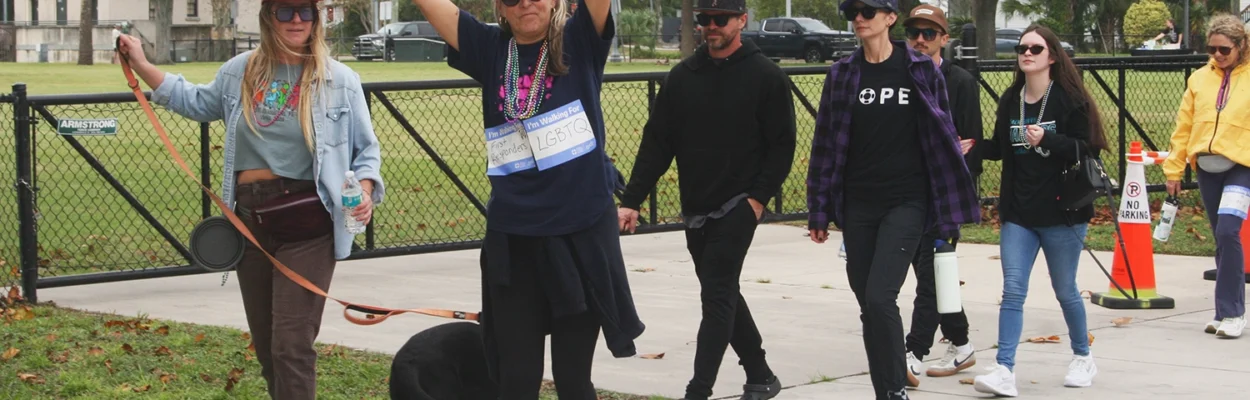
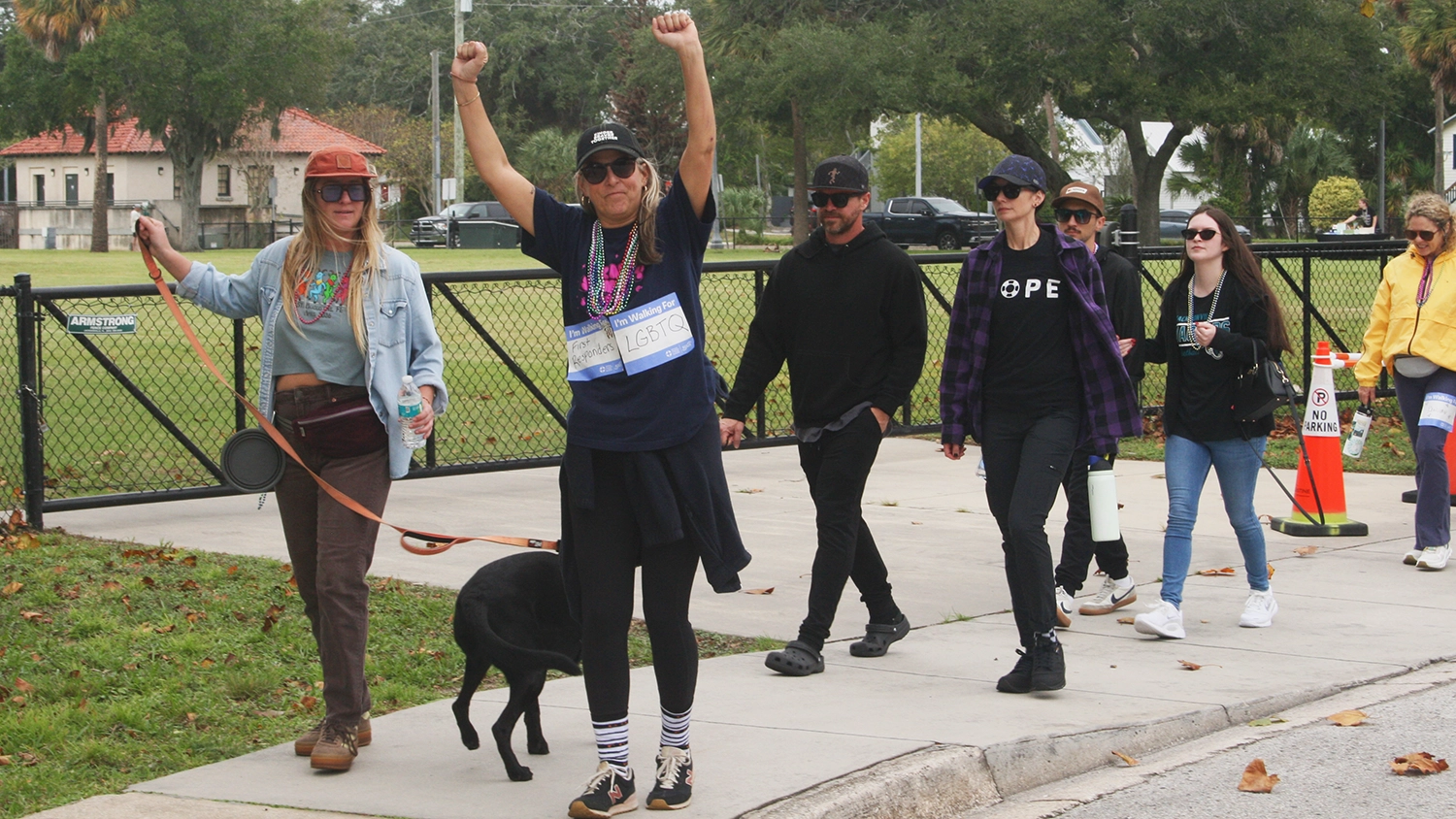
A crowd walks through St. Augustine on Sunday, Oct. 25, 2026, as part of the annual Out of the Darkness Walk organized by the American Foundation for Suicide Prevention North Florida. | Noah Hertz, Jacksonville Today
Published on October 26, 2026 at 2:42 pm
Free local news and info, in your inbox at 6 a.m. M-F. Sign up for the Jacksonville Today newsletter.
While organizations across the state and country work to expand access to mental health resources, the rate of deaths by suicide in Florida has stayed relatively consistent in recent years, even in comparatively well-off communities like St. Johns County.
“Suicide affects everybody,” says Wendy Thompson, executive director of the American Foundation for Suicide Prevention North Florida. “I think that’s the bottom line. It does not discriminate.”
Jacksonville Today thanks our sponsors. Become one.
The North Florida chapter of the organization serves a chunk of Florida that ranges from Alachua County through St. Johns and Duval into Florida’s smallest county — rural Union County.
Rural areas typically see higher suicide rates than urban areas. State data shows counties like Baker and Union more often than not have suicide rates higher than the state average.
But it’s not just rural counties. St. Johns, with its high rates of immigration from other parts of the country, its highly-rated schools and its top-of-the-state average household income, still sports rates of death by suicide on par with — and, in some years — higher than neighboring Duval and the state average.
Jacksonville Today thanks our sponsors. Become one.
As part of the organization’s effort to support suicide prevention efforts, Thompson helped organize an event on Sunday: the annual Out of the Darkness Walk in St. Augustine. The event serves as an opportunity for people who have been affected by suicide to gather together and show support for one another.
Ahead of the walk, the local chapter raised more than $12,000 to help support suicide prevention efforts around the region.
Finding support
The American Foundation for Suicide Prevention is far from the only organization working in this arena. A number of other organizations and individuals convened in St. Augustine Beach in August as part of the Zero Suicides St. Johns conference.
The event was an opportunity for leaders in the suicide prevention world to get together, share stories and brainstorm about what St. Johns County’s most vulnerable populations need.
Rachelle Burns, Florida Suicide Prevention Coalition chair, was at the conference.
Burns is based in Florida’s Panhandle, but she says factors that contribute to suicide are consistent around the state.
“Suicide is no respecter of person. It’s no respecter of economic status. It’s no respecer of age, family, circumstances,” Burns says. “It can happen to anyone, but we do know there are more vulnerable populations in our society.”
Burns says a lack of community often plays a large role, and she specifically identifies men ages 55 and older as particularly high risks for suicide.
“Men are often less likely to seek help than women. They tend to particularly have been impacted by this sort of sociocultural norm of not seeking help,” Burns says.
They are also, on average, more likely to have access to lethal means, like firearms.
But some areas, including St. Johns, are seeing numbers beginning to trend down.
In 2020, the average number of deaths by suicide per 100,000 people in St. Johns County was 16.5. In Duval County, it was 15.5, and in Clay it was 13.
Although the state average has crept up, numbers in those counties were down in 2024, the most recent data available through the state. St. Johns County’s rate was down to 13.9, Duval’s down to 14.6 and Clay’s down to 14.3.
Burns is optimistic that this is a trend that will continue, and not just in Northeast Florida.
She believes that the accessibility to emergency assistance through the 988 Suicide & Crisis Lifeline has been a net positive. Across the country, the number of young people committing suicide has been in decline since the service launched in 2022.
Those numbers are less consistent county by county in Florida, but organizations around the state are making efforts to reduce the stigma around discussing suicide and self-harm.
Beginning dialogues
One group trying to get people talking about mental health early is Wolfson Children’s Hospital’s Common Thread program.
Jennifer Arevalo is a coordinator with the group. She works to create resources that can help young people who may be struggling with mental health issues.
One area where she has seen positive outcomes is in peer counseling. It’s one thing to hear from an expert in their field about mental health, Arevalo says, but it’s another to hear from your peers.
Circumstances are different in every community, she notes, and Arevalo believes that stressors for young people in St. Johns are likely different than in neighboring areas.
“There could be a lot of pressure … to succeed academically, to go to a great university,” Arevalo says. “Maybe talking about mental health isn’t at the forefront.”
Common Thread targets young people who are still in schools, but resources can be less easy to access for people who are no longer students.
That’s another area where members of the community are trying to make a difference.
‘Grief doesn’t really go away’
Rocking Chair Records owner David Smart attended the recent Out of the Darkness Walk in St. Augustine. He lost his father to suicide more than 10 years ago.
Smart kept that fact to himself for years, attending the occasional support group, he says. This year, he decided to help raise money for the American Foundation for Suicide Prevention’s Out of the Darkness Walk in St. Augustine.
Smart raised $1,776, the second-highest of any individual raising funds for the event. That money goes toward the American Foundation for Suicide Prevention’s suicide prevention research and prevention programs like pairing up grieving individuals with peers who can relate to what they’re going through.
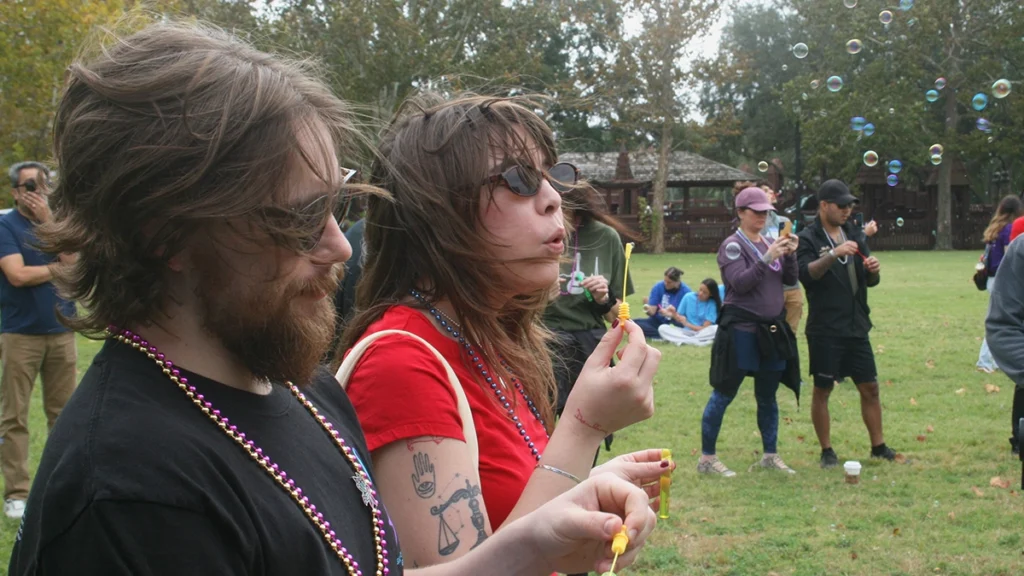
Now, Smart’s hope is to start a loss survivor support group at his shop.
He was never someone who regularly attended support groups, but Smart says he has been thankful for them over the years.
“I was having weekly … grief-induced breakdowns and mental episodes surrounding my grief, and the only thing that ever helped with that and actually completely stopped it was going to those support groups,” Smart says. “Just hearing other people and just knowing you’re not the only one going through it is just like so powerful. It’s crazy.”
These days, he says most of the support groups surrounding suicide in St. Johns County are affiliated with churches. Smart doesn’t disparage those groups, but he acknowledges that can be a barrier to entry for some people who may need to talk about their experiences.
Smart doesn’t have a definitive timeline for when he hopes to launch his own support group, but he hopes to continue his journey with grief by helping others work through theirs.
“The grief doesn’t really go away. Other people say it gets better with time, but I like the saying that it doesn’t really get better with time, but you get better at dealing with it,” Smart says. “It’s a corny saying, but I think it’s true.”
If you or someone you know is struggling with feelings of suicide or self-harm, you can text or call the Suicide & Crisis Lifeline at 988.