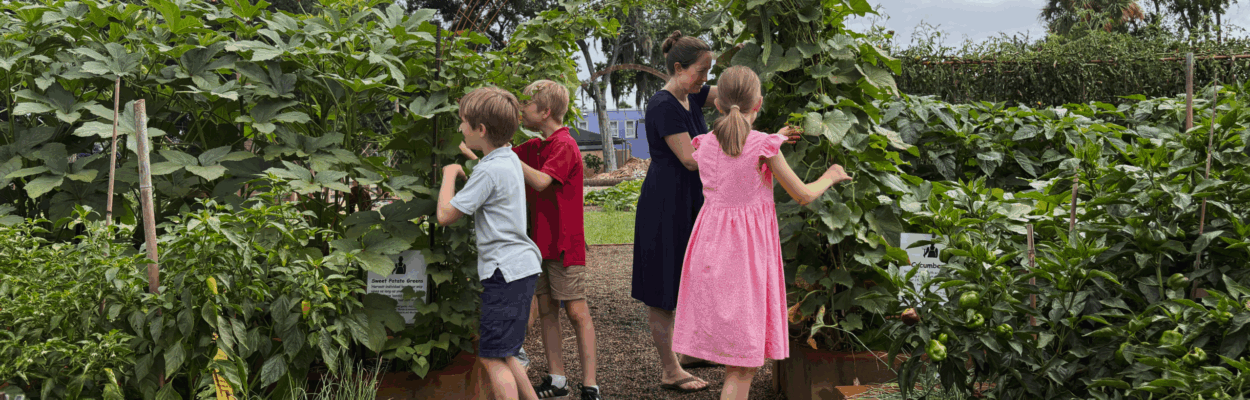
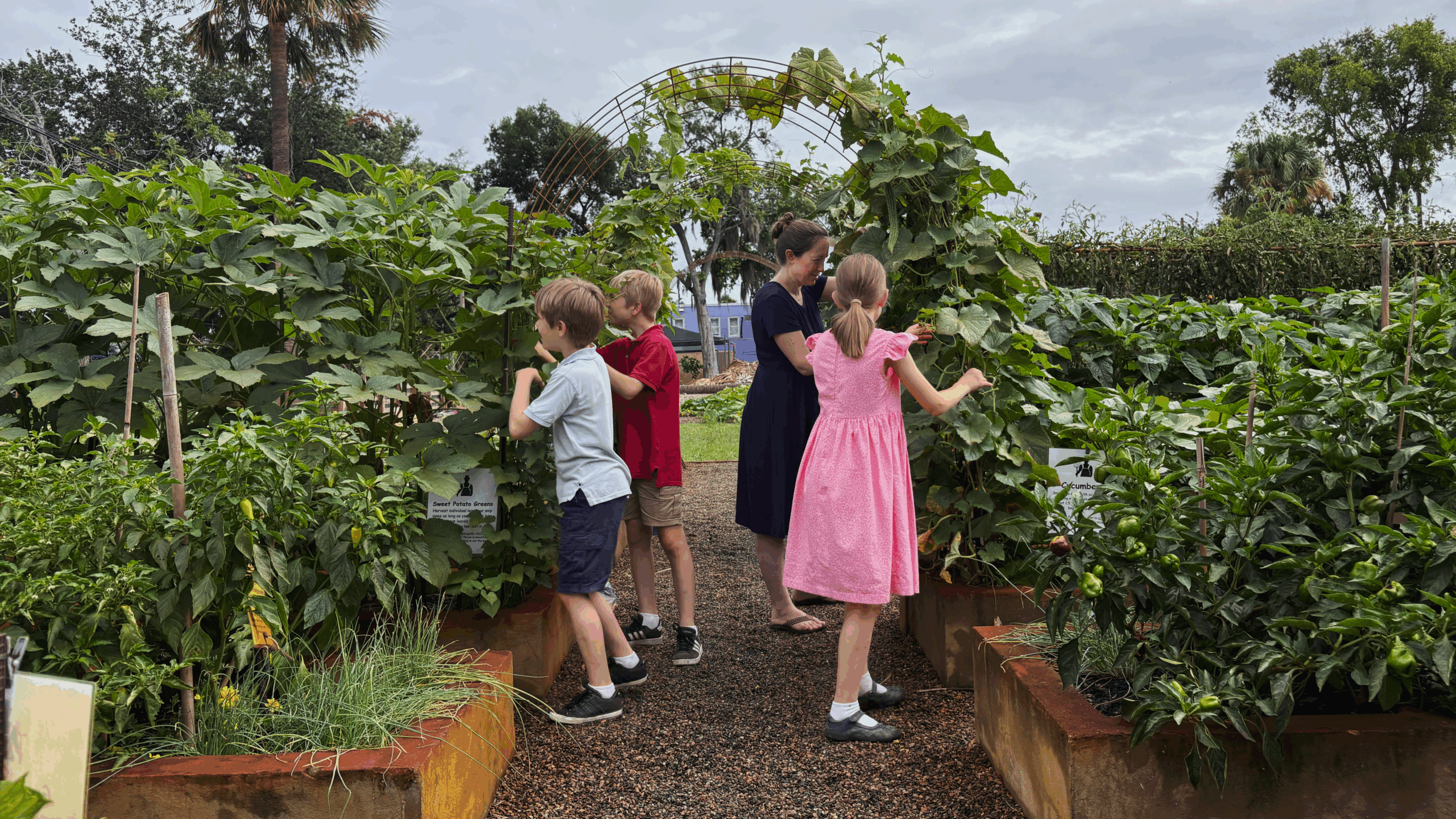
Ashley Rhea and her children pick produce from Overalls Farm Three. They have been members since 2025. | Simone Endress, Jacksonville Today
Published on July 14, 2026 at 11:33 am
Free local news and info, in your inbox at 6 a.m. M-F. Sign up for the Jacksonville Today newsletter.
In 2009, Nathan Ballentine graduated from college into a dreadful job market in Tallahassee. “I don’t know how to fix the economy, but I do know how to grow food,” he says. He started gardening and selling produce.
Years later, Ballentine moved to Springfield and wanted to grow food for his neighbors again. He didn’t realize how complicated that would end up being. For years, zoning regulations in Duval County exposed him to citations.
Jacksonville Today thanks our sponsors. Become one.
Jacksonville Today reader Marianne B. asks:
“Can you look at why Overalls Farm in Springfield can’t operate legally? Keep getting citations, and the city wants them to pay for (a Planned Unit Development). They provide fresh vegetables!”
A: Ballentine received permission to operate in June 2026, but he continues to push for regulatory shifts for other urban farms.
Before he planted the first seed, Ballentine met with the city to ask what he needed to do to operate legally. Nathan tells Jacksonville Today that he spoke with a few City Hall members, who told him the city couldn’t advise him. “And they said, ‘Well, we can’t tell you that you can do that, but we also can’t tell you you can’t do it because it’s not defined in our code at all.’ … And I said, ‘Well, that sure sounds risky.’”
Ballentine started a community garden in his yard. It took off, and he began a subscription service for his neighbors to collect produce.

Jacksonville Today thanks our sponsors. Become one.
His neighbors received the garden enthusiastically. Soon, Ballentine expanded. He made a deal with another Springfield resident that allowed him to farm on their property.
The citations didn’t start until Ballentine opened his third farm location, also in Springfield. The garden was on a vacant lot, not a residential one, which meant he would need either a Certificate of Use or a Planned Unit Development to operate legally.
(A COU is an application for the city to check that the proposed property use meets zoning requirements and will not disrupt the area. A PUD creates a site-specific zoning classification, allowing more flexibility for what can be done on the lot. Usually, these are for large developments that blend residential, commercial, and recreational activity.)
Ballentine applied for the COU, whose flat fee application cost him $112. He says the PUD would have cost him roughly $4,980, a fee that varies by acreage. For a community garden like his, this amount didn’t seem reasonable to him.
Helena Parola, planning department director for Jacksonville, says the city thought Ballentine should apply for a PUD because “[t]he farm in Springfield includes several uses including growing and selling food along with agritourism events that could bring people from the larger Jacksonville area in to enjoy.”
“The City was determining the impacts from this type of use and found that a PUD rezoning would be most appropriate,” Parola says in an email.
As Ballentine continued to push for a Certificate of Use, he received three citations from the city. One was for unpermitted staging of mulch, a second for trash — Ballentine says he had piled up firewood by the road and told his neighbors that it was up for grabs — and a third for operating Farm Three without a COU.
“Because they wouldn’t give us one,” Ballentine says. “We had to operate because … our farm was gonna go bankrupt.”
Ballentine started a petition for his right to operate and gathered over 1,350 signatures, with 350 coming from immediate neighbors. Eventually, the city dropped all three citations, and Overalls Farm received the certificate for its third farm in June 2026, after applying in 2023.
Ultimately, Parola says, the Certificate of Use was granted because “the site was approved for Greenbelt status from the Property Appraiser’s Office. Greenbelt status allows farm operations and agritourism. It is awarded for “good faith commercial agricultural use of the land,” according to the city’s website.
Ballentine paid the $15 application fee, was inspected by state officials and was awarded Greenbelt in January 2024.
Overalls Farm Three now has the legal right to operate. “We got our COU, and for our current operations, we don’t have to look over our shoulders anymore,” Ballentine says.
The larger problem, according to the urban farmer, is that there aren’t clear rules for community gardens in Duval County, which leaves growers uncertain about what is legal.
Ballentine is working with other farms and gardens in Duval County to propose the Free to Garden Act, which he says would establish community gardens, market gardens and similar small-scale urban agriculture uses as permissible by right across Jacksonville.
“My recurring feeling is it shouldn’t be that hard to start a community garden,” Ballentine says.