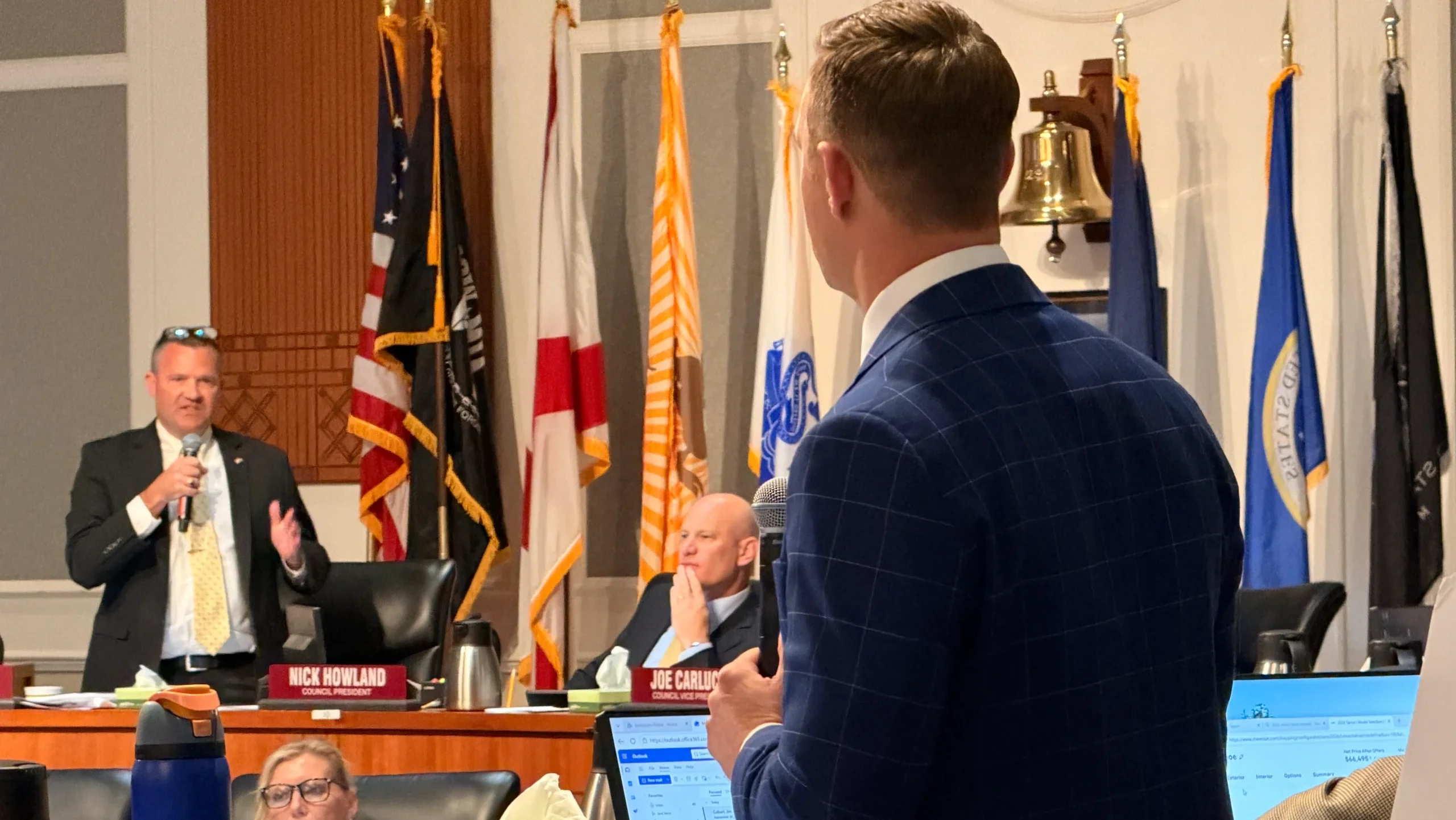
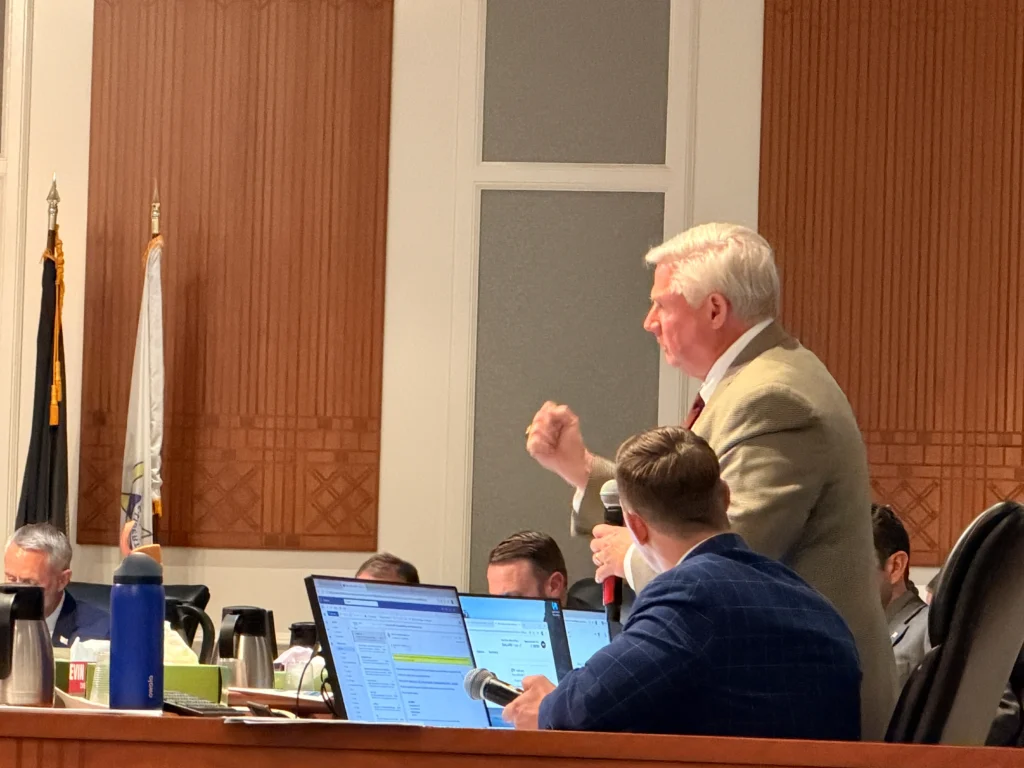
Jacksonville City Council Finance Chair Will Lahnen, left, speaks to Council member Jimmy Peluso during the 2026 budget debate as Council President Nick Howland looks on. | Mike Mendenhall, Jacksonville Today
Published on September 23, 2026 at 1:59 am
Free local news and info, in your inbox at 6 a.m. M-F. Sign up for the Jacksonville Today newsletter.
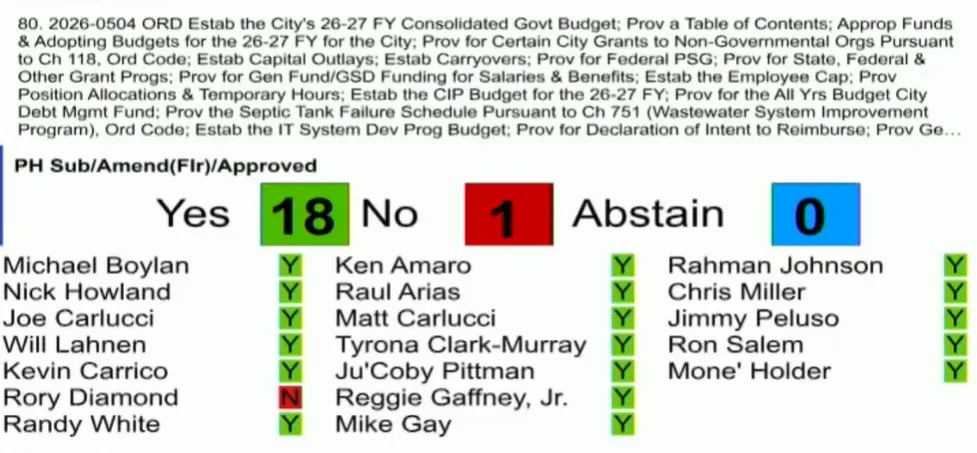
The Jacksonville City Council approved a $2 billion city budget Tuesday that includes record funding for police and fire services, restores money for an affordable housing trust fund, and fully funds public service grants that were previously in question. The budget passed by a vote of 18-1, with council member Rory Diamond the sole “no.”
After a three-and-a-half hour debate, the biggest portion of the city budget, $1.07 billion for the Jacksonville Sheriff’s Office and Jacksonville Fire and Rescue Department, remained unchanged.
Jacksonville Today thanks our sponsors. Become one.
Mayor Donna Deegan’s proposed budget, the starting place in the budget process, kept spending essentially flat other than salary increases for police and fire personnel.
With budget uncertainty looming ahead of the Nov. 3 property tax referendum, known as Amendment 3, the council agreed with the mayor to hold the city’s property tax rate steady rather than lowering it.
The budget includes $56 million for UF Health Jacksonville’s indigent care and $2 million for Wolfson Children’s Hospital’s pediatrics and a OB/GYN graduate medical education program. And the council approved Deegan’s $586.11 million city infrastructure capital improvement plan.
Jacksonville Today thanks our sponsors. Become one.
One of the unknowns going into Tuesday’s meeting was whether the council would reverse the Finance Committee’s move in August to strike a new $4.9 million affordable housing trust fund. Council member Matt Carlucci’s amendment to put the affordable housing dollars back in the budget passed 12-7.
After the final vote, Deegan told news reporters at City Hall that the housing dollars are “a win for affordability.”
“It was absolutely a moment where they really listened to the people and responded to something, frankly, that everybody tells us is a huge need,” Deegan said.
Another question was whether city lawmakers would make all funding available for public service grants and the cultural service grants awarded by the Cultural Council of Greater Jacksonville, rather than hold back half of the grant funding pending the outcome of the Amendment 3 referendum. [Disclosure: Jacksonville Today publisher WJCT Public Media receives cultural service grant funding.]
A majority of the Council supported an amendment by Council member Jimmy Peluso to reinstate the $2.45 million held back from city public service grants the city awards local nonprofits. But Peluso and Council member Rahman Johnson couldn’t rally the same support for the $2.45 million for the Cultural Council.
The Finance Committee held back the grant money, as well as funding for telehealth for the uninsured and eviction diversion assistance and tied it to Amendment 3.
If Florida voters approve the homestead property tax cut, that money would go into reserves to prepare for what’s expected to be a $300 million revenue shortfall by 2028. If Amendment 3 fails, those programs would be fully funded.
Council President Nick Howland and Finance Chair Will Lahnen championed the Amendment 3 contingency fund, and advocated Tuesday to keep the budget as it came out of the Finance Committee in August intact.
Millage rate unchanged
The city’s property tax millage rate remains at 11.1919 mills. That’s around $11.19 per $1,000 of a home’s taxable value. The rates also remained unchanged in in Duval County’s Beaches towns, at 7.9012 mills, and in Baldwin, at 9.4208 mills.
The council voted 16-3 on final approval of the property tax rate, with Diamond, Kevin Carrico and Mike Gay voting no.
But if Amendment 3 passes, the council and the Deegan administration both acknowledged Tuesday they may have to go back into the budget and make adjustments.
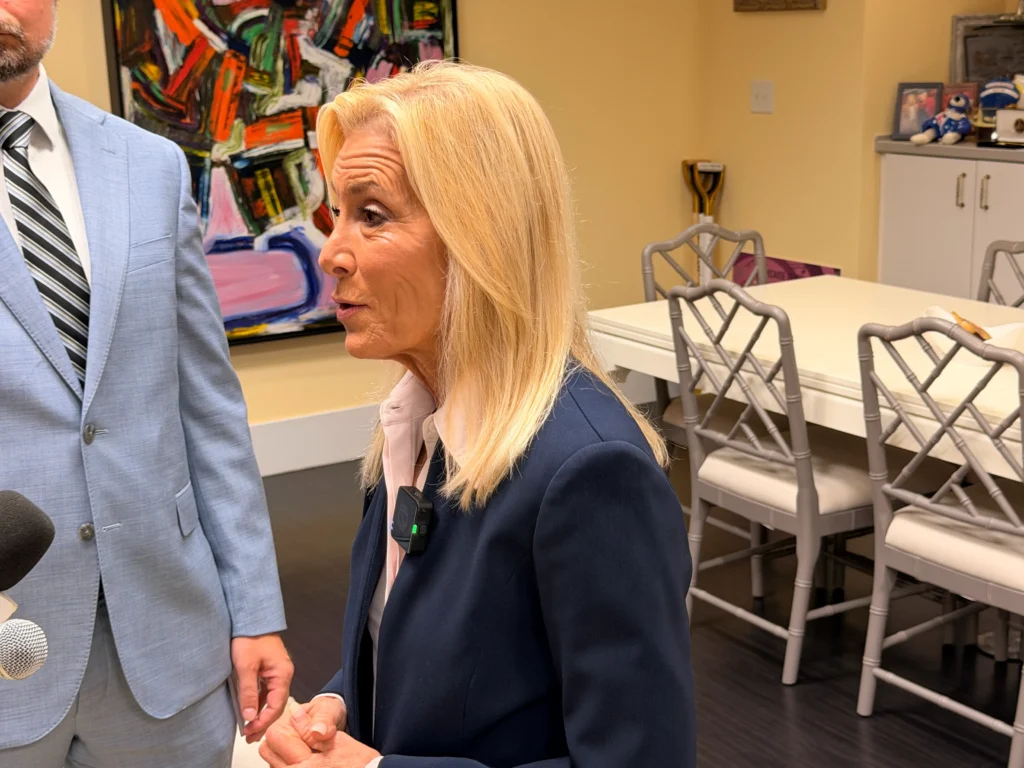
Despite their differences, Deegan, a Democrat, praised Republican Council President Nick Howland and Finance Chair Will Lahnen on how they handled this year’s budget process.
“It felt like a really grown-up process, and I really appreciated that.” she said.
A budget for affordable housing
Carlucci’s affordable housing amendment passed with help from council member Ron Salem, whose amendment shifted more money toward down payment assistance for home buyers.
The final trust fund now includes $2 million for down payment assistance, $1.4 million for capital stack funding, and $1.5 million for attainable housing utility tap fees.
Carlucci argued, if city leaders can provide half of the cost of a $1.4 billion stadium renovation for the Jacksonville Jaguars and $130 million for the new University of Florida Graduate Campus, they should be able to support an affordable housing trust.
“That’s great stuff. I’m all for it,” Carlucci said. “But you know what else is great stuff? Helping workforce people that make $60,000 to $80,000, teachers, police officers, firefighters, working folk that need a little help getting over the gap so they can qualify for a mortgage and move into a home with their families.”
In the end, Carlucci, Salem were joined by Council Vice President Joe Carlucci, Kevin Carrico, Ken Amaro, Raul Arias, Tyrona Clark-Murray, Ju’Coby Pittman, Reggie Gaffney Jr., Rahman Johnson, Jimmy Peluso and Moné Holder in voting yes on the trust fund.
Howland, along with Diamon, Gay, Lahnen, Michael Boylan, Chris Miller and Randy White voted no.
Before the vote, Howland tried to dispel what he sees as a false narrative that the city does not fund affordable housing. He noted that since since 2023, the city has appropriated more than $79 million in local, state and federal funding to affordable housing and homelessness diversion programs.
Howland says the $79 million, in addition to tax-exempt bonds for affordable housing developers, are “definitive proof that this council is indeed working to tackle the affordability issue.”
“Don’t say we don’t try to take care of the affordability crisis,” Howland said. “Saying that is disingenuous, and it’s political.”
But according to the Deegan administration, only a small percentage of those dollars came from the city.
Joy Viau is a member of the Interfaith Coalition for Action, Reconciliation and Empowerment, a group of 38 faith congregations that’s been pressing Deegan and council members to establish the affordable housing trust fund.
She told council members before the vote that affordable housing programs protect, not only the young and financially strained, but vulnerable seniors.
“The fastest growing population of first-time homeless citizens nationwide are folks 55 and older,” Viau said. “My mother is a 98-year-old retired school teacher who receives not only Social Security but a state pension as well. And yet, she depends on me financially to stay in her home.”
Public and Cultural Service Grants
The Finance Committee previously held back 35% of the $7.1 million the Deegan administration budgeted for the city’s public service grants, which provide funding to Jacksonville nonprofits, and from the city’s independent arts funding agency, the Cultural Council of Greater Jacksonville.
Peluso’s amendment will allow nonprofits to receive their full public service grants funding. But for arts institutions that rely on Cultural Council grants, they’ll have to wait until Nov. 3 to know if they can count on those city dollars.
Darren Dailey, the Jacksonville Children’s Chorus president and artistic director, says a funding cut to the Cultural Council would mean a 20% cut to his organization’s funding and reducing its operations.
He argued Tuesday, it “cannot absorb significant reductions indefinitely without affecting the children and families we serve.”
“We are not simply an organization located in Downtown Jacksonville. We are actively contributing to the cultural life and activation of Downtown, in addition to our singers and families,” Dailey told the council.
Other budget cuts upheld and restored:
Restored:
- Jacksonville’s membership in city and county leagues: Council approved an amendment by member Raul Arias to restore $237,427 removed during budget hearings for municipal dues for the city’s memberships in the Florida Association of Counties, the Florida League of Cities, the National Association of Counties and the National League of Cities.
Upheld:
- United Way Eviction Diversion: Johnson’s amendment to pull $500,000 from in the Amendment 3 contingency fund back into the budget for eviction diversion failed. The budget does include half – $500,000 – of what the program gets from the city.
- Telehealth: Healthlink Jax, the city telehealth program for uninsured residents, will have to wait until Nov. 3, to know whether $750,000 – half its budget – will be restored. Johnson’s amendment to fully fund that program also failed.
- OutEast Community Center Project: Another Johnson amendment that would have added $300,000 to establish a community center in Jacksonville’s historic Eastside did not pass.
- City Council office renovation: Johnson’s fellow Council members also voted down his amendment to take $500,000 from the public safety contingency to remodel city council offices.