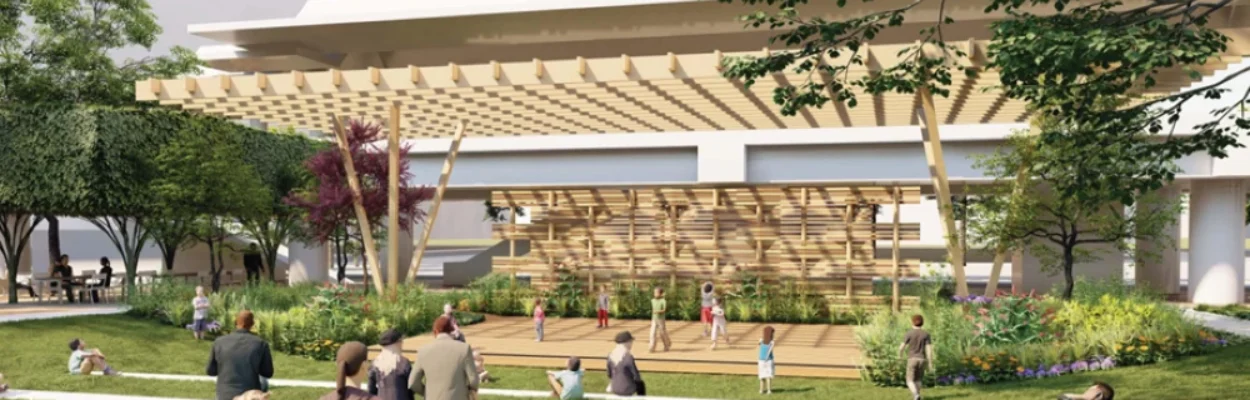
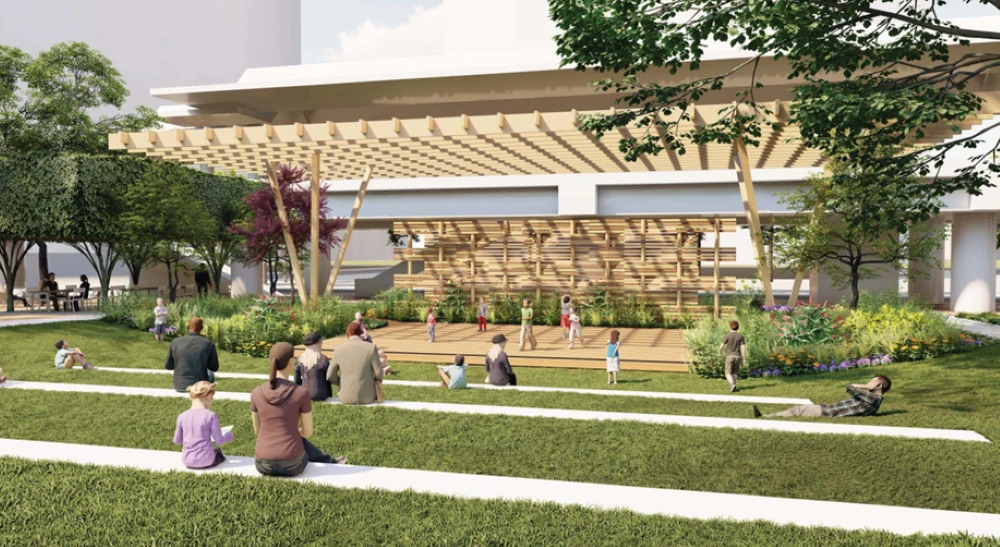
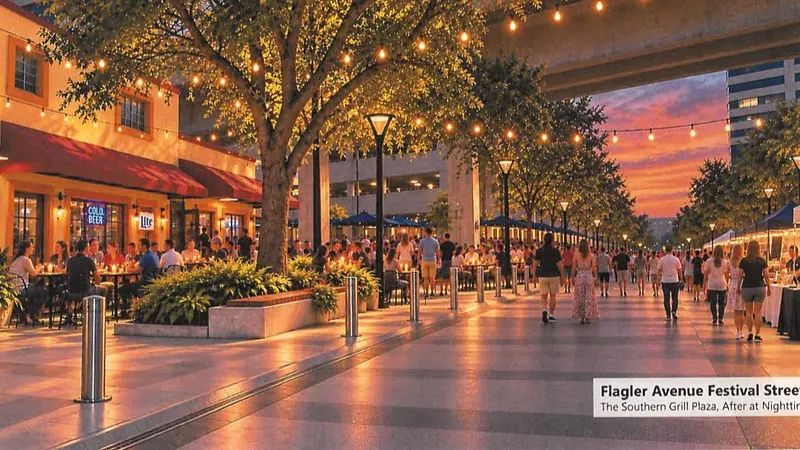
A rendering shows the James Weldon Johnson Park renovations that are funded in the city's proposed Capital Improvement Plan. | City of Jacksonville
Published on September 3, 2026 at 5:33 pm
Free local news and info, in your inbox at 6 a.m. M-F. Sign up for the Jacksonville Today newsletter.
A city budget for next year is headed to the full Jacksonville City Council, and it came together without the acrimony that engulfed last year’s budget process.
Six budget hearings in August came off without last year’s tug of war between conservative Republicans and a coalition of moderates, Democrats and the mayor.
Jacksonville Today thanks our sponsors. Become one.
The process was shrouded, however, by a tax cut proposal on the state ballot in November that, if approved by voters, could cost Jacksonville $300 million in annual tax revenue by 2028.
The uncertainty prompted City Council’s Finance Committee to make cuts and accounting moves than dropped $23.4 million from the budget.
If approved, the 2026-27 budget would be the first time since 2012 that the city reduced spending from the previous year. As of Tuesday, the committee’s edited budget is $2.002 billion, just under the $2.003 billion spending package approved last year.
Jacksonville Today thanks our sponsors. Become one.
None of the decisions are set in stone. Council members could restore funding, cut more or add spending priorities on budget night. But there were apparent winners and losers coming out of the hearings.
Budget winners
Jacksonville Sheriff’s Office and Jacksonville Fire and Rescue
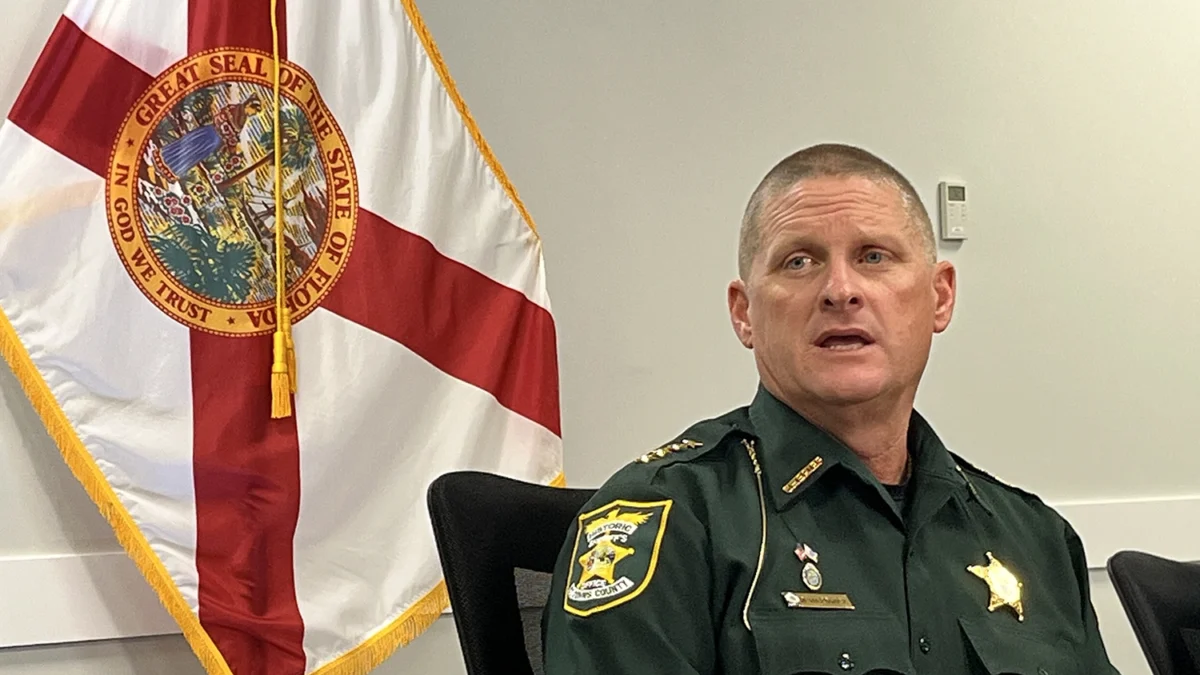
Nearly 53%, or $1.07 billion, of Mayor Donna Deegan’s proposed budget was set aside for public safety spending — a record number for Jacksonville. Committee members cut nothing from Sheriff T.K. Water’s $675.9 million budget request and also didn’t touch the $396.4 million for the Jacksonville Fire and Rescue Department.
The committee also moved $22.655 million of what it cut from Deegan’s budget into a special public safety contingency fund that could help pay for additional projects, like JSO’s push to consolidate its storage and evidence warehouses into one Downtown location.
Wolfson Children’s Hospital
Finance chair Will Lahnen and council President Nick Howland said they wanted no new spending. But the committee did say yes to a nearly $2 million request from Wolfson’s Children’s Hospital to aid the proposed expansion of its Pediatric and Obstetrics and Gynecology Graduate Medical Education Program.
Lahnen said Tuesday that the city’s return on investment would exceed the spending.
Baptist Medical Center Jacksonville, which operates Wolfsons, said in 2025 that the $25.8 million project to expand its labor and delivery services was in part to prepare for a rise in high-risk pregnancies.
Hogpen Creek homeowners
After years of petitioning the city to do something about sediment buildup and erosion along Hogpen Creek, homeowners who live on the waterway could finally see money put toward finding the root cause of the issue. The committee added $250,000 to the proposed $587 million capital improvement plan for the study.
Ultimately, residents on the creek want the city to dredge the creek to fix chronically low water levels in what was once a free-flowing creek, if the cause is found to be government infrastructure work on or near the waterway. They hope a study gets to the bottom of that. Diamond, who represents the area, promised residents during a town hall in May that he would add money into the proposed budget to fund the study.
James Weldon Johnson Park
Several of the Finance Committee members were hesitant to sign off on $6.75 million for upgrades to James Weldon Johnson Park, the historic public space across from City Hall in the heart of Downtown.
Lahnen and others argued that city lawmakers have already approved more than $200 million in the last five years for Downtown’s riverfront park system, and more could be a tough sell to Jacksonville residents who live farther from the urban core.
But, on Tuesday, the committee ultimately decided to keep $5 million in the capital plan for demolition, lighting and electrical work, landscaping and irrigation, walkways, security, engineering and ADA compliance for the park redesign.
They also set aside $750,000 for next year’s budget to build a stage at the park and put $1 million from the original budget back into city reserves.
Budget losers
Affordable housing advocates
For a second time, it seems unlikely that Deegan’s push to get money for an affordable housing trust fund will make it into the city budget. The mayor included $4.9 million in her spending plan to seed a permanent fund to make for-sale, owner-occupied housing more attainable for low-income Jacksonville families.
Deegan’s full trust fund proposal was broken down into three parts:
- $1.5 million for a down payment assistance home-ownership program
- $2.4 million for developers to help pay to build attainable housing
- $1 million to assist with utility tap fees for attainable housing projects
The committee cut those dollars on Day 1 of the hearings, citing their redline on no new spending. Lahnen said, despite the cut, affordable housing is a priority for council leadership.
“The affordable housing trust is a great example of sticking to our guidance of nothing new. Although it was lumped together in the budget as a single item called affordable housing trust, it was three separate line items, none of which were new, and items that have repeatedly not been put into the budget by the Finance Committee,” Lahnen said.
The $4.9 million for affordable housing was Deegan’s response to a request of the Interfaith Coalition for Action, Reconciliation and Empowerment — known as ICARE — earlier this year for a $10 million affordable housing trust.
In 2024, council voted down another attempt by Deegan to start a $10 million affordable housing trust that would have come with private sector and philanthropic matching dollars.
Last year, council removed $2 million to help developers finance affordable housing projects in Jacksonville, only to add $900,000 of that back after pressure from council member Matt Carlucci.
Over the last 12 months, council has approved development loans for individual affordable housing projects, including a 38-unit townhome community on Ricker Road and a 240-unit apartment project along Beach Boulevard.
“It was disappointing to see the affordable housing funding removed given that there is such a great need, and citizens tell us this is their top concern,” Deegan’s office said in an email. “We will work with the full City Council to restore this critical funding in September. We also hope that children’s programs will be preserved as the Finance Committee continues to discuss these investments in our city’s future.”
Coordination among counties
A majority of the committee voted to eliminate $237,427 that went to pay the city’s membership dues for the Florida Association of Counties, the Florida League of Cities, the National Association of Counties and the National League of Cities.
Jacksonville participates in these organizations to share ideas and coordinate with other local and county governments in Florida and the U.S. more broadly. Committee member Rahman Johnson and Randy White voted against the removal.
Council member Raul Arias, who is not on the committee, also pushed the committee on Tuesday to reinstate the funding.
Mayor’s office budget
For the second year in the row, the committee decided to cut the mayor’s office budget. Historically, the council has allowed mayors to determine how much their office needs for salaries and expenses.
The committee voted to reduce Deegan’s executive office budget by $245,376 to about $5.2 million. Lahnen said the drop was to match the salary increase allowed for the Office of the City Council. In 2025, the council cut $631,125 from the mayor’s office.
Lahnen says council “led by example” during the budget hearings by taking about $7.8 million of the council’s annual $10 million in strategic planning funding and moving it into the reserves.
Amendment 3 limbo
Cultural Council and public service grants
The Finance Committee decided to hold back some of what the city gives for cultural service and public service grants, telehealth for the uninsured and rental assistance and tie it to the property tax referendum, which is known as Amendment 3.
As a result, the city’s arts, cultural and public service nonprofits will not know until November how much money they’ll have to operate for the next 12 months.
The Jacksonville Cultural Council and the Public Service Grants Council will get at least 65% of the funding budgeted by the Deegan administration. The last 35% will be tied to whether Amendment 3 passes.
That means $7.1 million that would be basically split between cultural and public service grants will be put into the contingency.
Originally, the committee was going to advance a budget funding both councils at only 50% for the year. But pressure from some council members raised that to 65%.
“If Amendment 3 fails, we still have a year-over-year budget slightly less than last year. If it passes, we have a head start on scaling down to a budget of $200 million less for fiscal year 2027-28, by not approving all of the public service grant and cultural grant funding to be released on Oct. 1,” Lahnen said.
Telehealth and rental assistance
Deegan’s Healthlinks Jax telehealth program for uninsured residents has been a lightning rod for the mayor’s critics on council since it was first approved. Diamond tried to pull funding for what’s billed as an emergency room diversion program last year and investigated it for unproven fraud allegations through the council’s DOGE committee earlier this year.
The committee’s edited budget will provide program operator Telescope Health $750,000 of the $1.5 million before the November vote. The other half will be released if the referendum fails.
The committee did the same with $500,000 for an eviction diversion program, Jacksonville Eviction Diversion Collaborative, supported by the United Way of Northeast Florida, Jewish Family and Community Services, Jacksonville Area Legal Aid and the Duval County Court System.