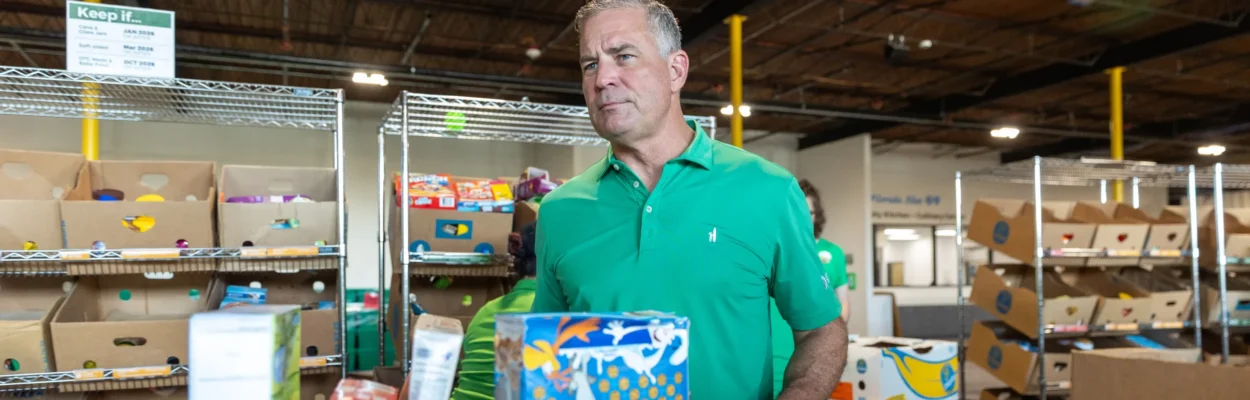
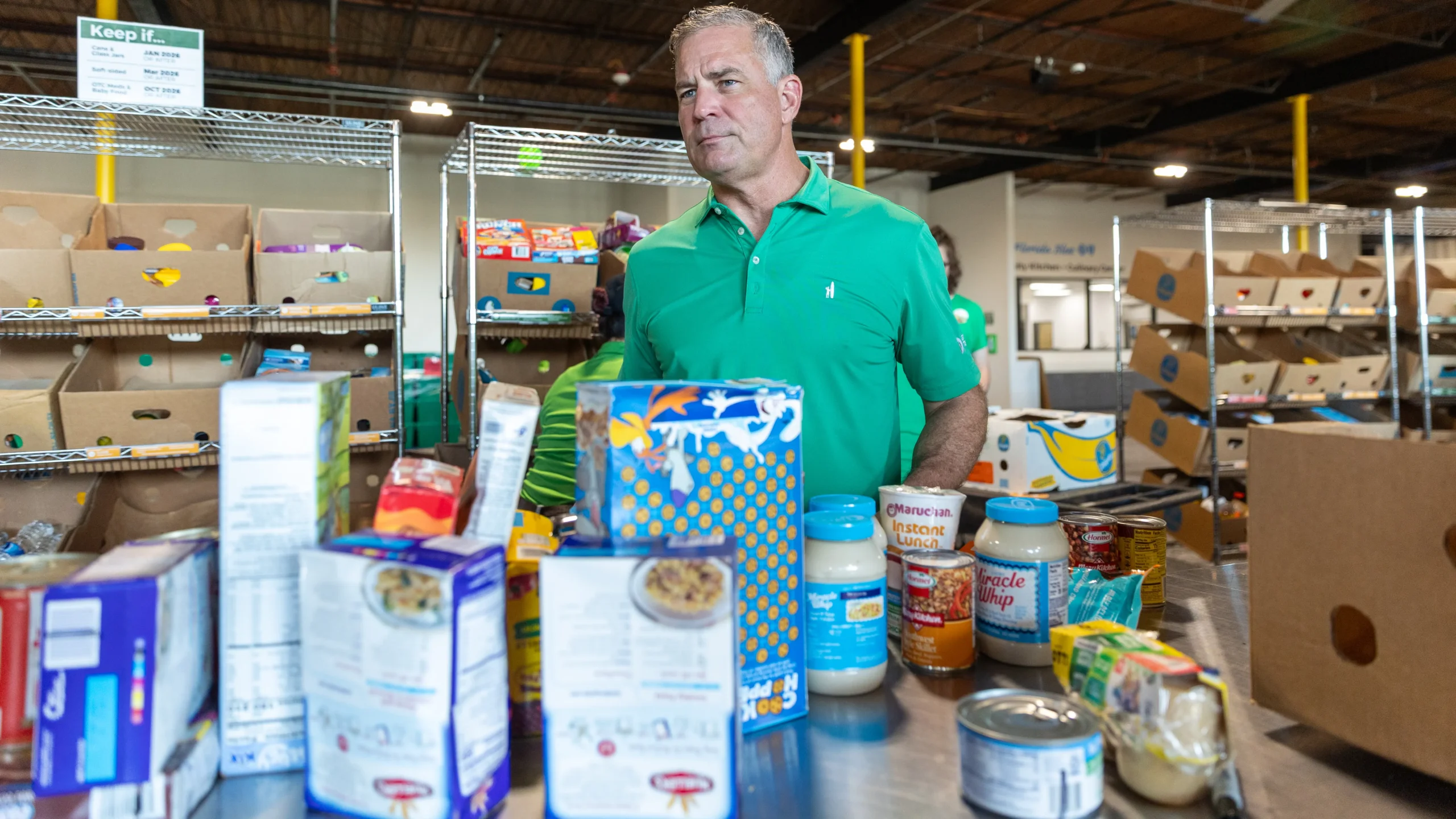
Publix CEO Kevin Murphy was among 70 employees who sorted canned food and other items on Tuesday, Sept. 22, 2026. Publix announced it will donate $25 million to combat food insecurity and hunger across its eight-state footprint. Feeding Northeast Florida will receive $1.1 million of the money. | Will Brown, Jacksonville Today
Published on September 23, 2026 at 11:47 am
Free local news and info, in your inbox at 6 a.m. M-F. Sign up for the Jacksonville Today newsletter.
Publix announced Tuesday that it will donate $1.1 million to Feeding Northeast Florida, part of $25 million the Lakeland-based grocer will make across eight southern states in its quest to eradicate food insecurity.
The money will help the regional food bank speed up its distribution to the rural portions of its 12-county coverage area that spans from the Gulf Coast to the First Coast.
Jacksonville Today thanks our sponsors. Become one.
Publix CEO Kevin Murphy says Feeding Northeast Florida is adept at reaching rural areas and ensuring people who need food have access to it.
“They do great work here. And, they have a history of doing great work,” Murphy said shortly after sorting canned goods at Feeding Northeast Florida’s headquarters in Northwest Jacksonville. “We’re very proud to continue to partner with them.”
Murphy started his managerial career at a Publix location in Orange Park and worked at the company’s location on 103rd Street on Jacksonville’s Westside.



Jacksonville Today thanks our sponsors. Become one.
Rising fuel and energy costs have forced food banks to recalibrate to the increased need. Feeding Northeast Florida CEO Susan King told Jacksonville Today this summer, food lines increased by 20% between the first and second quarter of this calendar year.
The federal Bureau of Labor Statistics reports that food-at-home prices in August have increased by 2.2% from August of last year.
Good Together
Feeding Northeast Florida distributed 38.1 million pounds of food in 2025. It estimates 7 million pounds of that total came through Publix’s Good Together program.
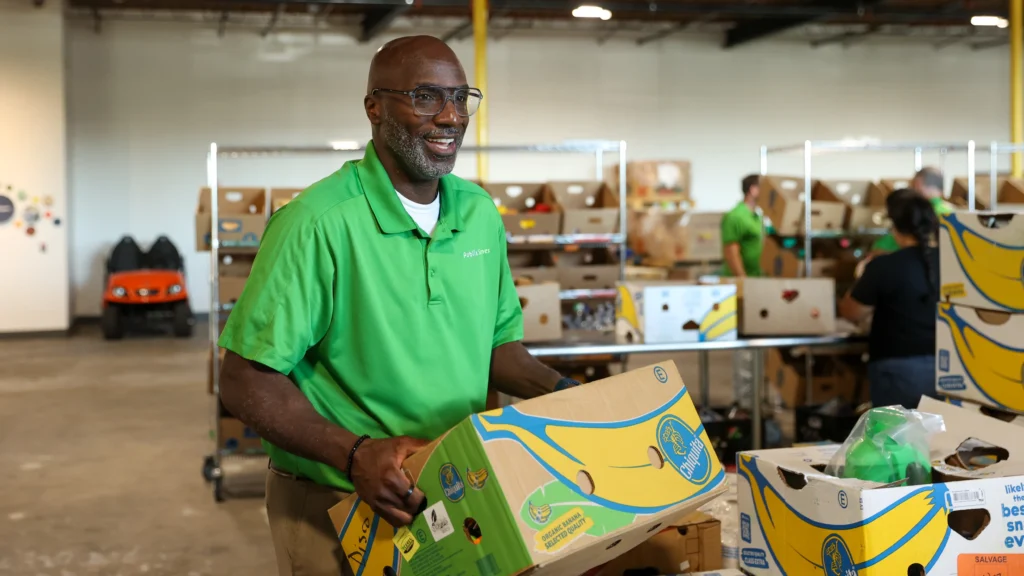
Every evening at its 1,442 stores, employees identify edible food in packaging that may not meet Publix’s aesthetic standards. That food is donated to local food banks.
Feeding Northeast Florida board Chairman Dipak Rajhansa said Publix donated 7 million pounds to Feeding Northeast Florida through its Good Together program. The company says the 140 million pounds of food it donated last year was a single-year high for the 17-year-old program.
Need never sleeps
Tuesday morning, Publix employees sorted 13,900 pounds of food inside Feeding Northeast Florida’s headquarters as part of a Hunger Action Month initiative. The nonprofit estimates that will produce 11,583 meals for hungry families.
Publix was not the only corporation with a large Jacksonville presence who donated millions on Tuesday.
Florida Blue Foundation announced it will donate $400,000 over the next four years to Clay County-based Waste Not Want Not to recover food and distribute it across Clay County. It was part of a $3.1 million donation intended to strengthen food emergency networks and support under-resourced people.
Florida Blue Foundation approaches a lack of access to food as a health issue. Publix views food insecurity as its greatest — and most obvious — way to support the communities where it operates.
Murphy says the sharp increase from last year’s $15 million donation is because of additional need.
“People are feeling the squeeze, whether its fuel prices or whether it’s the cost of energy or other things. That transcends to everyone,” Murphy says. “Those longer events create a bigger demand. Publix is happy to continue to do our part to support the Feeding America partners throughout our network.”
In its most recent earnings report, released Aug. 3, the privately held, employee-owned company stated “sales were negatively affected by economic conditions impacting consumer spending.”
Since that time, diesel prices have hit record highs. Because most food that grocers sell arrives to the retailer by truck, the rising fuel prices could not only provide higher costs to produce food, but to transport it to market.
“There are a lot of factors that go into the cost of consumer goods. … Fuel does affect the cost of everything throughout the supply chain,” Murphy says. “Here at Publix we are focused on what we can control. We’re here to combine our volunteer efforts — we have 8,000 associates working across 500 different Feeding America organizations and partner organizations — really trying to do our best to end hunger.”
Finding solutions to hunger
Feeding Northeast Florida estimates there are 142,000 people in Duval County who face hunger. Its leadership has noted the final three months of the calendar year are when it faces its greatest need for food.
Rajhansa, the Feeding Northeast Florida board chair, says solving hunger can eradicate a series of societal problems in the region.
“It’s not just going to bed hungry. But, it’s crime, its poverty, it’s nutrition, it’s education,” Rajhansa says. “We can solve a lot of problems if we are able to solve the problem of hunger in our community.”