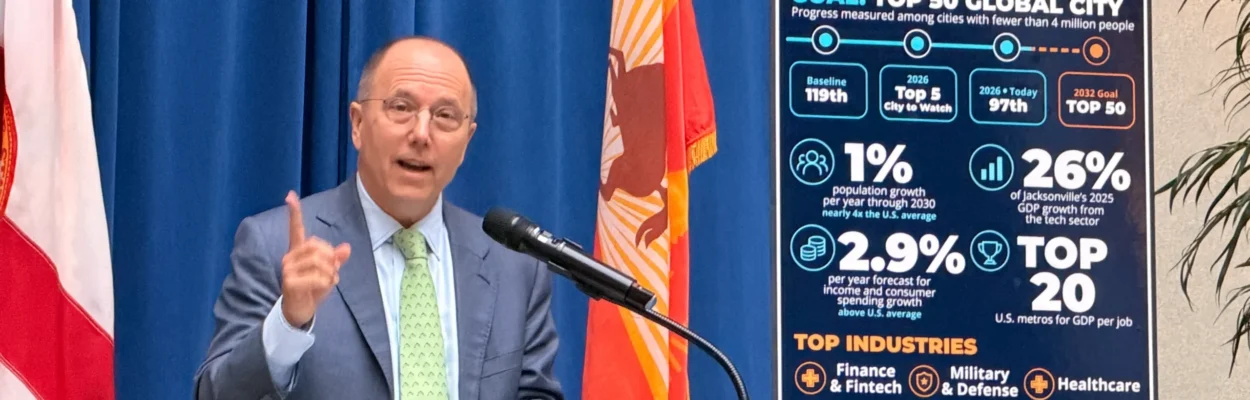
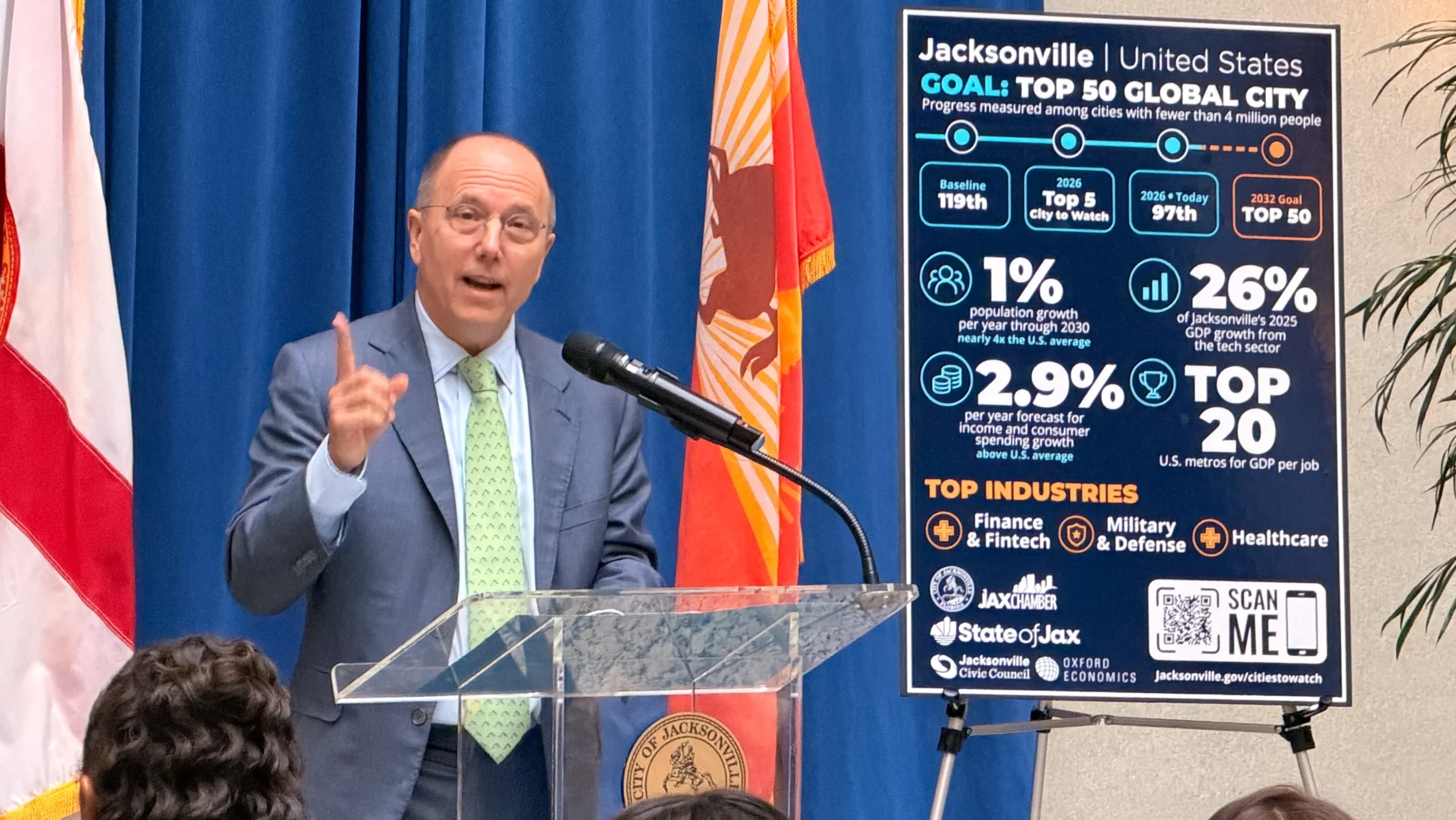
Jacksonville Civic Council President and CEO Dennis Whittle speaks Tuesday, Sept. 15, 2026, at Jacksonville City Hall. | Mike Mendenhall, Jacksonville Today
Published on September 21, 2026 at 3:09 pm
Free local news and info, in your inbox at 6 a.m. M-F. Sign up for the Jacksonville Today newsletter.
A prominent group of Northeast Florida business leaders and CEOs says it opposes the proposed statewide homestead property tax cut headed to the ballot in November.
In a statement released Monday, the Jacksonville Civic Council warned that the property tax cut advanced by the state Legislature, known as Amendment 3, would “sharply reduce services that Jacksonville’s residents rely on every day, including parks, libraries, roads, and drainage.”
Jacksonville Today thanks our sponsors. Become one.
The regional business group said its analysis of the property tax cut supports concerns raised by many of the state’s law enforcement and public safety groups that the strain on local budgets by a drop in revenue could reduce resources for their agencies.
“Police and fire leaders from across Florida have voiced major concerns about the strain Amendment 3 would place on public safety. Our analysis supports their conclusion that the proposed amendment could lead to longer police and fire response times and impair our ability to recruit and retain the first responders we rely on to keep our community safe,” the Civic Council said in its statement.
If Constitutional Amendment 3 passes Nov. 3, it would increase Florida’s homestead property tax exemption from $50,000 to $150,000 in 2027, followed by a jump to $250,000 in 2028. The referendum will require 60% of voters to approve the amendment for it to pass.

Jacksonville Today thanks our sponsors. Become one.
The Jacksonville City Council auditor said in June that the tax cut would mean a $300 million drop in Duval County’s projected property tax revenue for the 2027-28 fiscal year. That’s about 30% of Jacksonville’s pending $2 billion general operating budget for 2026-27.
The Civic Council, an organization of about 100 regional CEOs that analyzes and comments on community issues, is led by president and CEO Dennis Whittle.
Its 14-member board includes Chair Gary Chartrand, retired Acosta Inc. CEO, as well as executives at Miller Electric, the First Coast YMCA, the Jessie Ball duPont Fund and other influential Jacksonville companies and organizations.
The organization’s stated opposition adds to a growing chorus of organizations and local governments concerned about Amendment 3’s effect on city and county budgets and municipal services.
Florida TaxWatch, an independent watchdog group known for advocating for lean tax policies, came out last week urging Floridians to vote no on Amendment 3.
In August, the Florida Sheriffs Association released its concerns about cutting property taxes.
“The Florida Sheriffs Association is significantly concerned with Constitutional Amendment 3, which potentially allows Tallahassee to control your local budgets, creates longer law enforcement response times, limits communities’ abilities to provide road repairs and stormwater removal,” the sheriff’s association said in a statement. “These are a few things voters deserve to be aware of.”
Civic Council counters City Council leadership
The Civic Council said it would work with state and local policymakers to develop “the most efficient and fairest possible tax system.” The group said the state’s Taxation and Budget Reform Commission would be a logical place to do that work.
“We believe thoughtful tax reform can effectively address affordability concerns for residents as well as provide a supportive environment for business growth, while at the same time protecting public safety and vital public services,” the Civic Council said. “The work of the Commission, which gets underway next year, is the appropriate forum to ensure we meet these objectives.”
The Civic Council’s statement came less than a week after Whittle appeared to preview his board’s views during a presentation at City Hall on Sept. 15, where Jacksonville was named a top five North American city to watch by Oxford Economics’ 2026 Global Cities Index.
“A lot of people have spoken out against the amendment — the police and fire unions and a number of sheriffs. I won’t repeat what they’ve said,” Whittle said. “But I would hate for us to do anything that took the wind out of the sails of what you’re seeing here today.”
Leaders in St. Johns County also have warned that the tax cut could decrease government services there.
In Jacksonville, city leaders are split over Amendment 3.
Local lawmakers who publicly support the property tax cut acknowledge it’s going to create a budget hole for Jacksonville and Duval County.
After the Oxford Economics event last week, City Council President Hick Howland said that, beyond the $300 million drop in revenue, he could see a scenario in which homestead property tax revenue in Florida drops off entirely.
The council’s Finance Committee trimmed $26 million from Mayor Donna Deegan’s proposed budget and advanced only half of the city dollars set aside for cultural service and arts-related grants the city historically funds.
Still, that has not shaken Howland’s support for Amendment 3. The Republican said maintaining a low-tax environment is, in part, how Jacksonville can avoid local effects of national economic headwinds.
“First, I hope it passes, because the affordability crisis is real and immediate tax relief allows families to keep more of their hard-earned dollars.” Howland said. “Second, that means we have to be responsible for spending. And that’s what this (City) Council is doing right now.”
Deegan, a Democrat, and her allies on City Council are opposed to Amendment 3.
“I feel like, in a way, (it) punishes places like us. We’re so large and yet we have existed on really a bare-bones property tax that doesn’t even cover for us … our police and fire,” Deegan told Jacksonville Today in June. “So my big concern is the auditors are telling us this is going to be a $300 million hit in just the first year. That kind of takes your breath away when you’re just talking about core services.”
The Civic Council’s position on Amendment 3 is not the first time it’s weighed in a property tax cut. Last year, the group spoke out against the City Council’s decision to lower the city’s property tax millage rate by ⅛-mill.
“Reducing revenue at this time is inconsistent with maintaining public safety, ensuring quality of life, and managing growth,” the Civic Council said at the time.
“Jacksonville’s long-term fiscal health is at stake,” the group said in a letter to Mayor Donna Deegan and City Council. “We urge our elected officials to choose sound fiscal policy over political expedience.”