

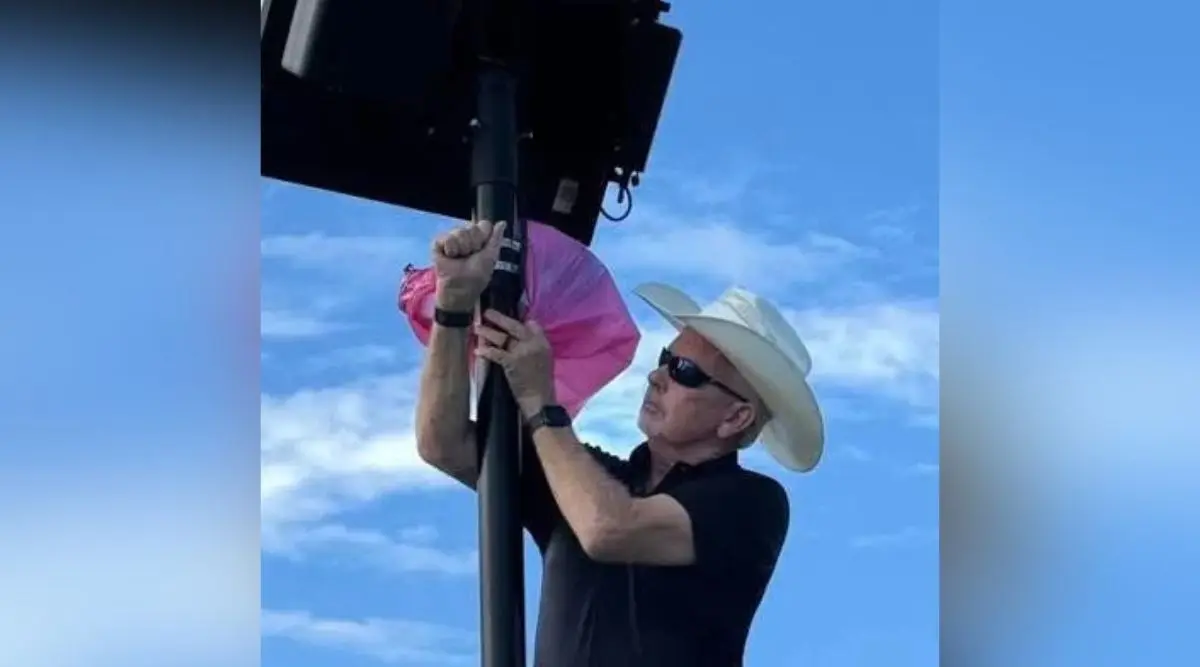
Franklin Sheriff AJ "Tony" Smith places a bags over a Flock automated license plate reader on Sept. 1, 2026. Smith learned the cameras continued to take pictures despite unplugging them.
Published on September 22, 2026 at 11:36 am
Free local news and info, in your inbox at 6 a.m. M-F. Sign up for the Jacksonville Today newsletter.
Florida sheriff’s offices have responded to concerns about Flock cameras in different ways.
Flock cameras — and other automated license plate readers — have gotten a lot of criticism over privacy concerns because the company’s data system can share license plate numbers and other vehicle details.
Jacksonville Today thanks our sponsors. Become one.
Law enforcement agencies in 49 states use Flock cameras to support ongoing investigations. Police departments will receive alerts when a vehicle associated with a crime enters the network.
Florida had banned the cameras’ use on state highways, but cities and counties can make their own decisions on their roadways.
According to a live, interactive map of Flock safety cameras, there were nearly 9,680 automated license plate readers reported in Florida as of Friday. Clusters are in larger metro areas, including Tampa, St. Petersburg, Jacksonville, Miami, Orlando and Fort Lauderdale.

Jacksonville Today thanks our sponsors. Become one.
ALSO READ: Flock cameras are watching more than roads in Jacksonville
Addressing concerns
Many citizens have expressed concerns that every time they go onto the road, their vehicle is being tracked and shared in the system.
On The Florida Roundup, Franklin County Sheriff AJ “Tony” Smith said he made the decision to turn off the devices due to all of his citizens’ concerns.
And although Smith agreed Flock cameras might make law enforcement work easier, he said his agency will still be able to catch criminals and hold people accountable without them.
ALSO READ: Northeast Florida police halt Flock cameras under state order
However, this decision to get rid of the devices created issues with the Flock company due to a contract stating that the cameras belong to Flock and are only being leased. Therefore, the cameras have to be taken down by Flock personnel to stop recording.
Smith ended up unplugging the cameras and placing pink bags over them so his agency cannot access the system. The cameras are still collecting the data for Flock, but he hopes citizens get some relief.
His action comes amid controversy over the way information on the Flock database is accessed after allegations that law enforcement officers in Fort Pierce, Haines City, Vero Beach and Brevard County were maliciously using the technology to stalk ex-wives or girlfriends.
Smith said it’s crucial that law enforcement build trust with the community.
“If they abuse it, they need to be arrested and fired — bottom line,” Smith said.
Why do some counties want to keep the cameras?
Some agencies view the cameras positively. For example, Polk County Sheriff Grady Judd addressed concerns and shared his perspective.
“We’re going to find lost children, lost Alzheimer’s patients, warrant suspects, and we’re never going to invade your privacy to do it,” Judd said.
Juan Caro, senior fellow for Law and Justice Policy at the America First Policy Institute, said people are willing to have this technology used by law enforcement for violent crimes or finding missing children — but not for misdemeanors or traffic offenses.
Caro addressed this and shared his experiences on how the license plate readers are helpful for identifying stolen vehicles and missing children.
“In Texas, they were able to identify a lost minor in 18 minutes,” he told The Florida Roundup. “A 12-year-old that was taken from Hilton Head, and they found him in 16 minutes.”
This story was compiled from interviews conducted by Carlton Gillespie for The Florida Roundup.
Copyright © 2026 WUSF 89.7