
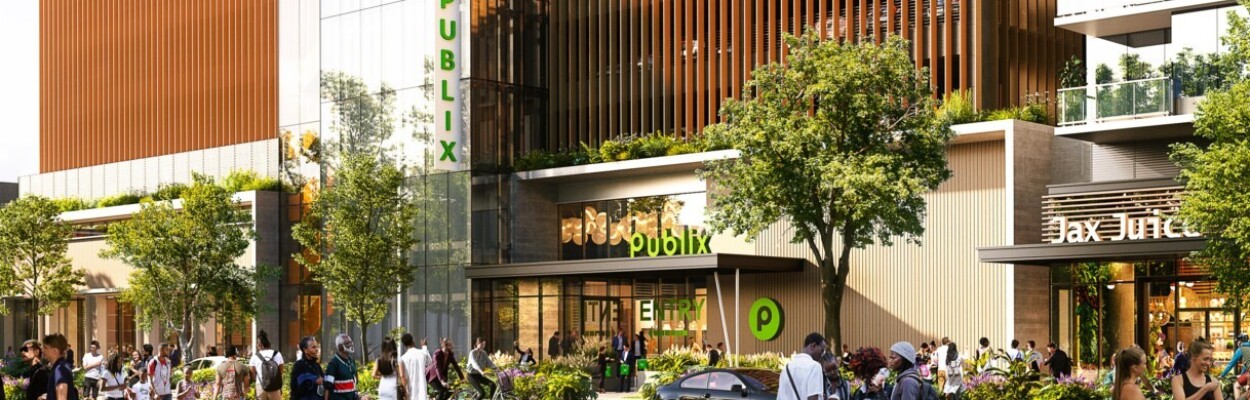
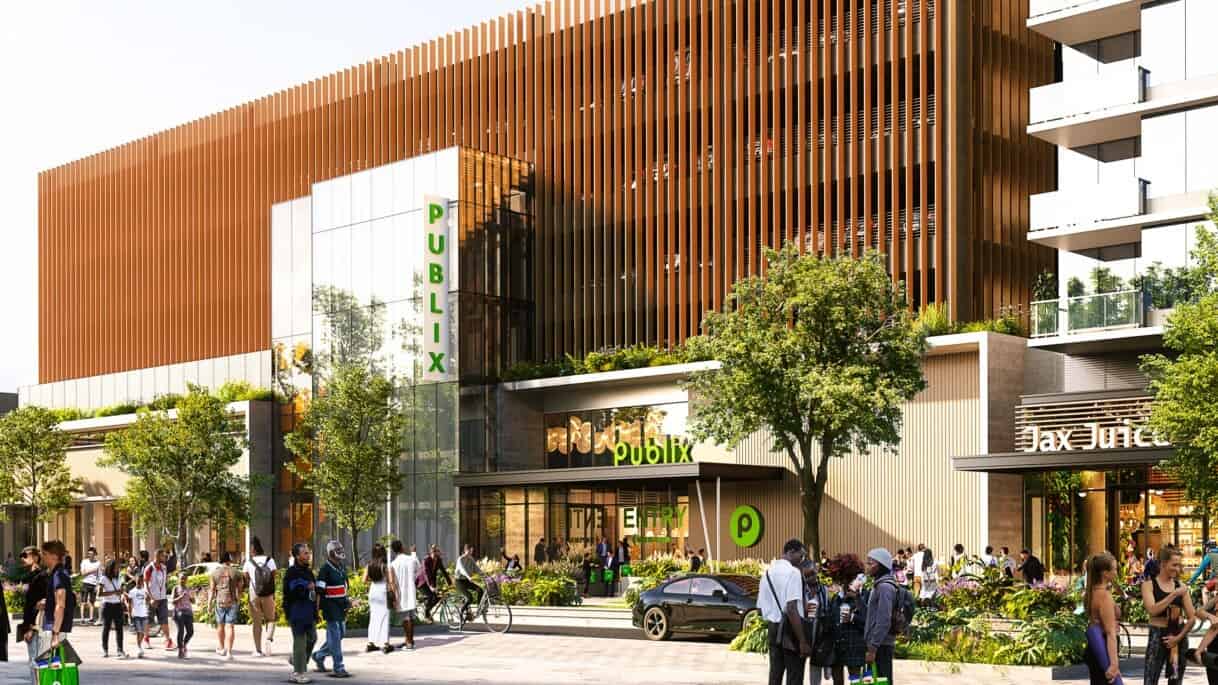
An artist's rendering of the planned 31,000-square-foot Publix at 119 W. Beaver St., part of a new building that will also include a 15-story residential tower and 400 parking spaces. | Gateway/Pearl Square
Published on October 6, 2026 at 5:34 pm
Free local news and info, in your inbox at 6 a.m. M-F. Sign up for the Jacksonville Today newsletter.
The fate of a multimillion-dollar cash incentive for developer Gateway Jax Inc. to bring a Publix grocery store Downtown could now ride on the outcome of the Florida Amendment 3 vote in November.
The Jacksonville City Council’s Finance Committee decided Tuesday to defer a vote on a $49.65 million incentives package for the developer’s proposed $140.15 million, 14-story residential and retail high-rise near City Hall that Gateway says will house a full-service Publix.
Jacksonville Today thanks our sponsors. Become one.
At issue is the $28.25 million cash completion grant in the deal that some council members worry would be a struggle for the city to finance if Florida voters approve the homestead property tax cut referendum Nov. 3.
The Jacksonville City Council Auditor’s Office has estimated that if the referendum, known as Amendment 3, passes, the city will experience a $200 million drop in revenue for the 2027-28 fiscal year and $300 million by 2028-29.
Tuesday deferral came after the council’s Neighborhoods, Community Services, Public Health and Safety Committee voted 5-2 on Monday to advance the bill that would award the incentives.
Jacksonville Today thanks our sponsors. Become one.
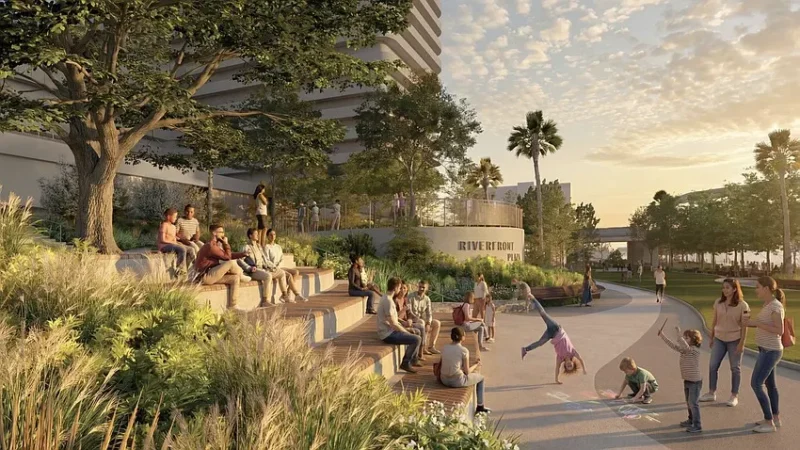
The proposed residential tower and grocery store is part of Pearl Square, a more than $1 billion mixed-use neighborhood Gateway Jax is building on the Northwest side of Downtown near City Hall.
Gateway is demolishing the former First Baptist Church auditorium at 119 W. Beaver St. to make room for the new high-rise. Publix is the tenant planned for the 37,000-square-foot retail space on the ground level. The building also would have 259 residential apartments.
In addition to the completion grant, the proposed agreement with the city also includes a $21.412 million 75% property tax refund over 17 years, called a REV Grant.
If approved by Council, the money would go to Gateway to subsidize the building’s construction. Publix would lease the space and would not receive any of the city dollars.
Publix’s value Downtown
Gateway and supporters of the project say bringing a grocery store to Downtown is an essential service that is needed to continue residential and commercial development in the city’s urban core.
But many council members have become weary of the city awarding more cash completion grants and incentives for development projects.
Council President Nick Howland is one of several council members who has been calling for fewer city cash completion grants and has publicly questioned whether this deal would pass council. He helped negotiate a deferral until the Nov. 4 Finance Committee meeting, when city leaders will know the results of the referendum.
“Listen, it would be great to have a Publix in Downtown. I prefer taxpayers don’t have to subsidize it. I certainly prefer that it not be subsidized by a completion grant,” Howland, who supports Amendment 3, said.
The council president continued by saying he understands that the developer and the city’s Downtown Investment Authority want the incentives package to keep moving because of a desire by the project’s financial backers and underwriters.
“But up here, we’re responsible for defending the taxpayers,” Howland said. “We’re in the midst of one of the most dramatic revenue uncertainties in policy that Florida cities and counties have experienced in generations.”
Howland also wanted to wait until November to take the final vote on the bill because he says he’ll be in London on Oct. 13, when the bill was expected to go before the full Council.
Council member Matt Carlucci will also be absent.
The proposed incentives for the residential tower with grocery store space has been in the works for more than a year. The DIA first approved the deal in December 2025 and has been treading water ever since.
In July, an attorney for Gateway emailed a DIA official seeking a deferral at City Council to allow the developer time to revamp the agreement, presumably with less direct city investment and more reliance on property tax refunds to make the project financially viable.
DIA CEO Colin Tarbert told the Finance Committee on Tuesday that his staff worked with Mayor Donna Deegan’s administration and Gateway for months to find an incentives package that would satisfy council concerns about cash investment and be amenable for the project’s financiers and investors.
“Real estate development, especially right now, is challenging. Time is never on our side, so there is an urgency to get this project approved and moving forward,” Tabert said. “We went back and looked at different versions of how we could construct this incentive package to determine if any were more advantageous to the city. We believe this is the best one.”
The deferral comes at a time when the cost to construct and finance a large-scale development project is getting more expensive. Last month, the Federal Reserve raised the benchmark interest rate to 3.75% to 4% to try to curb inflation. That, coupled with more expensive materials and labor, can make projects like Pearl Square more expensive.
According to Gateway, its total investment in Pearl Square is now at $1.269 billion.
Council member Jimmy Peluso, whose district includes Downtown and the Pearl Square development, argued Monday that the full service grocery store in this project is critical to Downtown’s development and Pearl Square’s success.
“The need for a pharmacy is great. The need for a large scale grocer is great. But more than that, the need for a massive amount of residential properties is great. We need more density in our Downtown, and this helps solve this problem,” Peluso said.
“We need to finish the work that we started so many years ago. You want to bring back Downtown, you gotta create a hub of activity.”
Amendment 3 and Jacksonville’s IOUs
For Finance Committee Chair Will Lahnen, the hesitancy to approve the $28.25 million grant is not about the quality of the project but city lawmakers’ propensity over the last three years to sign off on cash incentives without a clear way to pay for it.
According to data provided to Jacksonville Today by the City Council auditor, if the Gateway deal is approved, the city’s unbudgeted and outstanding completion grants would come to nearly $96.6 million.
Even if council decides not to award the cash grant for the Publix-anchored development, the city would still have to figure out how to pay for nearly $68.1 million unbudgeted cash incentives.
The breakdown of the total amount of cash incentive the city has awarded or pending since 2024 shows, including the pending Publix deal, $130.55 million in cash obligations to companies, developers and for the University of Florida graduate campus under development in LaVilla.
If council ultimately awards the cash for its high-rise and grocer project, $57.25 million of those outstanding incentives would be going toward Gateway’s more than $1 billion Pearl Square project.
Earlier this year, council passed Ordinance 2026-0572 that sets aside $33.95 million in available cash to pay down some of those incentives agreements.
Gateway and DIA officials are trying to make the economic case to city lawmakers that bringing a long-sought grocery store Downtown would have benefits beyond Pearl Square.
Cyndy Trimmer, an attorney for Gateway, told the Neighborhoods committee on Monday that the developer estimates a $330 million to $500 million economic impact to the city if a Publix is built in Pearl Square.
She told Jacksonville Today that the majority of that “Halo Effect” would come in the form of commercial property tax revenue driven by the increase in value of properties within a 15-minute walking distance of the grocery store in Pearl Square.
Trimmer says the Gateway team found independent studies and had them analyzed by Andres Gallo, a University of North Florida professor and director of the International Business Flagship Program, who confirmed the financial impact numbers.
Tarbet told council members Tuesday that, if Amendment 3 passes and residential property tax revenue drops, it will be important for the city to grow the commercial property tax base.
He argues that the Downtown grocery store will do that.
“Hopefully, (Amendment 3) doesn’t pass for a number of reasons. But, if it does, you’re going to be reliant on commercial real estate taxes to fund development on a lot of these things,” Tarbert said. “To me, regardless of where you are, the project has to happen in order for Downtown development to continue.”