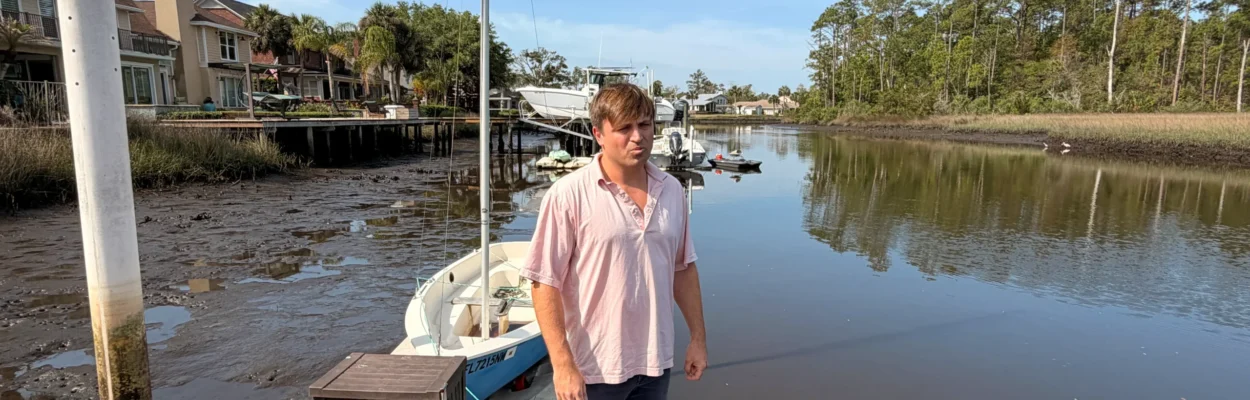
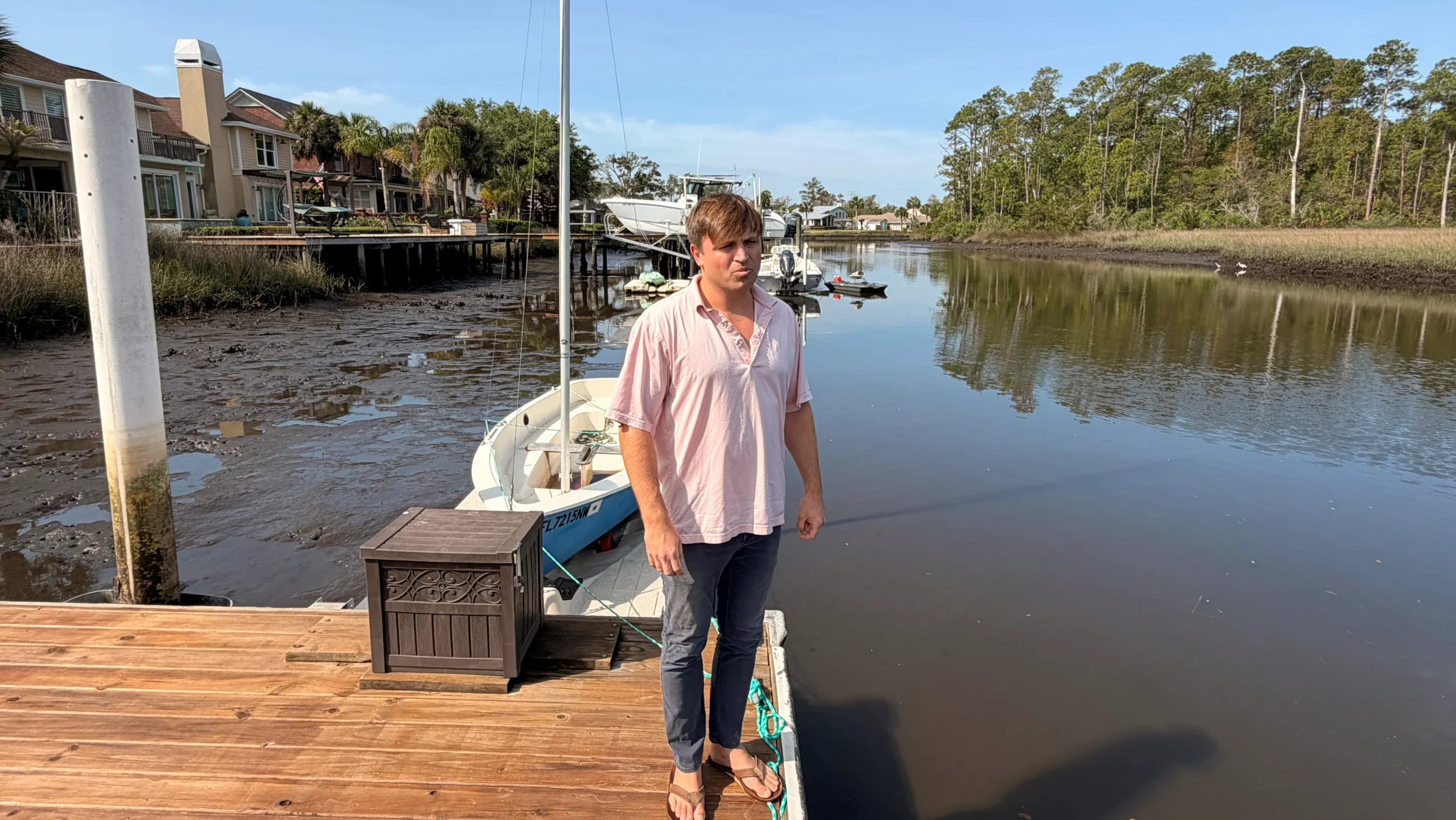
Seven Pines Island homeowner William "Jake" Jacobs stands on his dock off Hogpen Creek on Monday, May 11, 2026, near the Intracoastal Waterway. | Mike Mendenhall, Jacksonville Today.
Published on May 12, 2026 at 4:43 pm
Free local news and info, in your inbox at 6 a.m. M-F. Sign up for the Jacksonville Today newsletter.
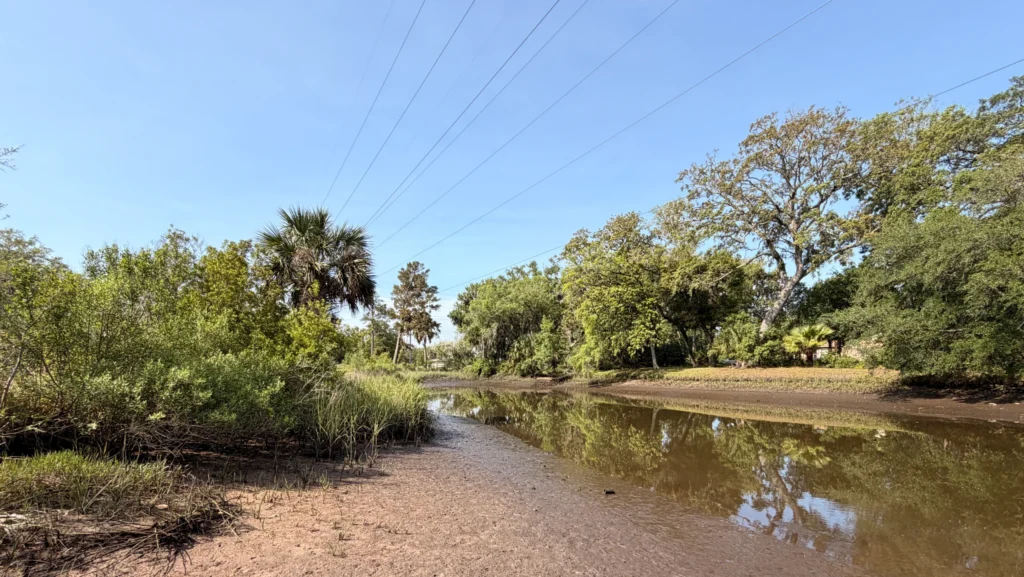
At low tide, the dock off Williams “Jake” Jacobs’ backyard on Seven Pine Island on Hogpen Creek is sitting on silt.
Around 10 a.m. Monday, the water level was at about 6 inches. Homeowners on Hogpen Creek have been trying for years to get the city to share the cost of removing the sediment buildup — a problem city officials say is from natural processes.
Jacksonville Today thanks our sponsors. Become one.
“Every single day I see the backyard and how terrible this situation is becoming,” Jacobs says.
Now, some residents want the Jacksonville City Council to fund a study to determine the cause.
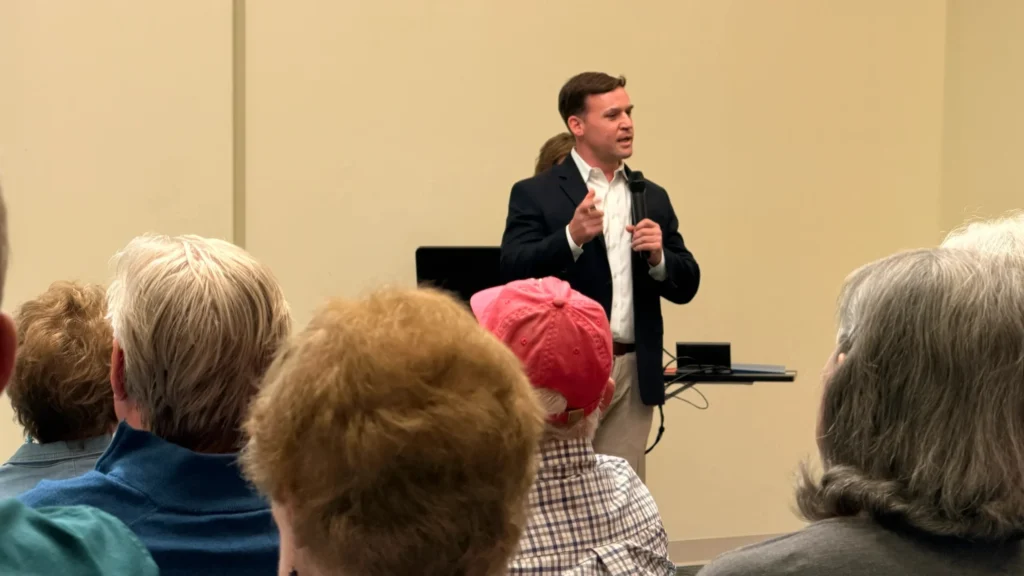
At a town hall on May 6, District 13 City Council member Rory Diamond committed to securing funding for a watershed analysis of the creek.

Jacksonville Today thanks our sponsors. Become one.
Diamond told a crowd at the town hall, hosted by the nonprofit civic group Beaches Watch, that he will file a budget amendment in August when the Council Finance Committee reviews Mayor Donna Deegan’s budget to add a line item for the Hogpen Creek study.
In addition to the sediment, Jacobs says there is erosion, bank collapse, channel souring and an odor-laden discharge coming from the Sandalwood Canal upstream. He also alleges runoff from development in the area, and work on San Pablo Road completed last year has also made the water flow issues worse, he says.
The manatees that once swam up to the dock when his family purchased the home in 2022 on Pine Island Drive in the gated are now gone, he says.
Jacob raised the issues at the Beaches Watch meeting. He says he’s trying to keep public officials focused on the water flow in Hogpen.
He hopes a study can shed light on those claims.
“Shouldn’t most people care about their environment? It really is an environmental crisis. I really don’t like this concept that this is just a rich guy trying to get his boats out,” James told Jacksonville Today. “This is a real environmental crisis, and it’s got to be dealt with.”
The City Council dissolved a special taxing district in late 2024 meant to fund the dredging to keep the creek’s depth at 5 to 7.5 feet. It levied an additional tax on homeowners in the district between San Pablo Road and the Intracoastal Waterway with the goal to raise about $4.5 million over 10 to 15 years.
Although some residents supported the district, the $4,500 extra per year came as a surprise to many others. Years later, Diamond still says he was not involved in creating the taxing district, despite his name being on the legislation that authorized it.
Diamond repeated that position at Beaches Watch, saying the bill was filed in 2023 while he was deployed on assignment with the U.S. Army.
Many residents of Seven Pines Island, Holiday Harbor and Ketch Cove were glad to see the extra tax burden of the special dependent district go. But they say the creek’s sediment and environmental issues persist.
Jacobs thinks dredging would “just be a Band-Aid” and hopes a watershed study will determine the root of the problem.
“We’re just looking for a fair shake,” Jacobs told Jacksonville Today. “If 80% of the problem is being caused naturally, I fully expect to be paying for 80% of it. But this seems much more complicated and not natural. And it’s all the more reason why I’ve been pushing so hard since last August to get a proper study done.
Hogpen not a city responsibility?
Phil Perry, the city’s chief communications officer, tells Jacksonville Today that part of the issue with putting public dollars toward dredging is the city policy. The city will commit to a deepening if there are city-owned docks on the waterway but not privately owned like those on Hogpen Creek.
Residents who reach out to the Deegan administration about the sediment backup have been directed back to Diamond’s office to work with him on securing funding for the promised study.
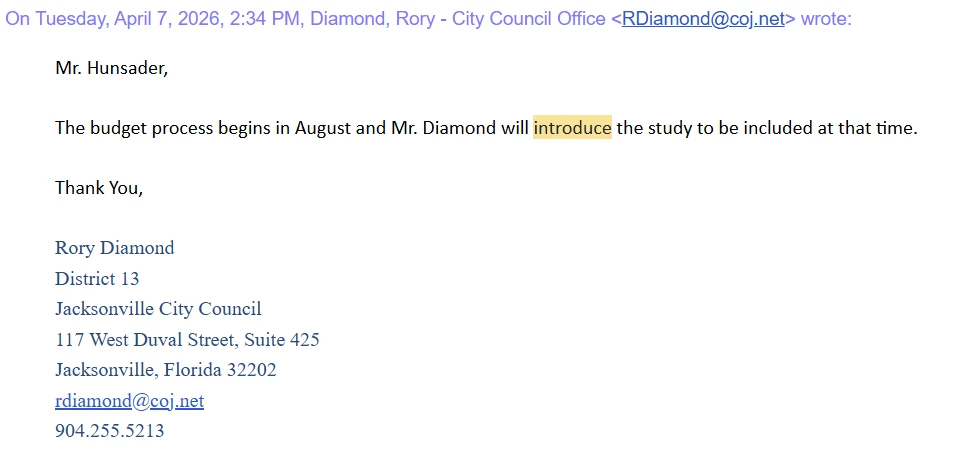
The administration provided three emails from September 2025 through April 7, 2026, from Diamond’s office responding to constituents with a promise to introduce the budget amendment for the study.
Perry said the city’s position has not changed since the debate over the creek began — work completed on the Sandalwood Canal in 2007 has not contributed to the increased sedimentation. The administration says it’s not responsible for the maintenance.
“The Sandalwood Canal project was completed 19 years ago, and the design incorporated several weirs along the canal, which would tend to retain sediment and prevent it from flowing downstream. Immediately following completion of the project in 2007, the City undertook a dredging operation in case any unexpected soil transport occurred in the waterway during construction,” Perry said in an email.
“The City has not performed work to Sandalwood Canal nor Hogpen Creek since that time. Thus, we expect that any ongoing siltation since project completion, as with many waterways, results from natural processes, such as stormwater flowing from adjacent properties that carries soil into the waterway.”
Mayor Donna Deegan will not include the study in her annual city budget proposal that she delivers to council in July. But Perry says that the administration will execute it, if Council adds it as a budget line item.
Asked what the city will do if the study finds public infrastructure is partly to blame for the low water levels, Perry said it was too soon to say.
“It is up to the councilman to fund a study in the budget, but the administration will act on it if passed by City Council,” Perry said. “It’s too early to answer hypotheticals about what a prospective study might find.”
James also wants a study to examine whether rebar and concrete he says were left behind from JEA’s Intracoastal Waterway Electrical Improvement Project, completed in 2018, could be contributing to changing water flow and depth in “previously navigable areas” of Hogpen Creek.
JEA Public Information Officer Karen McAllister says the utility has not fielded any direct complaints about the project’s effect on the watershed.
Paying for the study
It’s not completely clear how much a study will cost. Diamond said last week that he expects it to cost around $300,000, while Perry says the city does not have an official estimate.
Residents at the meeting asked Diamond to pay from the $1 million in discretionary funding he and the other 13 distinct council members each received as part of the city’s Community Benefits Agreement in the stadium deal with the Jacksonville Jaguars.
Diamond told the Beaches Walk crowd that his $1 million has already been committed to other projects. For a Hogpen Creek study, that means the money would have to come from a different revenue source.
Before money for a study makes it into the final budget, the appropriation must be debated and approved by the council’s Finance Committee. Diamond currently sits on that committee, but the next council president will be able to pick their own committee members in June, which may or may not include the Beaches council member.
At the town hall, Diamond said he was confident he could get the Hogpen budget amendment through, but he cautioned that there are other Jacksonville communities experiencing issues similar to residents on Hogpen.
Diamond told the crowd he suspects city and Florida Department of Transportation projects have contributed to the sediment problem.
“Here is my struggle as your councilman. There are like 20 of those across the city, where these different creeks in the city are backed up. And there’s development happening everywhere, so they’re all having this silt issue,” Diamond said. “And so most of these neighborhoods are dredging on their own.”