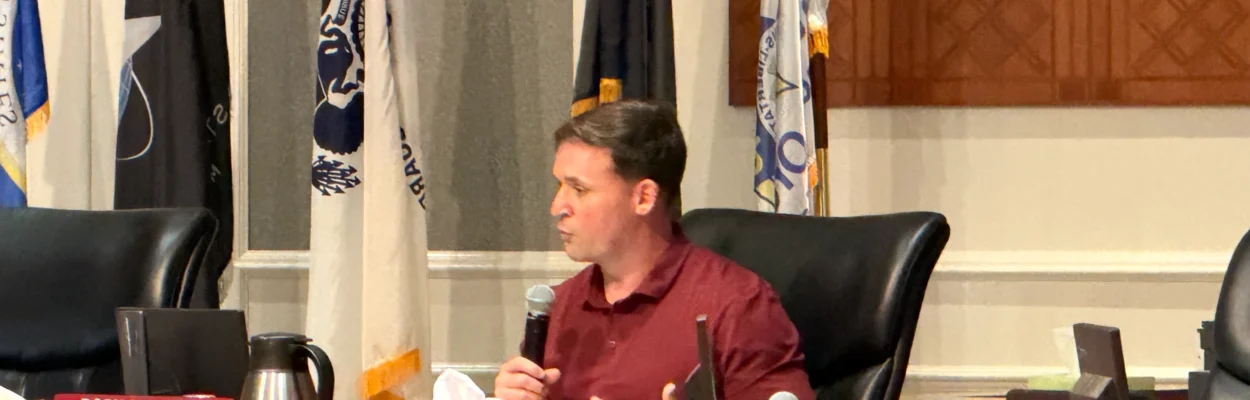
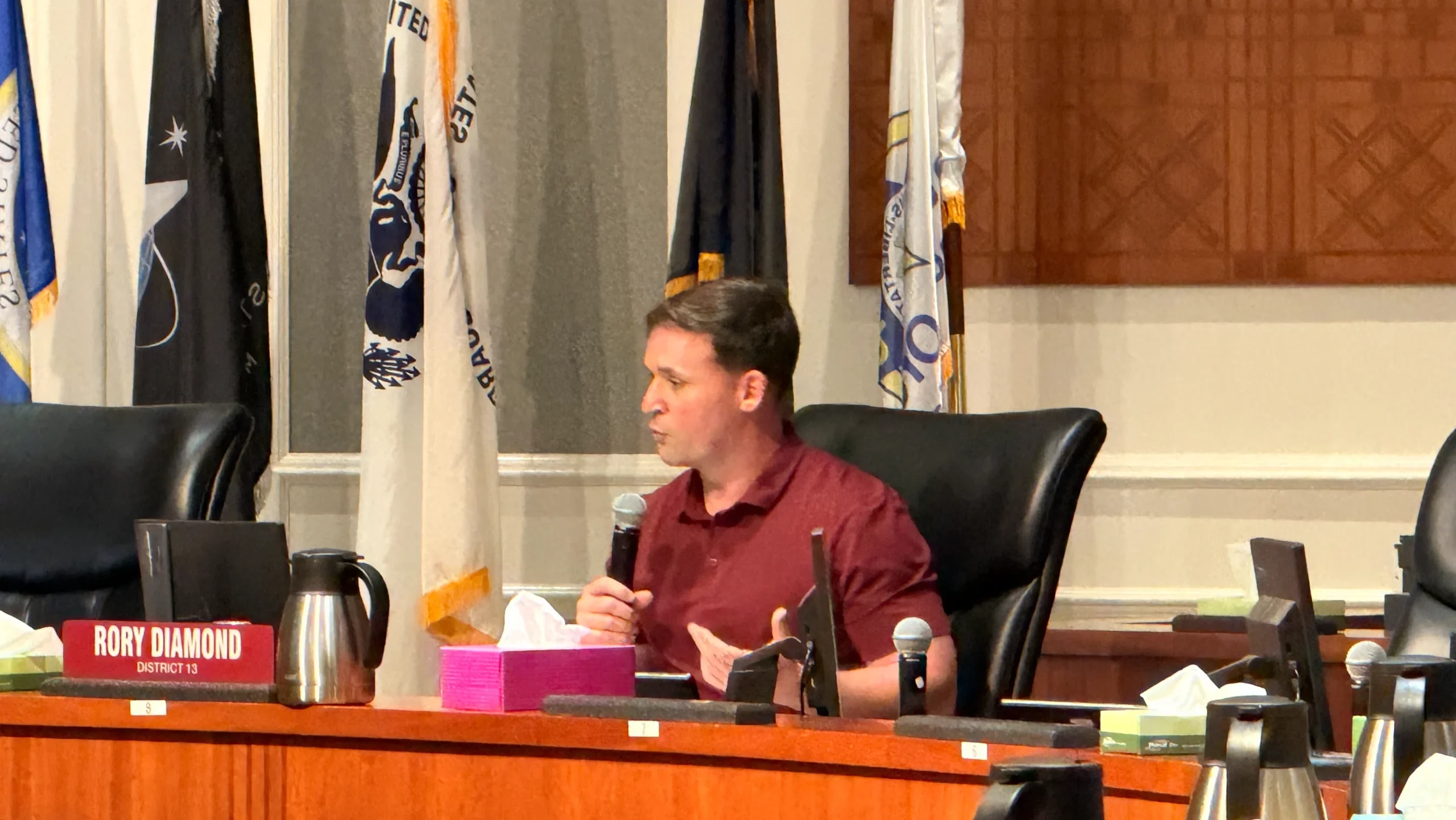
Jacksonville City Council member Rory Diamond at the Duval DOGE Committee hearing on Tuesday, May 5, 2026. | Mike Mendenhall, Jacksonville Today
Published on May 7, 2026 at 5:34 pm
Free local news and info, in your inbox at 6 a.m. M-F. Sign up for the Jacksonville Today newsletter.
The Deegan administration will keep funding its Healthlink Jax telehealth service unchanged in the mayor’s proposed budget later this year, according to a city spokesperson.
The mayor’s desire to keep the program going comes as a draft report released Tuesday by Jacksonville City Council’s DOGE Committee found no evidence that the program’s provider, Telescope Health, could have committed Medicare and Medicaid fraud — allegations floated by council member Rory Diamond during the six-month probe.
Jacksonville Today thanks our sponsors. Become one.
After initially tossing out the funding, City Council approved $1.5 million for Healthlink Jax in the 2025-26 city budget. That’s the amount city Communications Director Phil Perry says the mayor will include for the program in her 2026-27 budget.
“We will include the same telehealth funding that we proposed in last year’s budget.” Perry told Jacksonville Today in a text message Tuesday.
Healthlink Jax provides telehealth services at no cost to uninsured Duval County residents who would otherwise seek care in emergency rooms or no care at all. It was budgeted to cost $2.185 million in its first year, 2024.


Jacksonville Today thanks our sponsors. Become one.
Diamond claims Telescope has exaggerated the program’s financial benefit to the city, which is stated in the report.
During the DOGE Committee meeting Tuesday, he urged council to use it as a blueprint to defund the program and pursue a different telehealth business model when it debates Mayor Donna Deegan’s budget this summer.
It could set up a repeat of last year’s budget battle over the telehealth contract between the council’s Finance Committee and Deegan later this year.
No fraud in Healthlink
Diamond’s allegations of wrongdoing and “potential illegal conduct” in Telescope’s multiyear contract with the city was central to the investigation he launched in November through a DOGE subcommittee.
The goal of Healthlink Jax, proposed by the Deegan administration two years ago, is to divert non-emergent patients from hospital emergency rooms that can be expensive for the medical systems and the patients, and overload the ERs.
Patients who call the service speak to a triage nurse who determines whether a patient needs to be evaluated by a physician. If they meet the program’s criteria of being uninsured, they’re connected by phone with an ER doctor. There’s also a follow-up visit connected through the JaxCare Connect social safety net clinics.
After the committee meeting Tuesday, Diamond said to news reporters that the documentation made it clear that Telescope was not billing insurance — something that Telescope CEO Dr. Matthew Thompson told Duval DOGE Chair Ron Salem letter Nov. 1 — and the fraud portion of the investigation was dropped.
“It was clear that telescope health wasn’t billing Medicare or Medicaid patients, so we just stopped that investigation and made no conclusion either positive or negative about Medicare or Medicaid fraud,” Diamond said.
The draft report addresses the lack of fraud evidence about a third of the way through the report.
“Telescope does not provide services to those patients and, therefore, the Committee could not (and did not) make any conclusions either negative or positive with regards to allegations of Medicare or Medicaid fraud,” the report says.
Another key claim in Diamond’s investigation was that Jacksonville Fire and Rescue Department Medical Director Dr. Bradely Elias funneled patients to emergency rooms staffed by his other employer, Emergency Resources Group, which also owns 64% of Telescope. That claim also was found to be unfounded.
“It appears that although Dr. Elias’s dual affiliation could create the appearance of an incentive for Telescope to refer (Healthlink Jax) patients to ERG-staffed ERs, the documents reviewed show no financial incentive to do so, nor does the low number of HLJ patients who have actually gone to an ERG ED support such an incentive,” the report says.
One of the report’s recommendations is a review by the city’s General Counsel and Ethics offices of Dr. Elias’ dual employment. JFRD provided written comments from the State Ethics Commission’s general counsel and city attorneys stating his work with ERG at Baptist Health does not raise a conflict
Shannon Nelson, communication and public relations manager, told Jacksonville Today in an email that the ethics director confirmed that Emergency Resources Group is not a city or JFRD vendor and receives no City funding.
“JFRD would also like to note that Dr. Elias’s active clinical practice directly benefits the department and the patients it serves. A Medical Director who continues to practice emergency medicine brings current, real-world guidance to JFRD’s protocols and personnel,” Nelson wrote.
Council Vice President Nick Howland, who could be president when city lawmakers debate Deegan’s next budget in August, acknowledged that the fraud claims could have harmed Telescope, but he stopped short of apologizing to the company.
“But I do know that they were accused of Medicare and Medicaid fraud. And that was found not guilty,” Howland said during the DOGE meeting. “Not to owe them an apology, we have to research that when we see those kinds of things, but I feel bad for them if they suffered any reputational risk along those lines.”
JFRD says RightSite inconsistent
The report spends a lot of time examining the business model of the city’s other active telehealth provider, RightSite Health, which has a memorandum of understanding with JFRD to connect non-emergency calls that come in through the city’s 911 service to ambulatory, in-network care.
RightSite doesn’t charge the city. It accepts all nonemergency patients and bills Medicare, Medicaid and private insurance in addition to offering care to indigent patients at no cost.
The telehealth report claims JFRD is underutilizing RightSite and says more 911 callers are eligible for the service than is being offered.
Diamond and the report promotes RightSite and its business model as a financially better alternative than Telescope for the city. But JFRD says the company’s “follow-through has fallen short.”
Nelson said the biggest obstacle has been the San Antonio-based company’s lack of a local representative to do hands-on instruction on RightSite’s system and service.
He said RightSite has canceled three consecutive training sessions for JFRD employees. The fire department said RightSite operates only from 7 a.m. to 11 p.m. while JFRD’s 911 service is 24 hours per day.
There’s also a learning curve with 911 callers.
“When patients lack the necessary technology to access the RightSite application, JFRD personnel must bridge that gap with their own devices to facilitate the telehealth connection,” Nelson said. “This creates workflow complications and raises questions about standardization and patient privacy.”
Nelson called these issues “central to any assessment to RightSite’s viability.”
In a statement after the report’s release, the Deegan administration scolded Diamond’s claim from the dais Tuesday that Telescope was awarded the Healthlink Jax program in a no-bid contract.
Telescope was one of three companies to vie for the contract in a competitively sealed request for proposals in 2024. Telescope scored the highest in the March 13, 2024, review and started operating Healthlink Jax that October.
When speaking with reporters, Diamond refined his claim and called the original solicitation “de facto or no-bid de jure.”
“It was written in a way that RightSite couldn’t bid on it because it was for only indigent care,” he said.
The Deegan administration refuted Diamond’s assertion.
“The City’s Procurement Division takes great care to ensure fairness and promote competition when drafting RFPs. And the market has multiple steps throughout the selection process to protest the specifications of an RFP if they believe it is too narrow or preferential to one company,” Perry said in an email. “That did not happen here.”
The mayor’s office also questioned the time and money the DOGE Committee spent on the report and called its findings politically motivated.
RightSite did bid on the Healthlink Jax solicitation.
“The City Council approved funding for it twice,” the statement said. “And it has saved millions on emergency room costs. This program is saving lives. The political attacks on it need to stop.”
What’s next
The City Council Auditor’s Office is expected to do a cost-benefit analysis of Telescope and RightSite’s service models.
Howland said Tuesday that he will meet with the administration on rebidding the HealthLink Jax telehealth contract. He wants to see the request for proposals broaden so models like RightSite that bill insurance and don’t serve only indigent patients are considered.
When Deegan submits her budget to City Council in July, the Finance Committee will decide whether to keep the money for Telescope, remove it or come up with an alternative.
“To me, the answer is let’s not take care of Telescope, let’s not take care of RightSite, let’s take care of the people of Jacksonville,” Howland said. “Let’s relet in a competitive bid.”