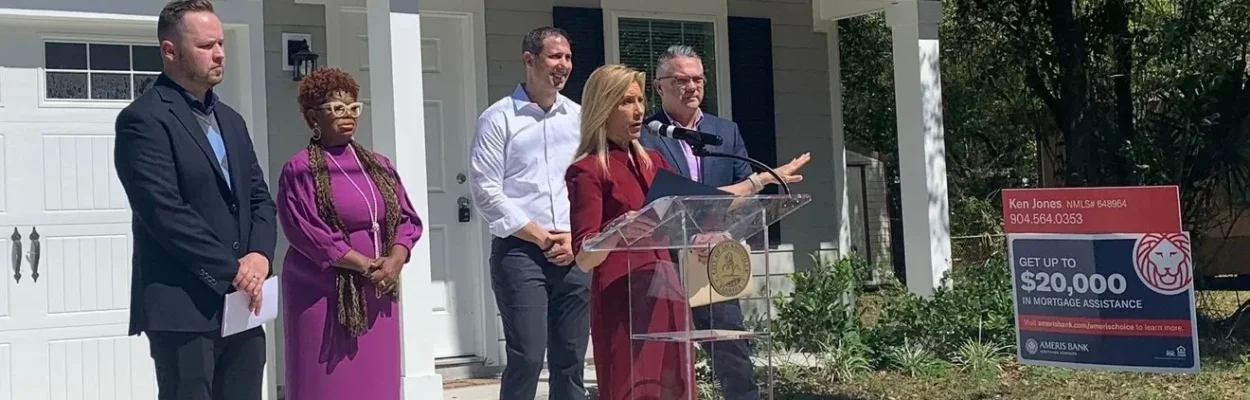
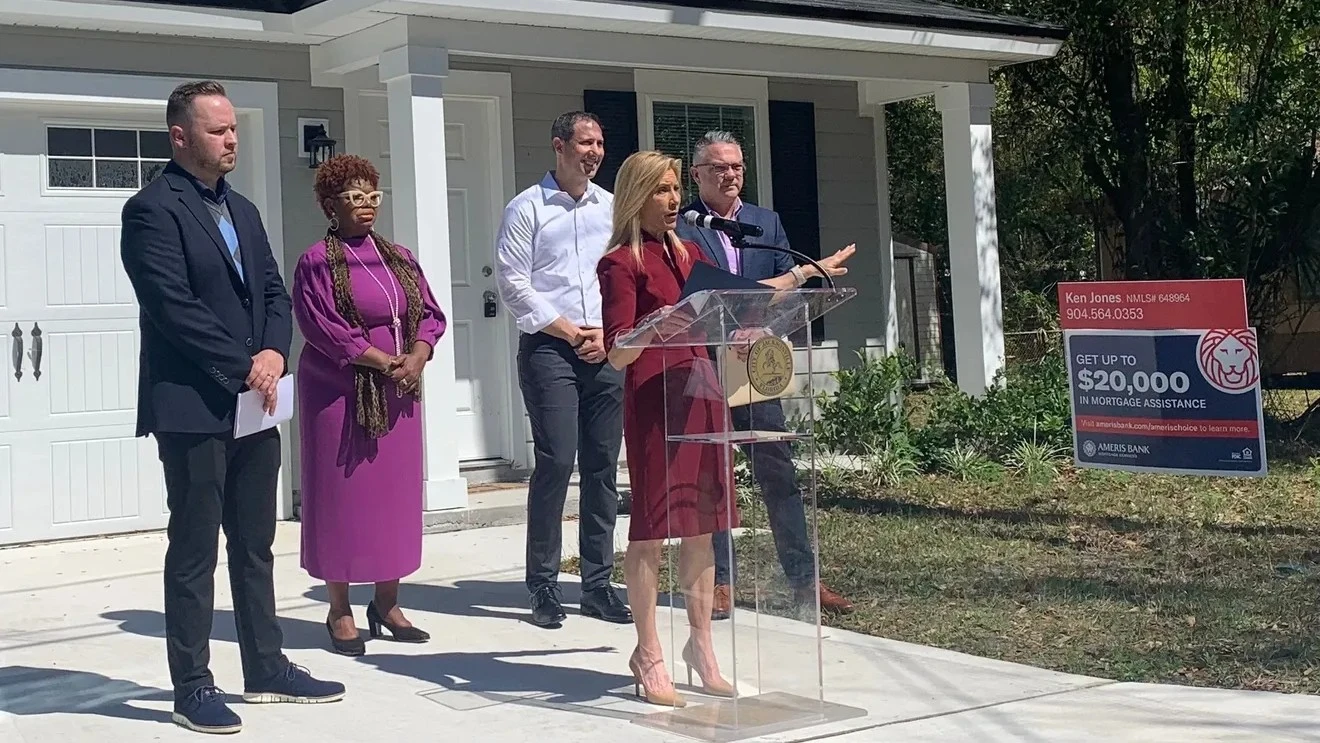
Jacksonville Mayor Donna Deegan announces the city's down payment assistance program for home ownership. Joining her March 7, 2026, are, from left, Joshua Hicks, the city's director of affordable housing; City Council member Ju'Coby Pittman; Adam Rigel, chief financial officer of JWB Real Estate Cos.; and city Housing and Community Development Chief Travis Jeffrey. They gathered in front of a house for sale in the 1400 block of 25th Street East. | David Bauerlein, Florida Times-Union
Published on June 24, 2026 at 4:40 pm
Free local news and info, in your inbox at 6 a.m. M-F. Sign up for the Jacksonville Today newsletter.
The city of Jacksonville has added 14 more surplus city-owned properties to a list of sites deemed suitable for donation to nonprofit developers to build affordable housing.
The Jacksonville City Council voted 15-0 Tuesday night to approve legislation that adopts the list of properties sprinkled throughout the city’s North, Northwest and Eastside neighborhoods.
Jacksonville Today thanks our sponsors. Become one.
The state requires Florida cities to create an affordable housing list and update it every three years. According to city officials, 37 of the 41 properties on the 2023 list were donated to nonprofit organizations for affordable housing projects.
Of those 37 sites:
- Eighteen properties have been completed and released to the homeowners or renters.
- Twelve properties received extensions to complete projects.
- Two properties have been returned to the city.
According to city Chief Communications Officer Phil Perry, five properties are out of compliance with city code, and officials are working with the Office of General Counsel on enforcement.
The city plans to host an application workshop later this summer for nonprofits to get more information about the properties and how to acquire them for affordable housing projects.
Jacksonville Today thanks our sponsors. Become one.
The city estimates the total assessed value of the properties to be $194,091. A council Finance Committee last week removed one property from the original list of 15 sites.
According to a real estate certificate approved by the city’s chief real estate officer, Renee Hunter, the removal brought the value down from $200,242.
Perry says the city program allows rentals and for-sale homes to be built on the surplus properties, but the dwelling must remain affordable for 99 years.
Nonprofit developers trend toward building for-sale homes on the surplus properties, Perry tells Jacksonville Today.
“So this is giving more working people an opportunity to buy their first home and start creating generational wealth,” Perry said in an email Wednesday. “Rental homes at affordable levels are also doing the same in the sense that lower rents allow tenants to save for a down payment over time so they can one day afford to buy a home.”
Race to affordable housing programs
The city has launched and been developing more affordable programs this year, as the median purchase price of a single-family home in Duval County continues to rise and rental rates remain high.
As of May, the city had about $13.4 million in unspent funds from the Florida State Housing Initiatives Partnership program, known as SHIP. The money remains from about $28.5 million the state awarded Jacksonville over three years.
In March, city lawmakers and Mayor Donna Deegan’s administration committed $2 million from SHIP to 10 affordable, single-family homes reserved for very low-income homebuyers.
More funding for affordable housing is likely to find its way into Deegan’s 2026-27 city budget proposal. The mayor told the Nehemiah Assembly of the Interfaith Coalition for Action in April that she will try to get as much money in the budget for an affordable housing trust fund.
The 14 lots approved by council this week for donation are all zoned residential, and any project has to align with the neighborhoods’ existing zoning conditions. Perry said the small number for surplus properties available should increase demand.
“Nearly all are smaller lots that are appropriate for single-family or small multifamily units, not large apartment complexes,” Perry said. “At this time, there are only (14) lots on the proposed affordable housing list, so we expect the application cycle to be highly competitive.”