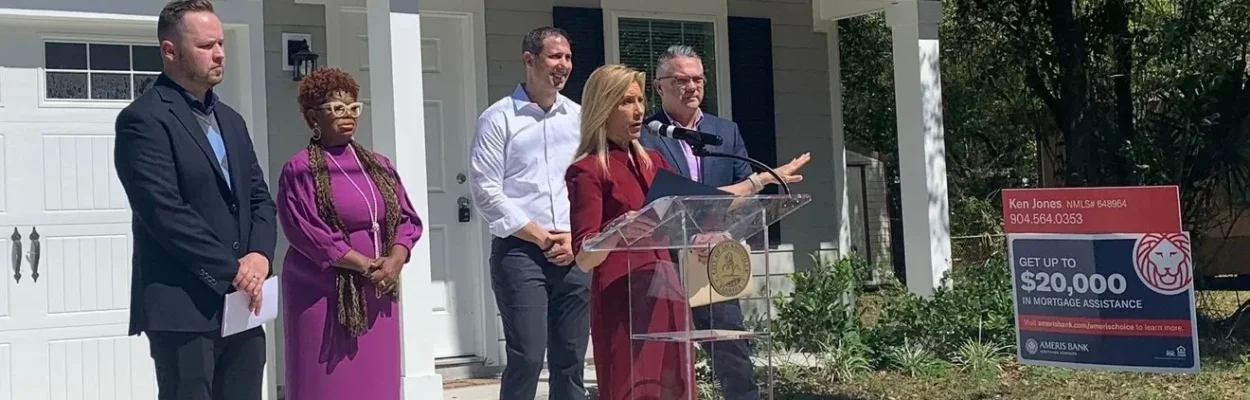
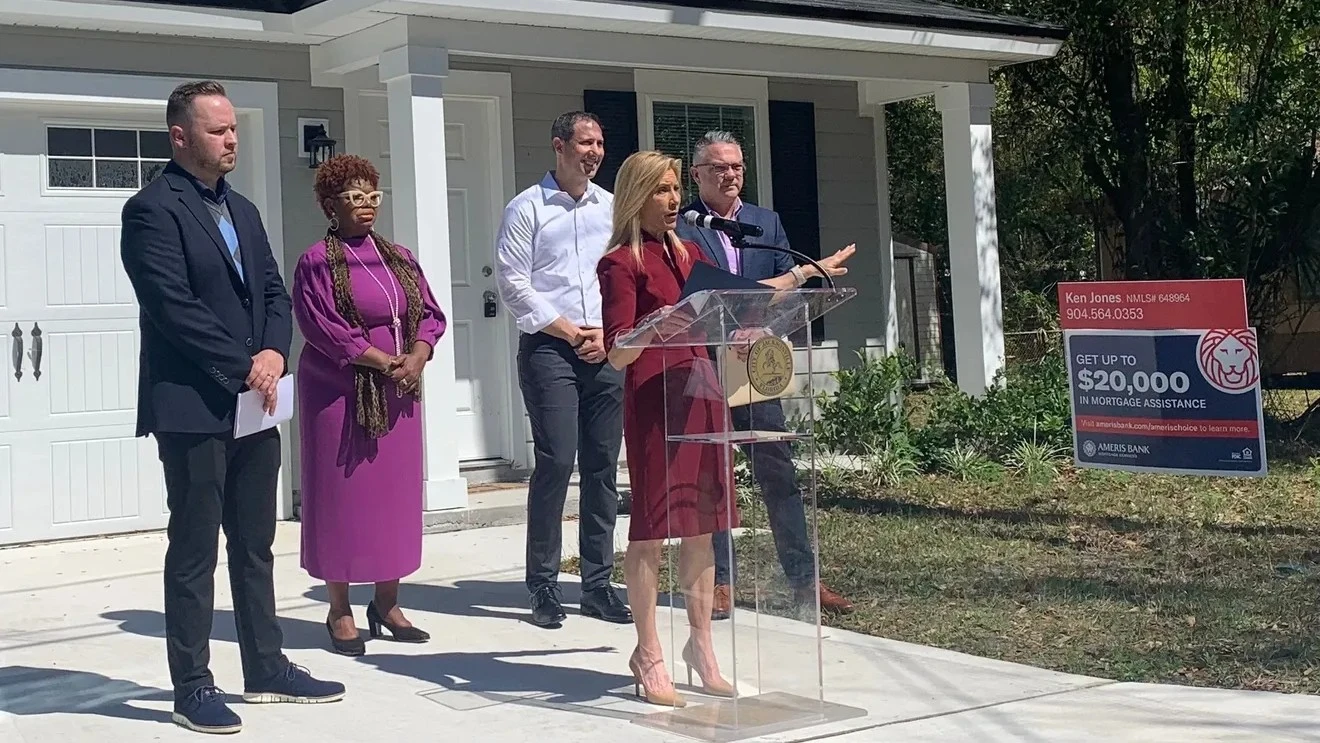
Jacksonville Mayor Donna Deegan announces the city's down payment assistance program for home ownership. Joining her March 7, 2026, are, from left, Joshua Hicks, the city's director of affordable housing; City Council member Ju'Coby Pittman; Adam Rigel, chief financial officer of JWB Real Estate Cos.; and city Housing and Community Development Chief Travis Jeffrey. They gathered in front of a house for sale in the 1400 block of 25th Street East. | David Bauerlein, Florida Times-Union
Published on May 8, 2026 at 10:56 am
Free local news and info, in your inbox at 6 a.m. M-F. Sign up for the Jacksonville Today newsletter.
The state of Florida has provided record-high levels of funding to Jacksonville for affordable housing programs, but the city has not spent millions of dollars it has received, even as Mayor Donna Deegan has called solving the affordable housing crisis her top priority.
The Florida State Housing Initiatives Partnership program — commonly called SHIP for short — provided $28.5 million to Jacksonville over a three-year period since Deegan took office in July 2023. About $13.4 million of that funding remains unallocated by the city.
Jacksonville Today thanks our sponsors. Become one.
Travis Jeffrey, chief of the city’s Housing and Community Development Division, said .Jacksonville has been “behind the eight ball” as have other cities on spending the SHIP money.
“We’re not in this boat alone,” he said. “In talking with the state and with some of the other municipalities, they’re behind as well. But we’re ramping up.”
The lack of affordable housing, defined as costing no more than 30% of a family’s monthly income, is a national problem that public opinion polls show is a major concern in Florida and in Jacksonville.

Jacksonville Today thanks our sponsors. Become one.
The issue hits hardest for residents with below-median incomes, a category that can cover very low-income people as well as teachers and public safety employees starting their careers.
“Solving our housing crisis is my administration’s top priority,” Deegan wrote in her May newsletter to constituents.
She also cited lack of affordable housing when she did her most recent round of town hall meetings to see what people want her to propose in the 2026-27 budget.
“That’s really what we hear more about these days than just about anything in terms of what people want us to focus on,” Deegan said March 3 during a town hall at Douglas Anderson School of the Arts.
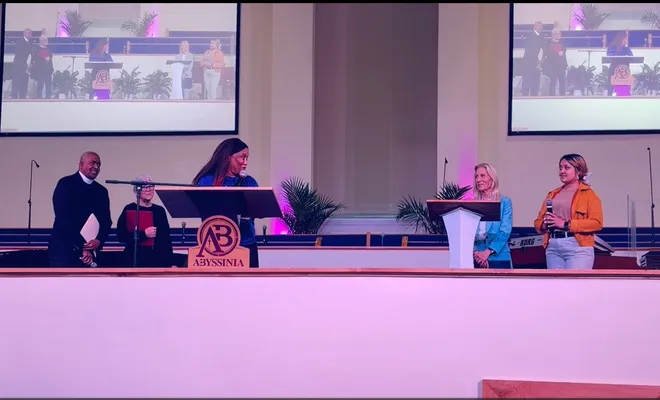
But at an April 13 assembly convened by the Interfaith Coalition for Action, Reconciliation and Empowerment, she stopped short of committing to the nonprofit’s call for a $10 million affordable housing trust fund in the budget she’ll propose in July.
“I can promise you that if I can do that, I absolutely will do that,” she said. “I’m going to put as much money into that fund as I possibly can.”
ICARE said the affordable housing trust fund would build more affordable homes for very low-income buyers, give down payment assistance for first-time homebuyers, help families avoid evictions that would make them homeless, pay for home repairs “especially for elderly resident so they can age with dignity in their homes,” and connect homes to utility service.
Those programs are similar to what Jacksonville is able to do with the state SHIP dollars it receives.
SHIP is supported by the state’s Sadowski Fund, which gets its revenue from documentary tax stamps assessed on mortgages and titles when property is transferred. For many years, the state swept the Sadowski Fund to help balance the budget, leaving SHIP partly funded such as in the 2020 fiscal year, when Duval County’s share was $1.67 million.
But in recent years, the state has fully funded SHIP and has had historically high levels of support for affordable housing because the busy real estate market generated a high volume of documentary stamp taxes.
Affordable housing allocations
In the three years since Deegan took office, SHIP steered nearly $12.2 million to Jacksonville in the 2023-24 fiscal year, about $8.3 million in 2024-25 and nearly $8 million in 2025-26. The amount for 2026-27 won’t be known until the state approves next year’s budget.
Jeffrey said the challenge of getting the SHIP funds spent locally has been the state requirements for how much of the money must go toward new construction and for very low-income residents. He said the city has worked to hit those targets by allocating a big chunk of the SHIP funding for repairs of owner-occupied homes in order to preserve affordable housing.
He said that kind of work is difficult.
“If you’ve done any rehab on your house, you already know,” he said. “We’re going into these houses that need substantial rehab. People are living there. We’re working with contactors. It just takes a long time to get it done.”
Of the $12.2 million budgeted in the 2023-24 fiscal year, the city has $2 million remaining and faces a June 30 deadline to either spend it or encumber it for a specific contract.
Faced with that deadline, the city created a new SHIP single-family development program announced by Deegan in March. It will shift $2 million from the owner-occupied home repair program and use it instead for building 10 single-family homes for residents whose income is 50% of the area median income.
“We’re excited to increase affordable home ownership opportunities in Jacksonville and create new pathways for families to create generational wealth,” Deegan said.
The $2 million would set aside $500,000 in down payment assistance for 10 homebuyers whose income is at or less than 50% of the Jacksonville area’s median income, which equates to $51,250 for a family of four.
The other $1.5 million would be short-term zero-interest construction loans for the homebuilder. The city would recoup the loans when the homes are sold and could use it for another round of new affordable housing. Jeffrey said that will create a “continuous pipeline of new homes for families who need them most.”
That would use up all the SHIP funding received by Jacksonville in the 2022-23 fiscal year. The city still has nearly $5.3 million remaining from its 2024-25 allotment and about $6.1 million from this year’s SHIP funding, plus whatever it will get from the state in the coming year.
This story was published as part of the Northeast Florida News Collaborative.