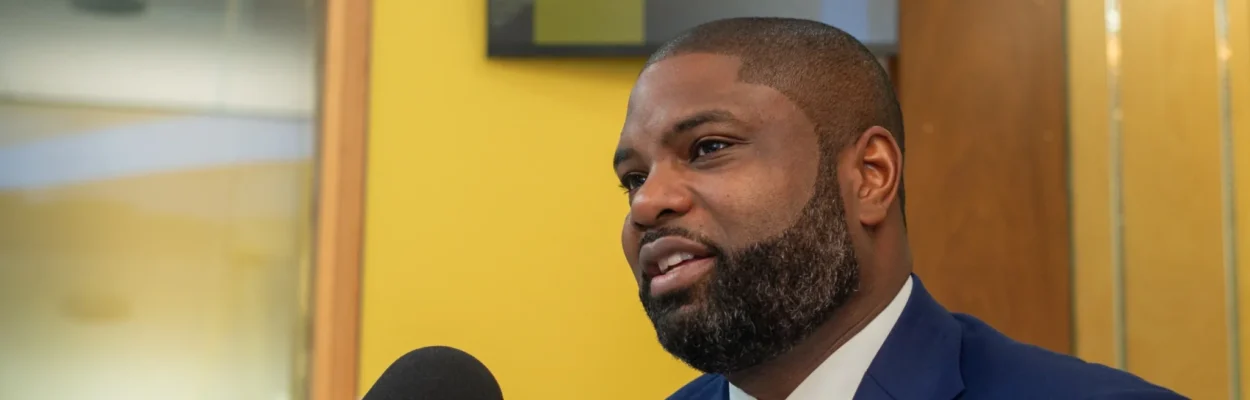
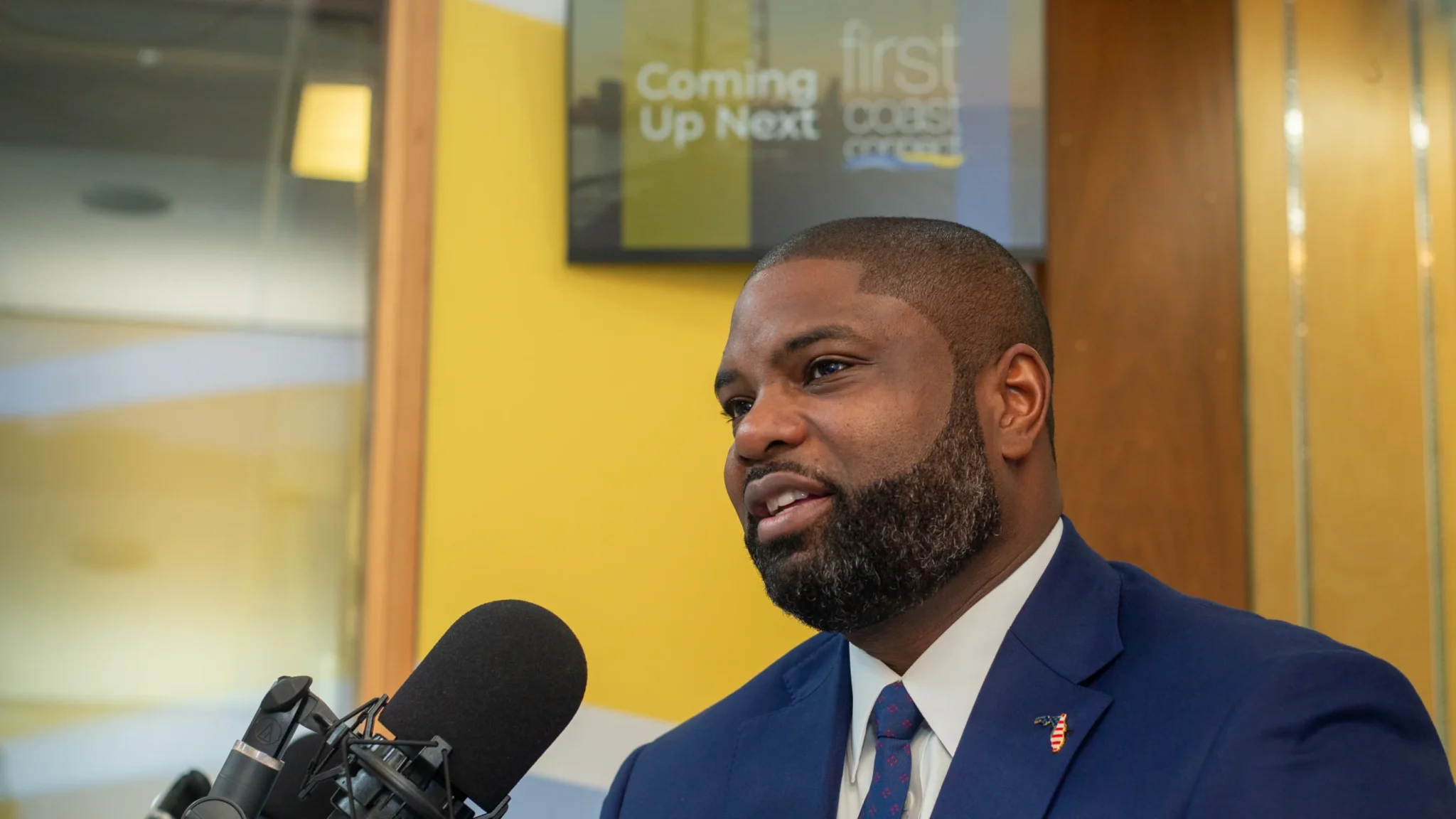
Rep. Byron Donalds is three-term member of Congress who is a Republican gubernatorial candidate. He spoke with "First Coast Connect" host Anne Schindler on Monday, Aug. 3, 2026. | Will Brown, Jacksonville Today
Published on August 3, 2026 at 3:12 pm
Free local news and info, in your inbox at 6 a.m. M-F. Sign up for the Jacksonville Today newsletter.
First Coast Connect host Anne Schindler interviewed U.S. Rep. Byron Donalds, R-Naples, on Monday morning.
Donalds, a former member of the Florida Legislature and three-term member in the U.S. House of Representatives, is the prohibitive favorite to win the Republican gubernatorial nomination later this month.
Jacksonville Today thanks our sponsors. Become one.
This is a transcript of Donalds’ remarks on First Coast Connect on WJCT News. It has been edited for length and clarity.
The full conversation may be found here:
WJCT: Congressman, welcome. Thanks for being here.
DONALDS: It’s good to be with you.
WJCT (0:41): You are, as we said, leading in a number of metrics — money, polling. You’ve got an endorsement from our president. And, many are saying that this is your race to lose. It’s predicated on, in many ways, money and this Trump endorsement. So, let’s start a little bit with money. You have raised over $100 million so far, between your (political action committee) and your personal campaign fund. And, a lot of money has come from some very wealthy people — a lot of billionaires and a lot of folks with interests in artificial intelligence.
So, I want to ask you about the influence of money in politics.
Jacksonville Today thanks our sponsors. Become one.
First of all, one of the recent donations was this $10 million that came from billionaire Citadel (LLC) founder Ken Griffin. Do you believe that it is appropriate in politics for someone to be financing someone to the tune of such a large amount of money?
DONALDS: I think campaign financing is something that’s really more a matter of free speech. If somebody decides that they want to take their hard-earned money and donate it to a candidate because they believe that that candidate is going to support values or policies that they agree with, then, in our country, you’re free to do so.
I think a lot of times when people talk about is it responsible, or is it something that’s helpful to politics, I think it’s because there is a frustration out there that elected officials, by and large, are bought and paid for. Let me be very clear with the listeners, and frankly all Floridians, I’m not bought and paid for by anybody.
When I talk with prospective donors, or people who’ve supported my campaign, I’m not asking them what policies they want to see. I tell them about my vision and what I think is going to be critical for the future of Florida, for Florida to remain No. 1.
Everything from making sure that our children are getting a world-class K-12 education; to how we’re going to manage the growth in our state; to how we protect the beauty of Florida and make sure we have fresh water for the future of our state. Those are the issues I talk about.
And then, what happens is, you have people like Mr. Griffin who decide after doing their own due diligence, that they want to be supportive of my efforts. This is much more about having a value system that allows for Florida to continue to be the best state in America. And, I think, that the reason why we’ve been very successful in fundraising is because there are a lot of people who have come to Florida. They fled other states — like a New York, like an Illinois — in the case of Mr. Griffin, like a California. And, they do not want Florida to follow those models. And, so, in looking at this race for governor, they’ve made the decision on their own accord that I’m the candidate that’s going to be successful. I’m the candidate that’s going to keep Florida as the No. 1 state in all of America.
WJCT (3:28): I think the people who think that there’s a bought and paid for sense in politics, is because, typically, policy follows money. And, lawmakers tend to approve policies, or laws, that benefit their moneyed constituency perhaps more than those who are not active campaign donors. Certainly, they have the ear of the candidate and the lawmaker, or the executive, once in office.
So, why would you be different from that perception in the first place? What would separate you from what we understand as sort of a pattern in money and politics?
DONALDS: Well, that’s because my policies and my vision really hasn’t changed in 15 years when I first got into politics in the Tea Party Movement. Same person, haven’t changed. When I ran for Congress the first time in 2012, I raised $80,000. Half of that was an in-kind donation from a family that wanted to support me, and they let me use one of their offices that they owned as campaign headquarters.
We didn’t raise any money, but the same policies around border security, immigration policy, limited government, low-tax environment, low regulatory environment, those are the same policies that I support today. So, I think what’s changed is, yes, through my time in the Statehouse and my time in Congress, we’ve built a lot of support amongst Republican voters across the entire state. And, in some respects, around America.
You know, people have come to know me and understand that I am a conservative who’s been committed to these ideals for a very long time, and I’ve been consistent on these ideals. I think you have people who want to see Florida continue in the direction it’s going, and they’ve decided to make contributions to my efforts.
WJCT (5:08): So, when it comes to changing or evolving, some might say, on issues, I want to ask you, particularly, about AI data centers, because that’s been a huge issue. …
Have you followed, in some ways, the changing perspective? We know that as many as 70% of Americans oppose data centers near them. That’s more than historically, opposition to nuclear power plants, which is kind of extraordinary when you think about it relative to what we know is the threat of a potential nuclear meltdown versus a center that’s known to be a drain on resources and also noisy; but, perhaps, not a life-threatening-type situation.
DONALDS: So, it’s interesting you brought the corollary up about nuclear power plants because I know how people feel about this issue.
I’ve been traveling the state nonstop. I’ve been in 61 of the 67 counties so far. I know how people feel about these, but here’s what I found when I went and did the research.
What I found is: In Florida, we’re a regulated utility state.
Your utility bills cannot go up unless the Public Service Commission votes to increase utility rates. (It’s) very different from Virginia. When data centers were exploding in Virginia, they’re not a regulated utility state. And, so, what ended up happening is those came on the grid, they took away power and the utility bills went up for everybody else.
We’re a regulated state. No. 2, Gov. (Ron) DeSantis just signed into law Senate Bill 484. Under state law, right now, your utility bills, as a Floridian, cannot go up because of a hyperscale data center. That is state law. We are going to keep that law on the books.
When it comes to water consumption, the first generation of data centers, that’s the stuff that people are looking at on YouTube. Yeah, very concerning. All they were doing was sucking water out of the aquifer every, single, day and then dispensing that water back out into whatever basin that was available in those other states.
Gov. DeSantis put it into law. It’s law today. You have to get a consumptive use permit from the water management district in order to have access to that water, the same way people who bottle beverages in our state have to get a use permit, the same way communities (and) planned use developments have to get a permit, golf courses.
And, so, those are the things, those are the protections that are in law today.
WJCT (7:50): Both of those regulatory agencies, the Public Service Commission and the water management districts around the state, have, typically, been fairly friendly to applicants.
I mean the Public Service Commission has allowed rates that have been very controversial and opposed by ratepayers. The water management district has continued to permit large-scale consumptive use permits when we know that we’re in a water shortage, when we know that we don’t have a resource that is sufficient (for) the growth that’s projected. And, so, when you say that those regulatory agencies, I mean, certainly, they exist. But, are they empowered? Would they act to protect voters in these cases?
DONALDS: Absolutely. I live in Southwest Florida. I remember 12 years ago when we had blue-green algae blooms that were coming because of the projects that were not done around Lake Okeechobee and the Everglades restoration. It completely damaged Southwest Florida’s economy. I know firsthand that if you don’t have fresh water, you have nothing. So, we are going to to protect the water resources of the people of Florida.
Secondarily, we are not going to let your electric bill go up because of a data center.
If they get constructed, the data center company, they’ll have to pay for their utility usage and it’s not going to affect other people.
Today, in Florida we have 5 gigawatts of excess power on our electric grid, 5 gigawatts.
What that means is if you’re talking about a 1 gigawatt, hyperscale data center, the most that can be constructed in our state is five. Because, you would have to be able to access the free access power — the stuff that has not already been spoken for, essentially, when you’re dealing with the utilities.
We’re not going to let somebody come in and build a 10 gigawatt data center. You know why? Because, then, it would drive up utility costs on everybody else.
That’s what the law does. Those are the protections that I think are critical for Floridians. And, the last piece is proximity. I don’t want next to my house. Nobody wants one next to their house. There’s a reason why they can’t be more than a mile away from a residential neighborhood. That’s common sense. So, I think, when you look at the data and you look at the information, you say, OK, we can do that.
One last thing I’ll say on this. What people are seeing on YouTube are mostly first generation of these hyperscale data centers. The new designs are either completely air-cooled, nor requiring water, or they have a closed-loop system on site where they take initial water and, then, they recycle that water for their own purposes.
WJCT (10:25): Would you say that your view has evolved or changed as you’ve been hearing from constituents and voters on this issue?
DONALDS: Not so much that it’s changed, per se, but, it’s given me more time to do more of the research and more of the fact-finding, so that we have a constructive policy on how to manage this for the future of our state.
What I hear too often from other people on the campaign trail is we’re going to do moratoriums or we’re going to do bans. What that means is they haven’t sat down and done their homework. And, the governor has a responsibility to sit down, do the homework, actually get the facts and bring those findings to the people of Florida.
WJCT (24:37): I want to talk a little bit about climate change and how it’s impacting Florida in particular. (We ask) in part because we got a question from Matt in Arlington on a couple of environmental topics.
We know that people in Florida really care about the environment. And, I think there was some strong evidence of that when this governor proposed some alterations to state parks, including adding lodging the size of luxury hotels, golf courses, pickleball courts. There was a large uprising about that. What commitment will you make to protecting Florida resources?
Would you provide money for the Emerald Trail here in Jacksonville? (It) has been more recently defunded by the presidential administration, who clawed back some money that had been given to the city (of Jacksonville) to develop this multi-neighborhood connecting trail.
DONALDS: Well, first to state parks, we are going to protect state parks and state land.
We are going to do that, especially the ones that are environmentally sensitive, those that are largely based on conservation areas. We want to make sure that we protect those, and we’re going to do that.
WJCT (25:48): What does that mean? Would you pledge not to develop them in the way this current governor proposed developing them, adding recreational features?
DONALDS: No. We’re not interested in developing that property. We think that property needs to be held pristine for the future conservation needs of the state going forward.
If you’re going to talk about what property the state does own, the state does own a lot of buildings and some other real estate — not stuff that’s in conservation areas — we’re going to evaluate those.
Some of those properties, the state, probably, shouldn’t even hold anymore because the state is expending funds to manage those properties. And, they have, in today’s version of the state, and moving forward, probably, little value there.
But, when it comes to things that are in conservation areas. We have no plans to develop those. We are not going to develop those. We are going to keep those pristine.
WJCT (26:35): When you talk about buildings, are you talking about privatizing functions within state parks like vendors, restaurants?
DONALDS: No, no, no, no, no, no, no. I’m talking about buildings that the state owns around the state of Florida. We want to do an evaluation of those buildings already constructed. What’s the highest and best use of those? If the occupancy or use of those buildings is frankly up to snuff. If not, then the state will probably look at disposing of some of those assets.
WJCT (27:00): In terms of funding for something like the Emerald Trail …?
DONALDS: The Emerald Trail, I have to study. I’m not sure about the project. That’s something that we want to take a closer look at before I can make a determination one way or the other.
WJCT (27:12): Property taxes, a big issue before the state, could mean enormous cuts for local governments and municipalities, as much as $5 billion in the first year. Some local counties here would be impacted, because they are known as fiscally constrained. That includes Putnam, Union, Clay, Baker. Clay and Baker could lose up to 30% of their revenues. This governor has proposed sort of an emergency fund setup to backfill some of that money. A lot of people say you’re going to inherit a mess if this passes with 60% of voter approval.
What are you going to do to manage the situation for these underfunded counties like our local ones?
DONALDS: Well, first thing, if it passes, what we are going to inherit is a property tax cut for hardworking people in our state at a time where affordability is a major issue, especially for our working families and our seniors on fixed income in our state. It’s a major issue.
No. 2, a lot of our counties, not all, but a lot of them, when property values were increasing the last seven years, they could have gone to a rollback rate to smooth out tax increases. They did not do that. They let their budgets increase very steadily, very handsomely.
They didn’t go to a rollback rate, because they didn’t look at the people who fund their budgets, the taxpayers, and say ‘You know what, we could let these budgets rise.’
But, especially the Biden economy, how terrible that was — the inflation brought to us by Joe Biden and Kamala Harris and the Democrats — they could have smoothed off the tax increases. They chose not to. And, what they were telling people was: We’re just going to leave the millage the same. We’re not raising taxes, even though property values shot up.
So, now we’re in this situation where the people of Florida need relief. So, that’s what we’re going to inherit. In terms of the budgets, and the fiscally constrained counties, all 29 of them, what we want to do is set up a funding formula for these counties if this passes. So, that way, they’re not having to hire lobbyists and send them to Tallahassee to, essentially, sing for their supper.
WJCT (29:08): What would that formula look like?
DONALDS: We’re going to have to construct that with revenue estimating and with the members of the Legislature. So that way, there’s a consistent funding model for those fiscally constrained counties. And, considering the amount of money we’re talking about, the high mark that I’ve seen is $350 (million) to $400 million a year.
I think that’s something that we can definitely accommodate in the state’s budget if the amendment passes. And, those are for the fiscally constrained counties.
If you were doing a grant program, then what happens, essentially, the governor gets to pick and choose who’s going to get what. And, I just don’t think that’s appropriate.
I think for those counties, you set a funding formula. That way, they can plan their budgets and plan accordingly for the future of their counties.
If the amendment doesn’t pass, we’re going to use the (Taxation) and Budget Reform Commission, which is going to get sat next year, to come back and do a top-to-bottom review of all taxes and fees in Florida with the goal of eliminating homestead property taxes once and for all. And, if we can’t get there, if you can’t get the money to work, then we want to provide serious relief for seniors on fixed income and working families in our state.
WJCT (32:31): I do want to get to (Immigration and Customs Enforcement) very briefly. We know that ICE enforcement has been a big issue. I’m curious about — you were expressing strong support for ICE in January. Since then, there have been a number of revelations about the enforcement that ICE — that included lethal enforcement — that the officers involved were lying about the force they were met with and the circumstance surrounding those fatal encounters. Has your perspective changed at all on ICE enforcement and how this has all rolled out?
DONALDS: No. The biggest problem is a couple. No. 1, in the state of Minnesota, you had elected officials in Minnesota who were working with people who had a desire to obstruct federal law enforcement from doing their duty. There’s a reason why you haven’t seen in Florida what’s occurred in Minnesota. Why?
Because our law enforcement has a responsibility to work with federal law enforcement, namely ICE. If you create and foment a situation, like what happened in Minnesota, where you essentially are egging on and creating an organized, highly funded, highly orchestrated protest to impede federal law enforcement, that’s when things go wrong.
And, I don’t look at this from a political standpoint. I look at this from being a young kid who grew up in the inner city. My mom told me, ‘You do not get in the way of the police. When the police come, you get out of the way.’ And, that’s just how these things should be handled.