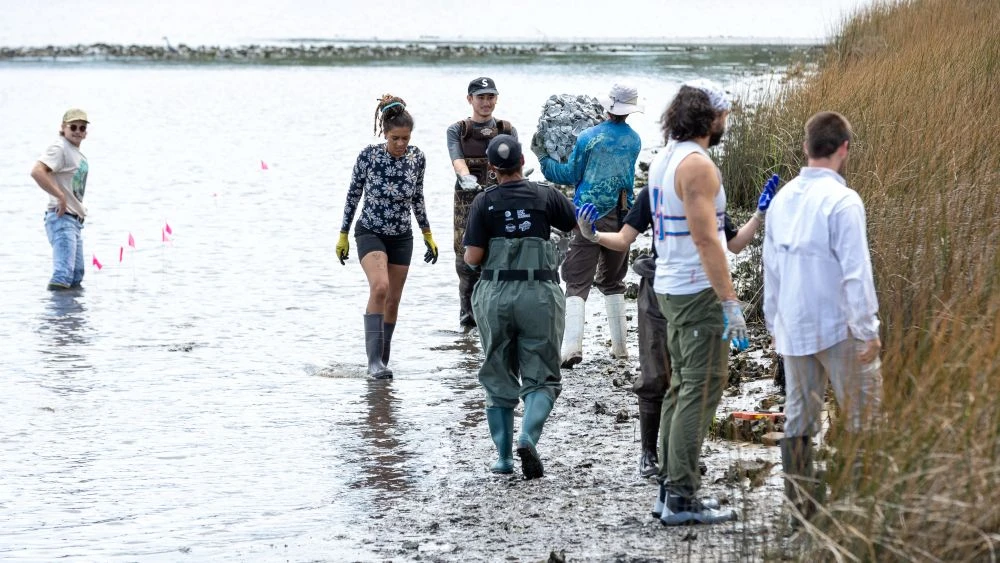
The Riverview Collective Community organization, as well as other groups, installed more than a dozen oyster reefs into the shore at
Riverview Park on Wednesday, June 10, 2026. The installation could allow
for an additional 300 gallons of water filtration in the Trout River on a daily
basis. | Will Brown, Jacksonville Today
Published on June 11, 2026 at 12:28 pm
Free local news and info, in your inbox at 6 a.m. M-F. Sign up for the Jacksonville Today newsletter.
Preparing an aquatic nursery to raise oysters is a tough job.
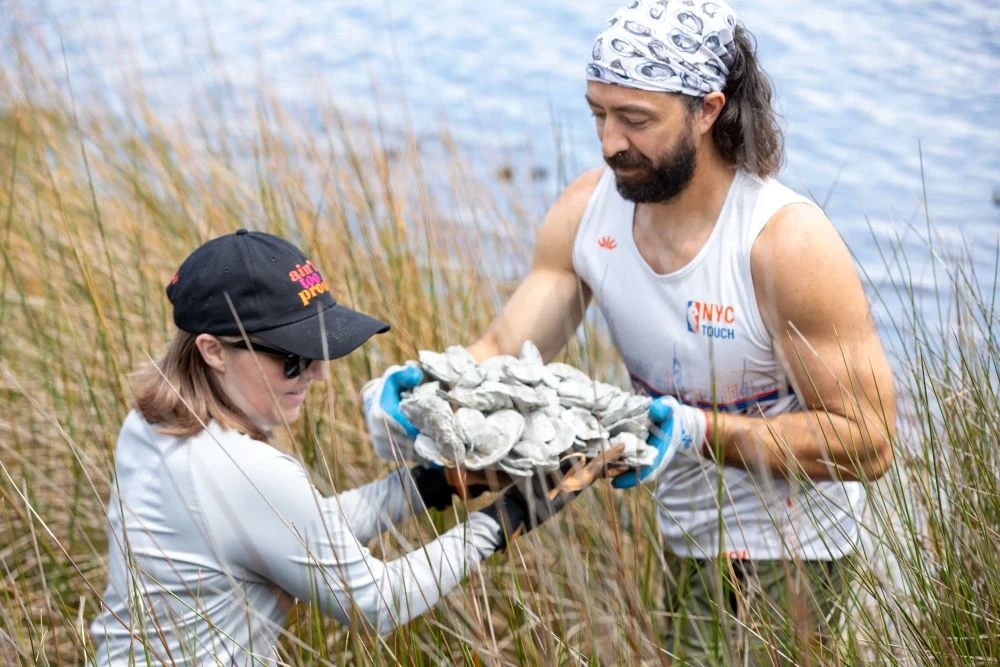
As thunderclouds gathered Wednesday afternoon, more than 30 volunteers labored to plant oyster shell habitats in the low tide shoals in Jacksonville’s Trout River at Riverview Park. The goal is to lure more knobby mollusks to grow there, to filter water and to stabilize the shore.
Jacksonville Today thanks our sponsors. Become one.
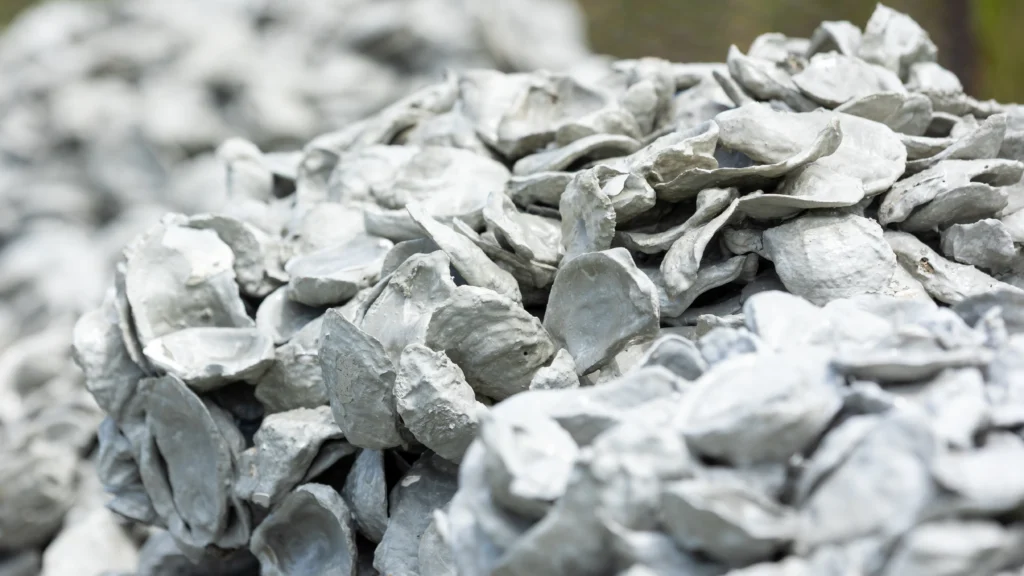
The planted habitats are known as Pervious Oyster Shell Habitats, or POSH for short.
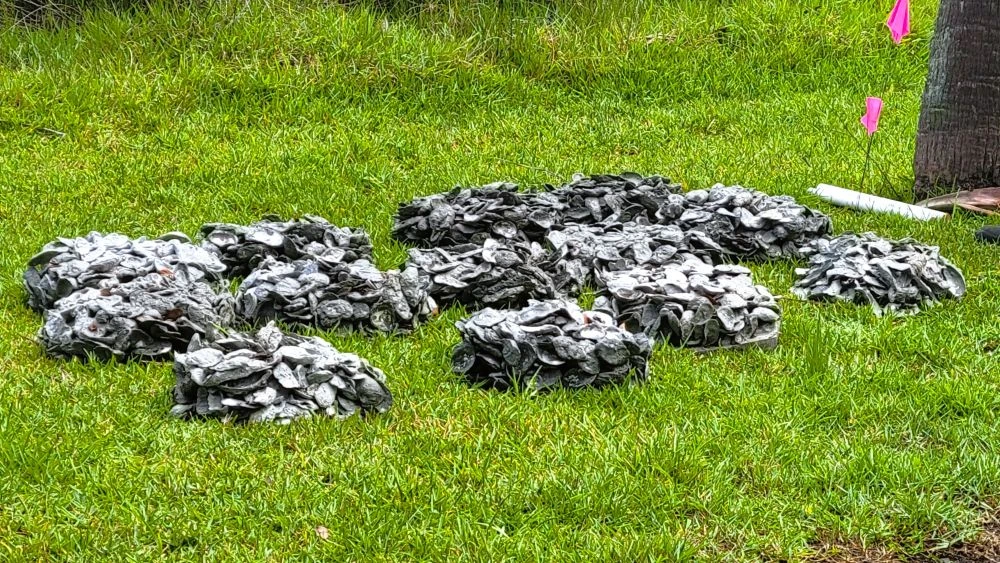
With help from the St. Johns Riverkeeper, Jax Oyster Conservation and other groups, 84 of the 30-pound circles of recycled oyster shells and cement were carried into the water to create habitat for oysters.
Supported by a grant to Local Initiative Support Corp. Jacksonville, or LISC, the POSHs will create the largest artificial oyster reef in the St. Johns River watershed. It significantly expands an oyster reef that included 40 POSH modules added last year in the Northside St. Johns River tributary.


Jacksonville Today thanks our sponsors. Become one.
“Oyster larvae like to attach themselves to some kind of substrate, and they love attaching to oyster shells,” said Jimmy Orth, executive director of St. Johns Riverkeeper. “What oysters can do is amazing. An adult oyster can filter up to 50 gallons of water. We are not going to clean up the river with this new oystery. What we are hoping is that we can demonstrate that the oysteries work and they can be replicated and scaled up in Jacksonville.”
The oystery is the second in the Trout River after one was planted on the Jacksonville Zoo and Gardens shoreline. It is important for another reason, said Marshiray Wellington, chairperson of the Riverview Collective Community Organization, which leads neighborhood revitalization and river policy in the predominantly Black Northside community.
“We are helping to filter one of our most valuable resources, which is the Trout River,” Wellington said. “So not only we are filtering the water, but then we are also helping establish a living shoreline that will help to protect our neighborhood from flooding and erosion, so on and so forth, from the storms we are experiencing, so healthier waterways and also protecting our homes that’s here.”
The Trout and Ribaut river watersheds are part of one of the most vulnerable regions in the country, according to an analysis conducted by Jacksonville University professor Ashley Johnson.
Wastewater treatment facilities, septic tanks, wild animal manure and stormwater runoff are responsible for high levels of fecal bacteria in those rivers. So recreational and commercial oyster harvesting in Duval County is prohibited year-round in almost all waterways, according to the Florida Department of Agriculture and Consumer Services.
“All of the tributaries that flow into the St. Johns are polluted and don’t meet water quality standards, and this is one of them,” Orth said.
In mid-2023, The University of North Florida began deploying the novel oyster shell conglomerations as a way of protecting the shoreline at the Timucuan Ecological & Historic Preserve.
Then just over a year ago, the first 40 POSH modules were placed near the Trout River shoreline and along the dock at Riverview Park to help clean that waterway.
The oyster planting
The shells, gathered on beaches and local restaurants by Coastal Conservation Association of Florida and the Guana Preserve in Ponte Vedra Beach, are laid out to dry, then glued together with concrete into circular modules.
On Wednesday, volunteers carried the 84 new modules to Riverview Park’s Trout River shoreline, then others, including Wellington and Hunter Mathews from Jax Oyster Conservation, planted them in the water. And yes, some volunteers got muddy.
“It’s a good time — a really good time,” Wellington said after slithering back up the mud out of the river. “Whenever you come together with like-minded people doing this type of work, it is inspiring; it’s healing; and it’s a good time.”
By next year, they hope to add more POSH modules to eventually have 240 in the waterway, Mathews said.
“Our mission and our motivation is to restore a lot of the ecosystem that we have lost with the decrease in our oyster cover,” Mathews said. “For this waterway, our goal is to provide some sort of water filtration, reducing some of the nutrients and pollution in the waterway, and stabilize the shoreline and protect the saltmarsh grass here.”
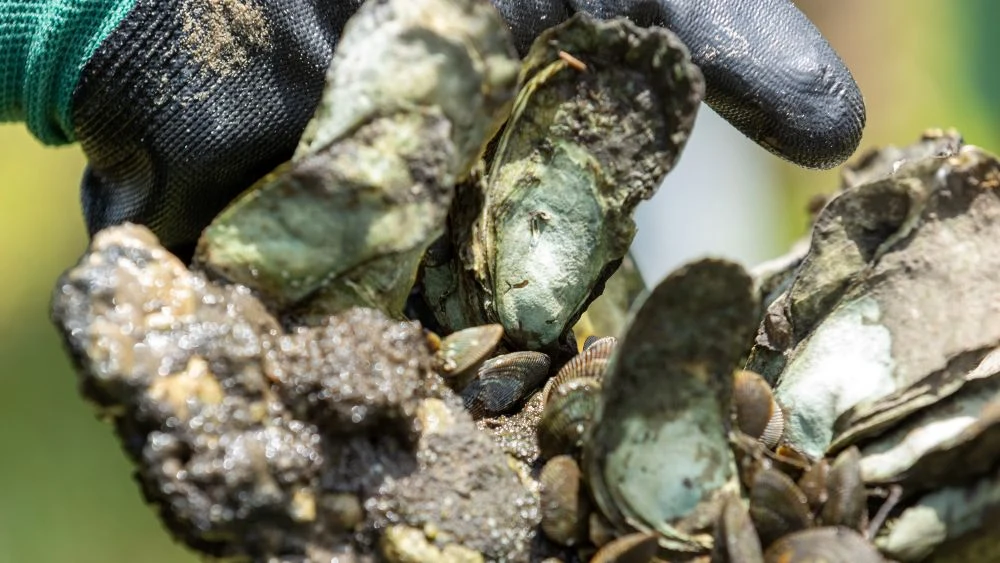
There was proof that the modules are becoming oyster nurseries, as Wellington showed volunteers the tiny mollusks growing on one planted last year. Then, she told volunteers that much more will be coming to the 11-acre park at 9620 E. Water St. near Lem Turner Road, including an expansion of the waterfront marsh to naturally handle flooding, a new boardwalk and modifying an old detention pond nearby to filter rainwater.
“We are working hard to try to activate this park,” she told them.