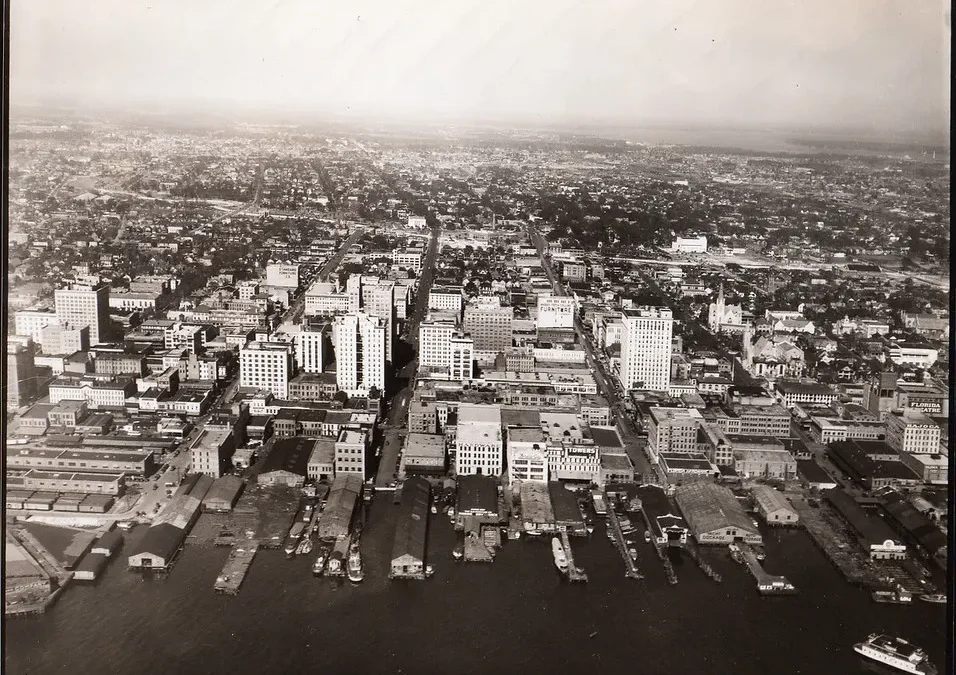

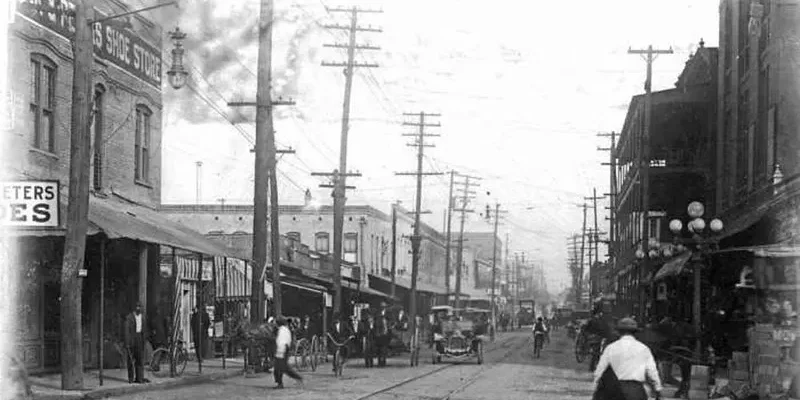
When Broad Street (pictured) was still known as Bridge Street, T. E. Ceruti and his wife, known professionally as Madame Ceruti, operated businesses that brought together beauty culture, retailing and cigar making.
Published on November 11, 2026 at 10:53 am
Free local news and info, in your inbox at 6 a.m. M-F. Sign up for the Jacksonville Today newsletter.
More than a century ago, a husband-and-wife business team operated a beauty parlor and cigar shop in the heart of LaVilla’s emerging Broad Street business district. Their story reveals an overlooked chapter of entrepreneurship, migration and international connections.
In 1906, when Broad Street was still known as Bridge Street, T.E. Ceruti and his wife, known professionally as Madame Ceruti, operated businesses that brought together beauty culture, retailing and cigar making. Their enterprises attracted the attention of local newspapers, which documented their professional reputations, travels to New York and even plans for a voyage to Paris.
Jacksonville Today thanks our sponsors. Become one.
Their story offers a glimpse into an often overlooked period of Jacksonville’s Black economic history, when entrepreneurs were establishing businesses and building professional networks that extended far beyond the city. It also raises intriguing questions about the Ceruti surname and its connections to the Bahamas, a Caribbean nation whose migrants helped shape Florida’s Black communities during the 19th and early 20th centuries.
A beauty entrepreneur on Bridge Street

By the summer of 1906, Madame Ceruti had established herself as a businesswoman in Jacksonville’s growing Black commercial district. A July 19, 1906, edition of the Jacksonville Journal reported that Mrs. E. F. Williams was successfully continuing a hair-work business originally established by Madame Ceruti in the Summer Building on Bridge Street near Duval Street. Two months later, the newspaper reported that Madame Ceruti operated an establishment in the Drew Building at the corner of Bridge and Church streets.
Her business offered much more than traditional hairdressing. Customers could purchase hair goods and receive manicuring, scalp treatments and other specialized beauty services. At a time when segregation restricted economic opportunities for African Americans, beauty culture provided an important pathway toward entrepreneurship and financial independence, particularly for Black women.


Jacksonville Today thanks our sponsors. Become one.
Madame Ceruti was participating in that emerging industry during the same era that Madam C. J. Walker was developing what would become one of the nation’s most recognizable Black-owned beauty enterprises. Although no evidence has been identified connecting Madame Ceruti to Walker’s organization, her Jacksonville business demonstrates that Black women were already developing sophisticated beauty enterprises in Florida during the first decade of the 20th century.
Her reputation appears to have been considerable. On December 16, 1906, The Florida Times-Union described the hairdressing parlor of Mme. T. E. Ceruti as “second to none in the state.” The newspaper praised her professional artistry and the quality of her merchandise, suggesting that her establishment had become a respected destination for beauty services and products. By February 1907, the Jacksonville Journal was again reporting favorable attention for her work.
A prize-winning cigar maker

While Madame Ceruti developed her beauty business, her husband pursued a different skilled trade. On December 5, 1906, the Jacksonville Journal announced that T. Ceruti had opened a cigar shop at 417 Bridge St. The newspaper described him as a prize-winning cigar maker who had successfully competed against other craftsmen in New York. It also claimed that Ceruti had made cigars for prominent international figures, including King Edward, Lord Salisbury and Sir Thomas Lipton.
Although those claims have not been independently verified, they illustrate the professional reputation attributed to Ceruti in contemporary newspaper accounts. His specialty was handmade Havana cigars, a product associated with the skilled cigar-making traditions of Cuba and Florida. A December 17, 1906, report in The Florida Times-Union confirmed the opening of his cigar business at 417 Bridge St. and described him as a first-class craftsman.
The following month, another newspaper account identified him as a “Cuban cigar maker” and connected him with Tampa, one of the nation’s leading cigar-manufacturing centers. These references to Tampa and New York suggest that Ceruti’s professional experience extended beyond Jacksonville.
A family business with international ambitions

The Cerutis’ businesses appear to have shared more than a family name. Newspaper accounts identify 417 Bridge St. as the location of both T. E. Ceruti’s cigar shop and Madame Ceruti’s hairdressing and manicuring parlors. A 1907 Jacksonville city directory also associated T.E. Ceruti with the occupation “Hair Goods,” suggesting that he may have participated in the couple’s beauty-related commercial activities.
In November 1906, the Jacksonville Journal reported that the couple had returned to the city after spending the summer in New York. Madame Ceruti resumed management of her Bridge Street establishment, which maintained an extensive inventory of hair goods. The newspaper also announced that she planned to introduce electric scalp treatments, an indication that she was incorporating new services into her business.
Their travels continued the following year. On June 27, 1907, the Jacksonville Journal reported that Madame Ceruti and her husband had departed for New York and intended to continue their journey to Paris. During their absence, Madame Ceruti’s establishment at 417 Bridge St. was placed under the management of Eva Shields.
Rather than closing her business when she traveled, Madame Ceruti had developed an operation capable of continuing under another woman’s management. Her establishment maintained customers, merchandise and specialized services while its proprietors pursued opportunities elsewhere.
A Ceruti connection to the Bahamas?

The Ceruti surname also appears in the history of Black migration from the Bahamas to Florida. One of the most notable individuals bearing the name was Edward Burton Ceruti, born in Nassau, Bahamas, in 1875. Biographical accounts identify him as the son of Edward Burton Ceruti Sr. and Eliza Jane Anderson. His family reportedly immigrated to the U.S. during his childhood, and the 1880 census has been cited as placing him and his mother in Jacksonville’s First Ward.
An 1894 Howard University record lists an E.B. Ceruti, whose residence was Palatka, Florida. Given Edward Burton Ceruti’s known educational background, the entry likely refers to the same individual, although additional verification is needed. Edward eventually studied at Shaw and Howard universities and pursued a legal education in New York. After earning his law degree in 1911, he was admitted to the California bar in 1912. He subsequently established a career in Los Angeles, where he became involved in efforts to challenge racial discrimination and advance civil rights. His life illustrates the geographic mobility of Black professionals whose experiences connected the Caribbean, Florida, historically Black educational institutions and the American West.
Another intriguing record comes from Key West. The 1900 U.S. Census identifies Clara Ceruti, a Black woman born in the Bahamas in March 1874, living on Whitehead Street. Clara reportedly immigrated to the U.S. in 1878 and worked as a cook. Her Bahamian birthplace and approximate age are noteworthy because Edward Burton Ceruti was also born in the Bahamas during the 1870s. Their shared surname may eventually reveal previously unknown family connections. For now, the records should be understood as separate pieces of a larger historical puzzle.
Before Broad Street became famous

Perhaps the most important aspect of the Cerutis’ story is where their businesses were located. Bridge Street, later renamed Broad Street, developed into one of Jacksonville’s most significant centers of Black commerce, professional life and community leadership. During the 20th century, the corridor became home to Black-owned restaurants, hotels, retail establishments, insurance companies, fraternal organizations and professional offices. Black physicians, attorneys, entrepreneurs and civic leaders helped transform the street into an economic and cultural center serving Jacksonville’s African American population.
Yet the Cerutis’ businesses demonstrate that this entrepreneurial tradition was already taking shape during the first decade of the 20th century. In 1906 and 1907, Madame Ceruti was selling specialized beauty products and providing professional services along the corridor. Her husband was producing handmade cigars. Their enterprises maintained connections to New York, and their travel plans reached across the Atlantic. Other women, including E.F. Williams and Eva Shields, played roles in maintaining Madame Ceruti’s business.
These newspaper notices reveal a commercial environment in which Black women were not merely employees but entrepreneurs, managers and skilled professionals. They also illustrate how Black-owned businesses participated in economic networks extending beyond their immediate neighborhoods.
Recovering Jacksonville’s Caribbean connections

The broader Ceruti story also contributes to a better understanding of Jacksonville’s historic relationship with the Bahamas. That relationship was about more than ships, ports and maritime trade. It was built by people who migrated between communities, established households, practiced trades, opened businesses, pursued education and developed professional networks.
Edward Burton Ceruti’s journey from Nassau to Florida and eventually California provides one example of those connections. The businesses operated by T.E. and Madame Ceruti provide another story of mobility and entrepreneurship in early 20th century Black Jacksonville, even though their possible relationship to Edward remains unconfirmed. Together, these records invite further research into the role of Caribbean migration in shaping the city’s commercial and cultural development.
They also remind us that Jacksonville’s historic Black business district did not emerge overnight. Its foundations were established by generations of entrepreneurs, including individuals whose names have largely disappeared from public memory.
More than a century after T. E. and Madame Ceruti operated their businesses on Bridge Street, their story offers a valuable reminder that the history of Black Jacksonville is much larger than its most familiar institutions and personalities.
Long before formal international partnerships and sister-city relationships, individuals were creating their own connections between the Bahamas, Florida, New York and the wider Atlantic world. Some of those connections passed directly through the storefronts of what would become Jacksonville’s famous Broad Street business district.