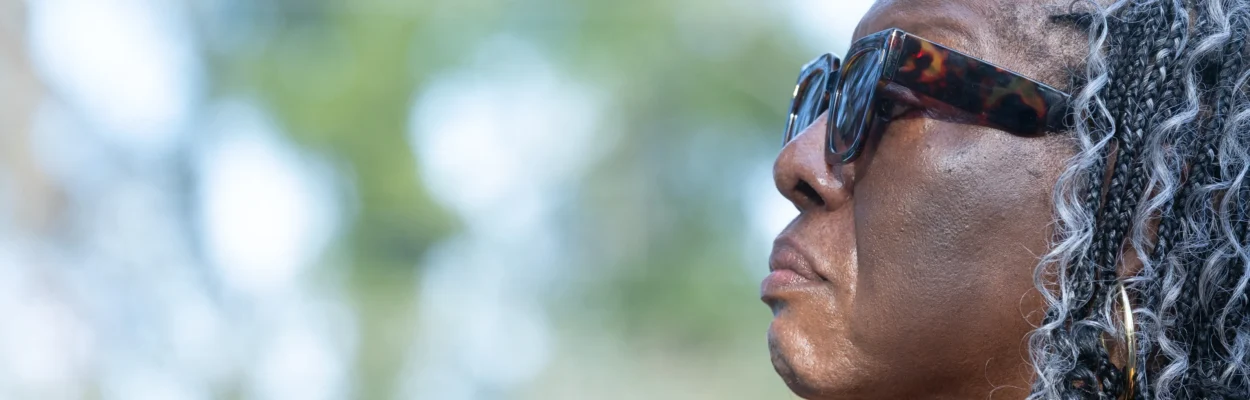
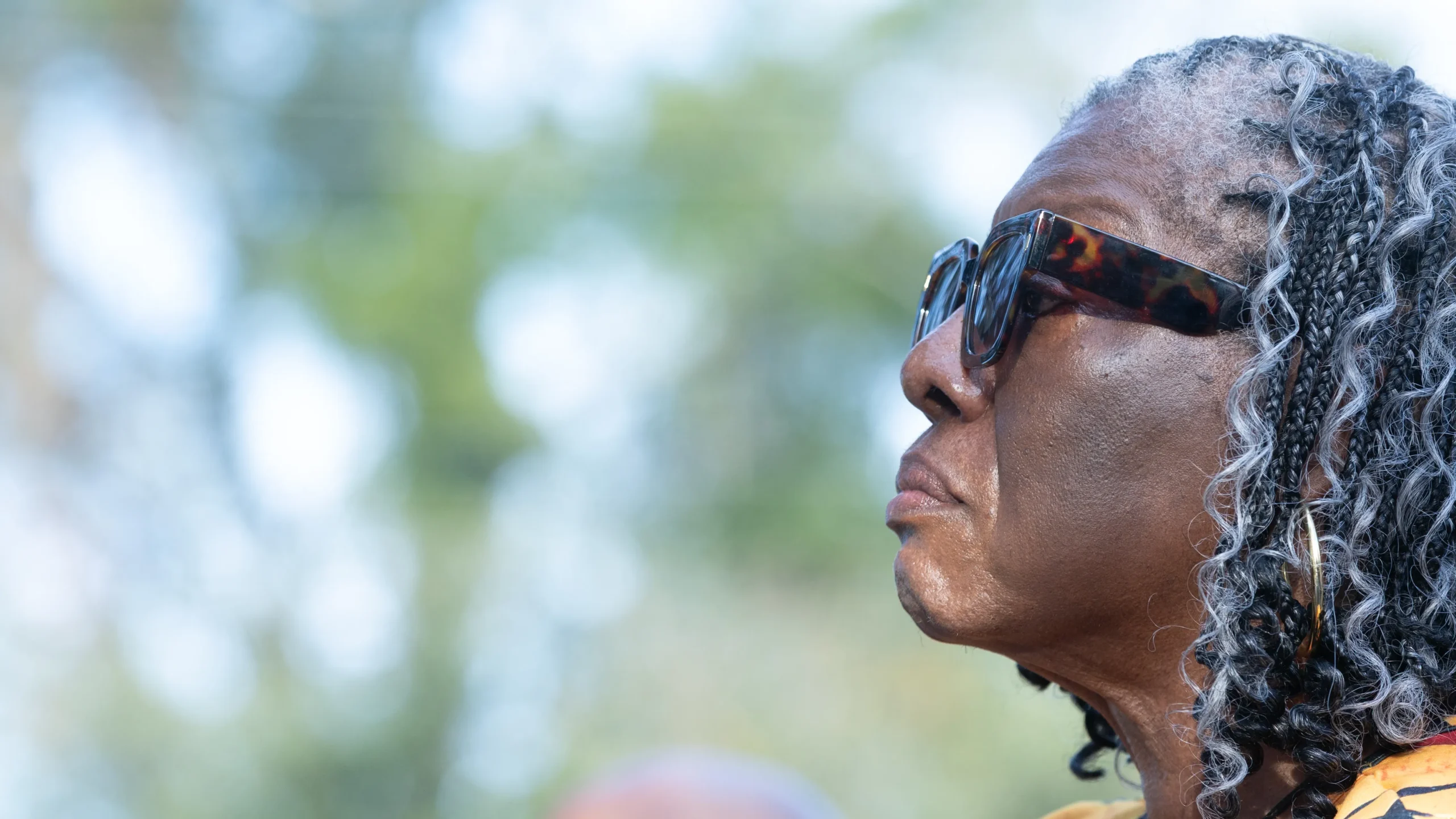
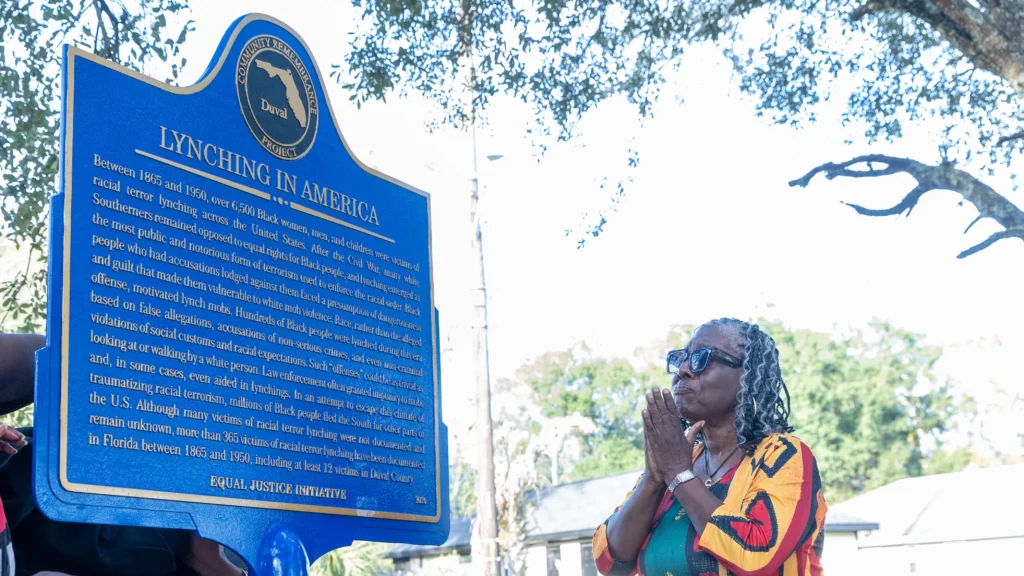
Samelia Adams listens during a Nov. 8 ceremony to commemorate her grandfather Benjamin Hart was held in Jacksonville’s Grand Park neighborhood. Hart was lynched by a mob in August 1923. | Will Brown, Jacksonville Today
Published on November 10, 2026 at 3:27 pm
Free local news and info, in your inbox at 6 a.m. M-F. Sign up for the Jacksonville Today newsletter.
Samelia Adams spent decades believing her grandfather abandoned her family.
The truth is Benjamin Hart was lynched. In Jacksonville.
Sunday, Hart’s life was memorialized with a marker in Jacksonville’s Grand Park community.
Jacksonville Today thanks our sponsors. Become one.
Marking the truth
In August 1923, a white woman claimed a Black man peered into her window. A group of white men sought to punish someone for the perceived crime. They selected Benjamin Hart from a log-cutting camp.
Hart was lynched on Aug. 24, 1923. He was 34 years old. His bullet-ridden body was found in a ditch along Kings Road, near Penton Street.
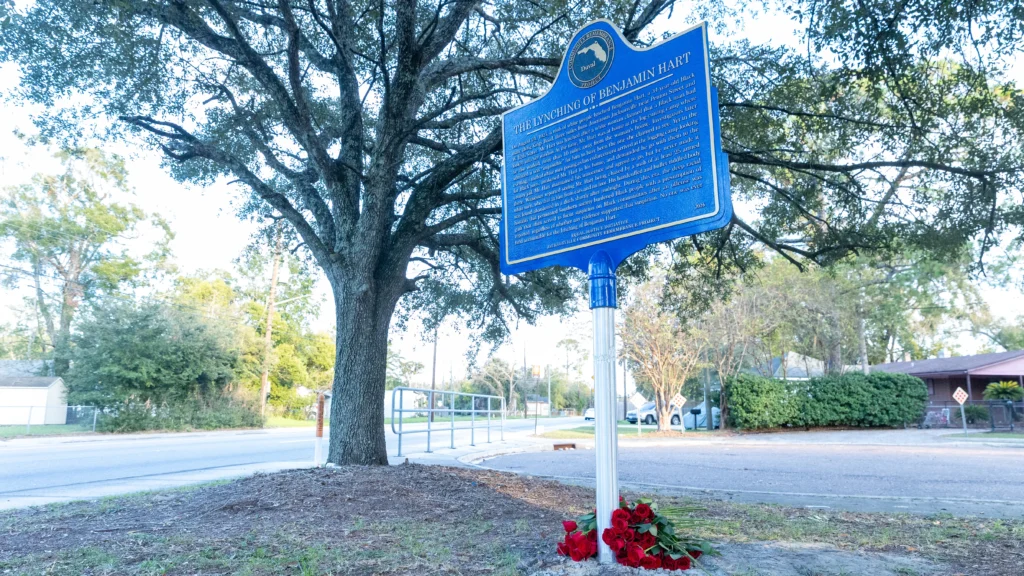
On Sunday afternoon, near the place where her ancestor’s body was found, Adams gasped as a black cloak was removed to unveil the marker in honor of her grandfather under the shade of an oak tree.
Jacksonville Today thanks our sponsors. Become one.
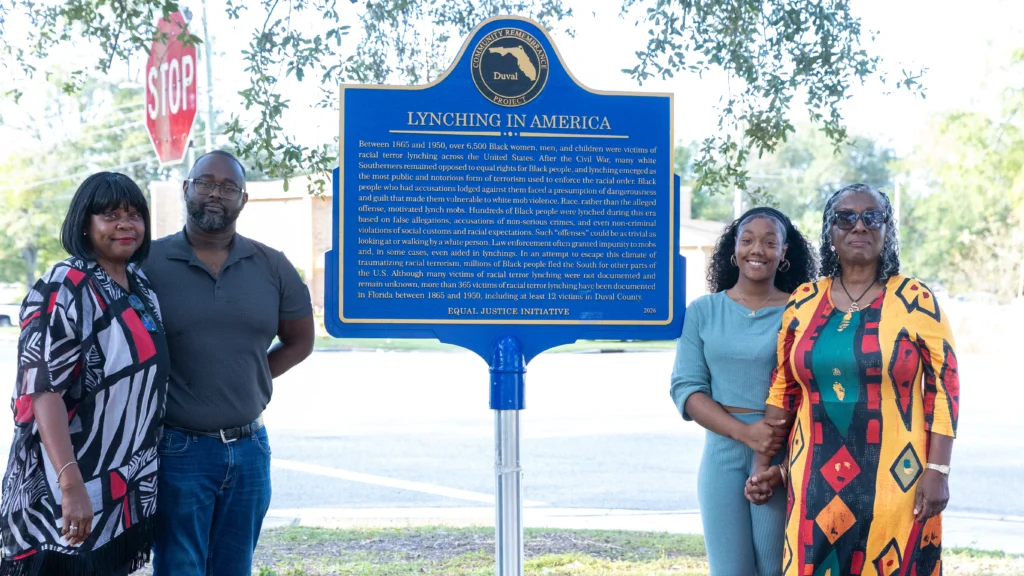
The west side of the blue marker with gold letters details known facts about Hart. The east side of the marker provides local and national context about lynching in America.
For Adams, the marker is a public acknowledgement that the mistruths her ancestors told about Hart, out of protection, or depression, have been corrected and immortalized.
“That same answer was given to all of us — for decades,” Adams said. “The answer that (my grandmother) gave (my mother) was: Her father went to work. And, because of how hard it was, and how difficult those years were, he abandoned his family and he never returned.”
“Because of that explanation, it changed the landscape of our family.”
Adams grew up in Jacksonville and graduated from Robert E. Lee High School. The Duval County School Board opened the school in Riverside four years after Hart was killed.
As a child, Adams was taught to not trust men like Benjamin Hart. Now, as a grandmother, she can tell her descendants the truth.
“For the rest of my life, I will be able to honor Benjamin Hart,” Adams said.
Making memories for the future
The marker was funded by the Alabama-based racial and social justice nonprofit Equal Justice Initiative, the Jacksonville Community Remembrance Project and racial justice nonprofit 904Ward.
Jacksonville Community Remembrance co-chair Lynn Sherman says the project’s researchers look for information about known lynching victims, as well as other, potential lynching victims whose stories have yet to be told.
“Our hope is by erecting these markers, it will bring hope, healing and understanding of history so we can look back and move forward with education, information and understanding,” Sherman said.
Nearly 100 people gathered under the late afternoon sun to remember a man who may have died because of lies. They were Black and white; educators and students; Jews and gentiles and people committed to racial justice.
The group included four of Hart’s descendants: Adams, Hart’s great-granddaughter Michelina Smith; Hart’s great-great granddaughter, T’Mia Hopkins; and Hart’s great-great grandson, Joseph Terrell.
“I think about how much of his story, our family never got to know,” Terrell said. “Who he was, the life he lived and the memories that should have passed down through the generations. Those are things we can’t get back. What we can do is make sure his name is no longer forgotten.”
Florida State College at Jacksonville professor and local historian Tim Gilmore said Hart lived on East 8th Street in what is now known as Durkeeville and worked in western Duval County, in what is now known as Pickettville.
Gilmore, who wrote about Hart’s lynching on his local history website Jax Psycho Geo, said on Sunday that no one was ever held accountable for Hart’s death.
“The facts did not matter, not to Ben Hart’s killers,” Gilmore said. “Hart was guilty of what their imaginations made them feel.”
Terrell said he was not focused on hatred or revenge because that wouldn’t change what happened to his great-great-grandfather. He sought an honest accounting of history, so people can move forward.
The Rev. John Newman has served as the pastor at The Sanctuary at Mt. Calvary for more than 40 years. His spiritual home was a three-minute walk from Sunday’s ceremony in Grand Park.
Newman reminded attendees that lynchings were an attempt at intimidation and forced silence. They were often because of accusations from white women, condemnation of innocents from unruly mobs, before unjust executions of violence.
“We must never confuse the discomfort of confronting history with the harm of living through it,” Newman said on Sunday.
Then and now
The centennial of Hart’s lynching went unacknowledged in Jacksonville. But, on that evening, Jacksonville’s mayor stood in front of a predominantly Black audience in a historically Black part of Jacksonville and listened to their concerns.
For more than an hour, Jacksonville’s mayor listened as Black people asked about removing a Confederate monument from a public park; reducing blight in predominantly Black neighborhoods and education opportunities for young children.
Some left that community conversation confident that things may be different here.
Two days later, a white supremacist with deadly intention visited three separate locations along Kings Road.
The Dollar General where the racist shooter killed three people could be seen in the distance from Sunday’s commemoration site.
Typically, the Equal Justice Initiative and the Jacksonville Community Remembrance Project collects soil samples at the location where a lynching occurred on, or around, the anniversary of the racial terror. The collection took place in August 2020. However, the marker unveiling was moved to November out of respect for the victims of the Dollar General shooting.
“We have to start paying closer attention to one another, to our families, to our neighbors and, especially, our children,” Terrell said. “We need to recognize when someone is being mistreated; when people are being divided or when someone feels they have nobody standing beside them. …That responsibility doesn’t stop with our community. It belongs to everyone.”