

CEO Cheron Corbett looks on at a Jacksonville Housing Authority board meeting Monday, Oct. 19, 2026. | Elizabeth Caldwell, Jacksonville Today
Published on October 20, 2026 at 12:04 pm
Free local news and info, in your inbox at 6 a.m. M-F. Sign up for the Jacksonville Today newsletter.
In a tense special meeting with city attorneys frequently chiming in, the Jacksonville Housing Authority board on Monday questioned a consultant’s role in a key housing program as members killed a proposal for more executive pay.
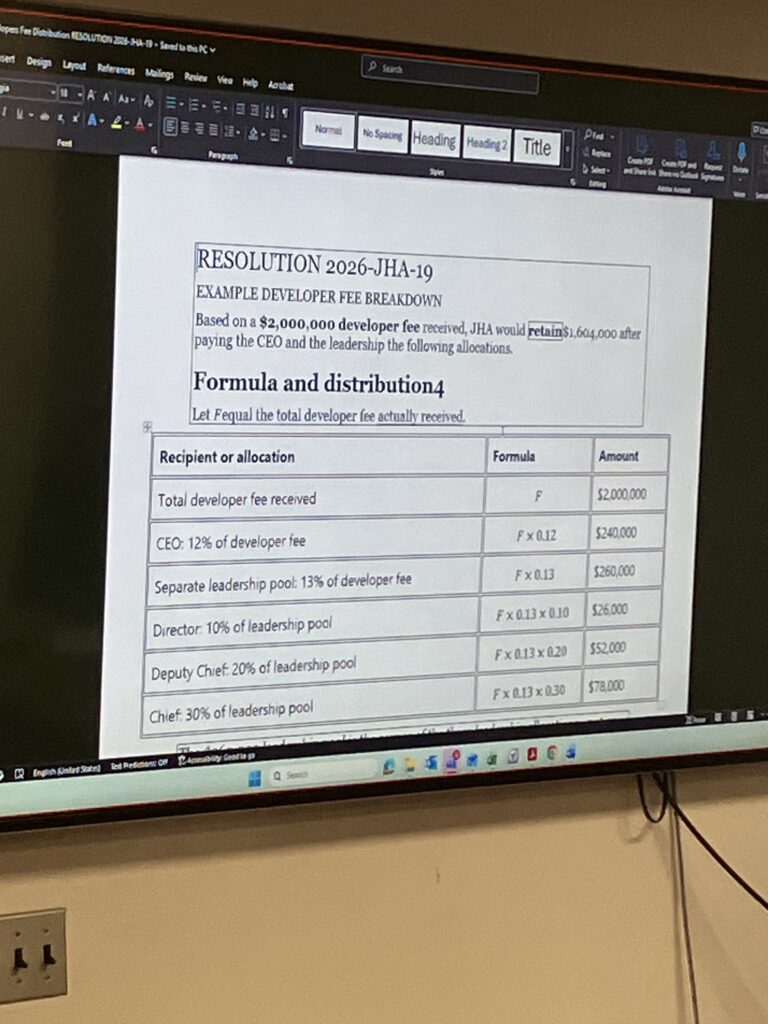
CEO Cheron Corbett brought a package before the board entitling her to 12% of any developer fee paid to the authority. If the Housing Authority collected a $2 million fee after finishing a deal for new housing construction, Corbett would’ve earned $240,000 on top of her $300,000 salary.
Jacksonville Today thanks our sponsors. Become one.
A separate pool for other Housing Authority leaders would subtract another 13% from the fee. The proposal said the director, deputy chief and chief would all get cuts, with the second-largest payout in the $2 million example being $78,000 to the role described as chief.
In the $2 million scenario, the Housing Authority as an agency would retain $1.6 million.
Corbett defended the package as necessary as she expects to hustle to replace cut federal dollars usually supplied by the Department of Housing and Urban Development. To pay for tax cuts, the Trump administration has again proposed slashing nearly $11 billion from HUD’s budget, a 13% reduction from 2026. A similar proposal failed this summer in Congress.



Jacksonville Today thanks our sponsors. Become one.
“We’re making this organization much more lean, to drive efficiency, not to be looked at as a government entity but to be looked at more as a private sector entity that will eventually generate those nonfederal funds,” Corbett said.
Commissioner Robin Smith, appointed by Mayor Donna Deegan in 2025, was the most strongly opposed to Corbett’s plan, challenging her on the spirit of her proposal.
“This just seems to abandon the heart of the entire organization,” Smith said. “It’s profit. We had a whole board retreat talking about goals, values. We talked about values for hours. Fees, your pay, never came up. To me, it’s inappropriate.”
Other commissioners took issue with the Housing Authority’s financial picture over an apparent shortfall of $2.8 million connected to a voucher program that helps low-income families, elderly adults and disabled people pay for housing. The program runs on more than $90 million and serves about 8,000 families, according to the Housing Authority.
“For me, I am still unstable in my sound understanding of how well we are doing as an agency financially,” said Commissioner Caleena Shirley, whom Deegan appointed in 2024. “It’s concerning that I’ve been in this seat this long and still don’t have clarity.”
Corbett defended the $2.8 million shortfall as money used in the voucher program, according to documents attached to the meeting’s agenda. A report from consultant Nan McKay showed voucher use jumped 18% in 2023, which the company wrote contributed to the Housing Authority’s 2025 loss.
Nan McKay’s involvement with the Housing Authority was itself a contentious subject. When Corbett took over in mid-2025, she quickly outsourced the Housing Choice Voucher program to the multimillion-dollar private company in an effort, she said, to quash frequent auditor complaints around things like missing documentation.
Corbett used a “piggyback” process to latch onto a Nan McKay contract held by Miami-Dade’s Housing and Community Development department in 2025. In response to questions, the city of Jacksonville’s general counsel, Michael Fackler, said the piggyback idea is an accepted process that agencies can use when they think another entity has already negotiated best terms.
“It’s ultimately a policy decision for you guys to determine if those terms are appropriate and consistent with your goals,” Fackler told the board.
The Housing Authority’s contract allowed Nan McKay to collect 72% of administrative fees, or 72 cents on the dollar, supplied by HUD to the Housing Authority for voucher program administration. Miami-Dade’s contract was for more than $135 million. Those terms were not renewed for 2027, with Miami-Dade saying it wanted to increase oversight with a new and longer agreement structure.
Now, the Housing Authority is trying to again piggyback off another city. A proposed 2026 renewal based on a current contract in Newark, New Jersey, puts Nan McKay’s cut from the Jacksonville Housing Authority at 67% of HUD’s administrative fees.
Commissioners were wary of approving the new terms without a full picture of whether the outsourcing has saved money. They tabled the proposal, planning to call another special meeting this month.