


Katrina Moore listens at a public meeting held by the Jacksonville Housing Authority on Saturday, June 26, 2026. | Elizabeth Caldwell, Jacksonville Today
Published on July 1, 2026 at 3:23 pm
Free local news and info, in your inbox at 6 a.m. M-F. Sign up for the Jacksonville Today newsletter.
The Jacksonville Housing Authority would give many low-income renters about three months to find a job under a tentative federal policy that also includes a two-year cap on aid.
As previously reported by Jacksonville Today, JHA appears to be one of the first authorities in the country to develop its own version of a new controversial U.S. Housing and Urban Development rule that isn’t even in effect yet.
Jacksonville Today thanks our sponsors. Become one.
The proposal, if enacted, says public housing agencies across the country would have the option to adopt a 40-hour-per-week work requirement and/or cap aid from most housing assistance programs at two years.
HUD’s proposal is expected to face legal challenges because Congress has previously rejected work requirements.
Jacksonville’s modified local policy would require people applying for benefits and those already enrolled to work 30 hours per week. JHA has been considering a two-year cap on benefits, which it mentions in its five-year plan, but so far has not spelled out a strategy.



Jacksonville Today thanks our sponsors. Become one.
Disabled and elderly residents would generally be exempt from the work requirement, along with some caregivers. But the policy would require disabled people under age 62 who work less than 20 hours per week to complete eight hours of community service if they didn’t have a doctor’s waiver.
JHA’s work requirements would begin if and when the federal rule is finalized. The timeline for that is unclear.
Housing concerns
If JHA’s policy were to go into effect, residents would generally have 13 weeks to find a job if they became unemployed. Tenants out of compliance would risk losing their benefits.
United Way estimates the average 2026 job search in the U.S. will last about seven months.
The most advertised jobs in Northeast Florida, according to CareerSource spokesman Ron Whittington, are often the lowest-hanging fruit.
“There are always openings for retail salesperson, food and counter workers, and first line supervisors at restaurants and serving workers,” Whittington said. “These are not the professional jobs some people are looking for, but at the same time, there are positions out there.”

Wendallyn Pinckney, 32, is a public housing resident who is in favor of work requirements but thinks three months isn’t enough time to find meaningful employment.
“In today’s society, it’s not possible,” Pinckney said. “After losing several jobs when my son was young, it took me at least six months to find a suitable job, a well-paying job that allowed me to be self-sufficient.”
Pinckney said she never wanted to be on welfare but “life happened.” Over the years, a popular initiative run by JHA called the Family Self-Sufficiency Program helped her get back on track. Researchers say work requirements are most successful when supports are in place.
But the Family Self-Sufficiency Program has a three- to six-month waiting list, and it is being cut as part of a $10.7 billion proposed reduction in HUD’s 2027 funding.
Alesia Scott-Ford, HUD’s field office director for Jacksonville, declined to comment on the elimination of the program.
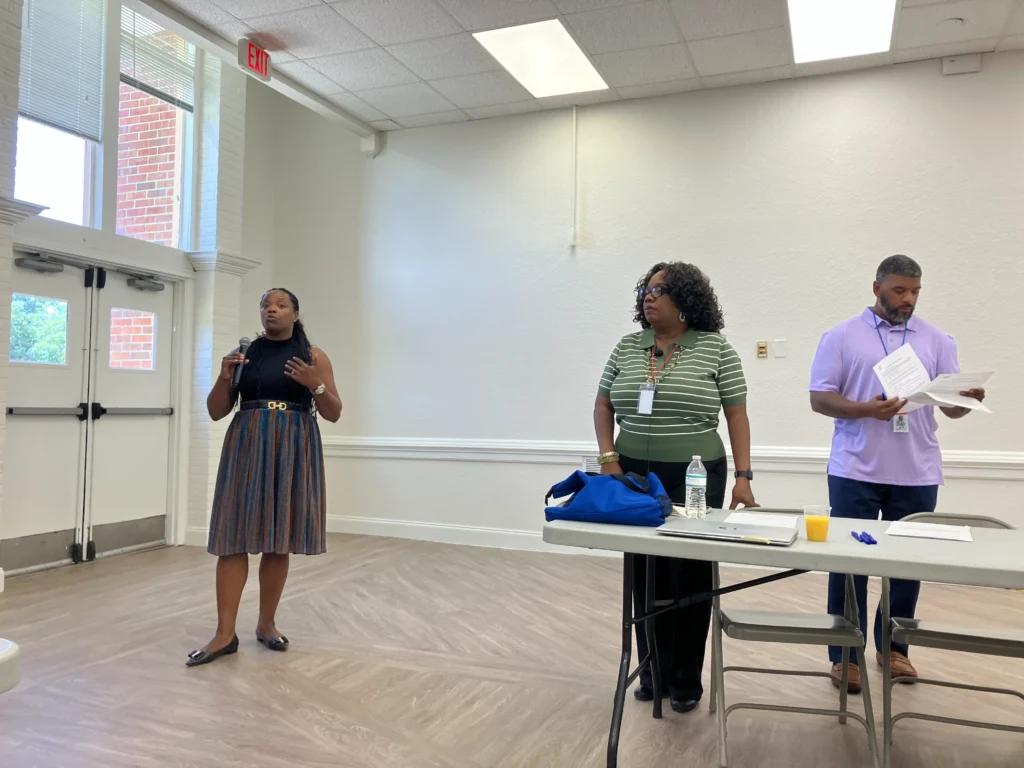
In a meeting with residents over the weekend, JHA CEO Cheron Corbett continuously emphasized that the work requirement isn’t in effect yet, but she also said that HUD is requiring JHA to develop a policy.
“The reality of it is, this is not an initiative that unfortunately JHA can control. We’re funded by HUD,” Corbett said. “But what we can do today is make sure we inform you of the rules, what is to come.”
The HUD rule is specifically designed to be flexible and gives public housing agencies — known as PHAs — and affiliated private owners the chance to adopt both a work requirement and/or term limits, or neither.
“In all cases, PHAs and Owners could establish either or both work requirements and term limits. PHAs and Owners may also implement neither requirement,” the rule reads.
When asked why she was painting JHA’s policy as required, Corbett accused Jacksonville Today of “writing false information.”
Corbett declined to address whether three months is enough time to find a job.