
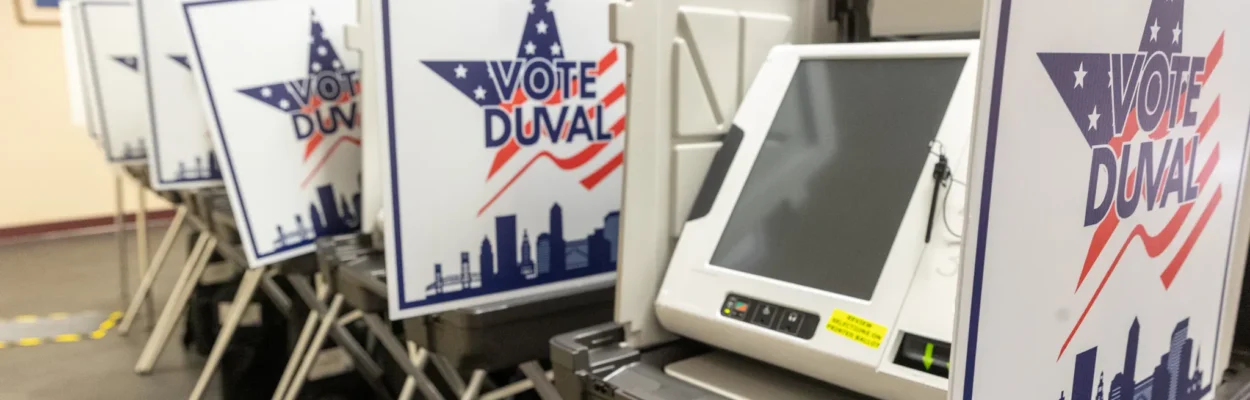
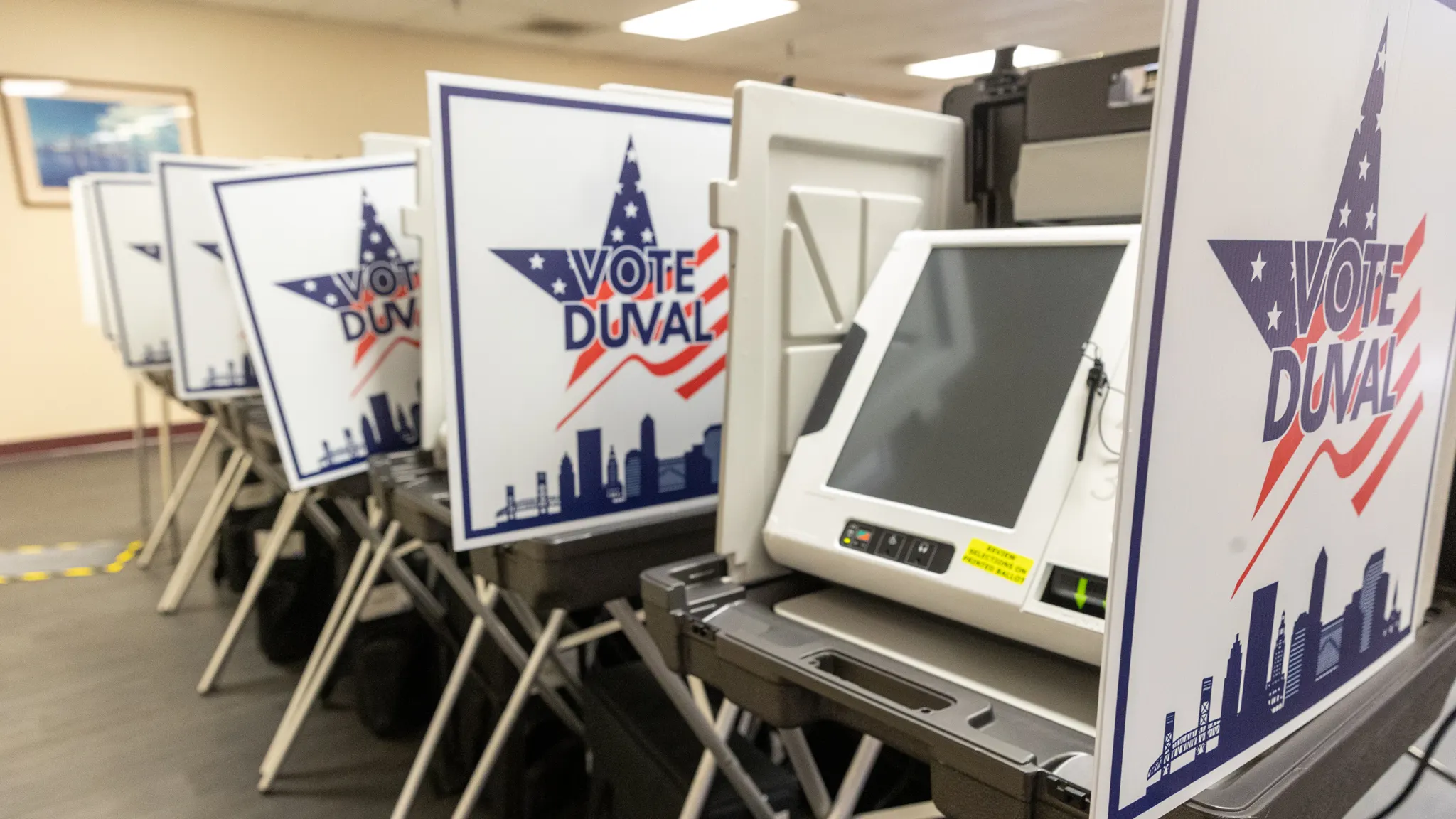
The Duval County Supervisor of Elections office will process nearly
1 million votes between both the 2026 gubernatorial and 2027 municipal
elections. | Will Brown, Jacksonville Today
Published on October 16, 2026 at 6:17 pm
Free local news and info, in your inbox at 6 a.m. M-F. Sign up for the Jacksonville Today newsletter.
When Florida voters go to the polls starting next week — in addition to a slew of local and statewide candidates on the Nov. 3 ballot — voters will be asked to decide on the future of property taxes in the state.
During a special session in June, the Florida Legislature voted to put Constitutional Amendment 3 on the ballot. It would increase the homestead property tax exemption for all non-school taxes to $150,000 in 2027 and $250,000 in 2028. Those numbers would adjust for inflation after 2028.
Jacksonville Today thanks our sponsors. Become one.
The amendment must get 60% of the electorate in the 2026 election to vote yes in order to pass.
Here’s what Florida voters need to know about the property tax change will mean for them, their neighbors and their communities:
Amendment 3 savings
The drop in taxes from Amendment 3 is widely expected to have a corresponding drop in revenue for Florida city and county governments.

Jacksonville Today thanks our sponsors. Become one.
There are dozens of groups spending millions of dollars across Florida trying to persuade voters to either pull the yes or no levers for Amendment 3.
Florida TaxWatch, the independent nonpartisan tax institute, has a calculator that allows homeowners to see how much they would save under Amendment 3 based on all the local non-school millage rates.
It notes that homesteaded property owners will still pay school property taxes under Amendment 3.
In Jacksonville/Duval County, the calculator says a homeowner with a $250,000 house could save an estimated $2,258 in 2028 on their city property taxes.
But, as some tax and detractors of Amendment 3 note, there could be costs for homeowners outside of their property tax bills.
A hit to local governments
One of the most widely discussed effects of the property tax cut is the financial hit to city and county governments and what that means for services.
Florida TaxWatch projects that Amendment 3 would cut local property taxes by $45.8 billion over five years. In its Florida Taxpayer’s Voter Guide for the 2026 Constitutional Amendments, the organization says that local governments could lose out on $4.9 billion in the first year of the amendment.
It points to the Legislature’s Revenue Estimating Conference that says that could rise to $11.8 billion by fiscal year 2031-32.
In Jacksonville, the City Council auditor’s estimates are in-line with TaxWatch’s assessment. In 2027, the auditor expects the new homestead exemption will reduce the city’s projected revenue by $200,000. That’s 10% of Jacksonville’s roughly $2 billion operating budget.
In 2028, that jumps to $300 million.
TaxWatch came out in September urging Florida voters to say no to Amendment 3. TaxWatch estimates that, for Jacksonville, that number will climb to $416.2 million by the 2031-32 fiscal year. Over five years, the organization says Duval County could lose nearly $1.69 billion in property tax revenue.
For St. Johns County, TaxWatch estimates the five-year loss could be $803.4 million, and $297.2 million for Nassau County.
Chris Hand, a government law attorney and chief of staff for former Jacksonville Mayor Alvin Brown, says if Amendment 3 passes there will be three moves for local governments — cut spending, find efficiencies to save money and raise other revenue.
“You may remember that scene from The Fugitive where Tommy Lee Jones says, we’re going to do a hard target search of every outhouse, henhouse, doghouse. And I think that philosophy, that approach will really define what every city and county government in Florida does in the event Amendment 3 passes,” Hand told Jacksonville Today. “They’re going to have to look everywhere for what are the fiscal levers that they can pull to try and mitigate the impacts of these revenue losses.”
Amendment 3 would require cities to use all the remaining property tax revenue solely for pubic safety, education and schools, infrastructure, natural resources, bond debt, services, retirement benefits for employees, and operations and administration.
But unlike an early proposal by Gov. Ron DeSantis, the tax cut in Amendment 3 does prohibit cuts to police, fire or any other government services.
Jacksonville City Council President Nick Howland, a Republican who supports Amendment 3, has said it would be the council’s priority not to cut public safety.
Many Florida law enforcement agencies and groups, including the Florida Sheriff’s Association, doubt cuts to public safety will be avoidable if Amendment 3 passes.
In this year’s city budget, that’s nearly $1.1 billion of the $2 billion spending plan. Nearly $1.3 billion of the city revenue for 2026-27 came from property taxes, according to budget documents.
If Jacksonville said no cuts to police and fire services, Hand points out that’s a much smaller $900 million pot of money from which leaders will need to cut $300 million.
Hand, who helped craft budgets in the Brown administration during the Great Recession, says that could likely lead to some job cuts at the city. He says city officials would likely start by cutting open positions. But more cuts could be needed.
He says that fewer people working in the city could lead to slower or a reduction in services.
“That’s a horrible exercise for anybody to go through. These are people’s livelihoods. These are hardworking public servants,” Hand said. “But with this scale of a cut, it’s hard to imagine that personnel is not one of the issues that the city’s gonna be examining.”
Aside from law enforcement, city leaders would have to determine where else to make cuts. The largest city department budgets this year were $69.39 million for Public Works; $58.74 million for Parks, Recreation and Community Services; $57.39 million for Kids Hope Alliance and its youth programing; and $45.74 million for public libraries.
The city also contributed $56 million to UF Health Jacksonville for indigent care, increased spending on road resurfacing to $35.94 million, and allocated $25 million to phase out aging septic tanks in Jacksonville neighborhoods.
“When you’re having to make a cut of that size, potentially the word scalpel doesn’t really come into it,” Hand said. “That’s more of using a cleaver at that point. Which is why I think you’ll see the city of Jacksonville, and again, other city and county governments around the state, use a variety of tools,” Hand said.
According to Hand, maintaining services will probably not be sustainable with spending cuts alone. He expects many cities and counties to look at raising existing taxes and fees or finding new ones to levy.
New taxes, fees and millage hikes
To make up for lost revenue, some cities could move to raise fees and other taxes to plug some of the revenue hole.
Although Amendment 3 exempts the first $250,000 of a homestead’s taxable value, homeowners will still have to pay property taxes on the taxable value higher than $250,000.
The amendment also lowers the cap from 10% to 5% on how much non-homesteaded properties, including commercial properties, can rise.
Hand says increasing the millage rate on the remaining taxable property could be an option. That could raise tens of millions for a city like Jacksonville.
In Jacksonville, if two-thirds of the council agreed, they could raise the JEA franchise fee. It’s currently at 3% and could be raised to 6%. The city raised $53.2 million on franchise fees this year.
There are also local sales taxes, like the indigent care surtax, that cities and counties could also try to raise. But, in Florida, that tax hike would need the OK of the voters, too.
Hand says New Smyrna Beach explored a fire assessment in the event of Amendment 3 passing.
“If you can’t receive the same revenue from property taxes going forward, a more diversified revenue approach is one that I think many of them will explore,” Hand said.
If local taxes and fees start to rise in the wake of an Amendment 3 approval, Hand said he would watch for the Legislature to step in and try to curb or put no limits on local government’s fee-setting ability.
Who’s funding Yes and No campaigns?
Every organization that receives financial support from city and county governments, as well as industry groups linked to housing, are following the Amendment 3 debate closely.
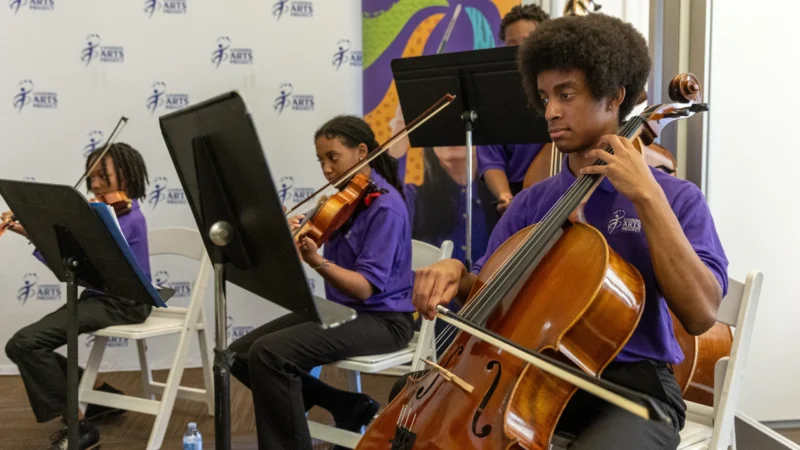
Statewide law enforcement groups, arts organizations, chambers of commerce and the independent nonpartisan tax research groups have either come out against the measure or warned of the strain it will put on cities and their affiliates.
DeSantis, many state-level Republican lawmakers and other industry groups are pushing for its passage.
Vote Yes
Within weeks of the Legislature’s vote, the Florida Association of Realtors launched “Vote Yes on 3” campaign and began funnelling millions of dollars into the effort.
The Florida Department of State’s Division of Elections campaign finance data base shows that real estate interests have contributed $21.51 million into the Vote Yes on 3 effort, the vast majority coming from the Florida Realtors organization.
Florida Realtors and proponents of Amendment 3 have framed homestead property tax reductions as an affordability issue for the middle class. Their argument is that the cost associated with taxing homesteads piles onto insurance and grocery and utility costs, among other necessities.
“Affordability is on the forefront for every Floridian, and they need meaningful relief,” Florida Realtors President Chuck Bonfiglio Jr. said in a Sept. 9 news release announcing the campaign. “We’ve spent years working to help people buy homes. But buying the home is only half the challenge. We also need to make sure families can afford to keep the homes they worked so hard to purchase.”
The Florida Realtors’ regional affiliate, Northeast Florida Association of Realtors, has been conducting an internal campaign to educate its residential and commercial members about Amendment 3, the organization’s Government Affairs Director Nancy Garcia told Jacksonville Today.
In late September, a poll from the University of North Florida’s Public Opinion Research Lab showed that 63% of homeowners surveyed said property insurance was a bigger concern than property taxes.
The push to pass Amendment 3 has since received out-of-state money. On Oct. 9, the National Association of Realtors, the Florida Realtors’ parent organization, made a $2.0165 million donation to the Vote Yes on 3.
Vote No
On the flip side of the issue, the “Vote No on Amendment 3” campaign to oppose the property tax cut launched in June by former Leon County Commissioner Bryan Desloge through Stop Unfair Tax Shifts Today Inc.
Campaign finance records show that Vote No on 3 Florida Inc. and other anti-Amendment 3 groups have raised far less money than the Vote Yes campaign, mostly from individual donors and government groups.
Those include the Florida Association of Special Districts, Palm Beach County League of Cities and Our Democracy, the political committee for Miami-Dade County Mayor Daniella Levine Cava.
These groups are warning of cuts to public safety, basic city services and hurricane preparedness by local entities, if property tax revenue drops.
They also worry that if cities raise millage rates on commercial properties to compensate, that will result in rising rents and put more financial pressure on small businesses and people who live in rental units.
They also point to Republican sheriffs, tax watchdogs and lawmakers concerned about what the tax cut will do to public safety services.
In Jacksonville, business groups like JAX Chamber and the Civic Council have come out against Amendment 3.
Not every real estate professional wants Amendment 3 to pass. Christian Harden, CEO of commercial real estate firm NAI Hallmark in Jacksonville, said in an Oct. 12 LinkedIn post that Amendment 3 “isn’t the fix” to what he says is a real affordability problem in Florida.
Harden referenced the financial strain local governments expect from the tax cut, shifting the tax burden to renters and putting local services like police, fire, parks and libraries at risk.
“It takes decisions away from voters and local leaders. The amendment lets the Legislature move toward eliminating non-school homestead taxes entirely, without coming back to voters. Decisions this big belong close to home, with the officials we elect and can hold accountable,” Harden wrote.
“This isn’t a Republican or Democratic issue. It’s a local control issue and a math issue, and the JAX Chamber, nonprofit leaders, and philanthropic groups have all raised the alarm,” he wrote.
What happens on Nov. 4?
If the amendment crosses the 60% support threshold needed for the amendment to pass, the first wave of the tax cut would go into effect in 2027 when the homestead exemption would rise from $50,000 to $150,000. In 2028, the full $250,000 homestead exemption starts.
The increased homestead exemption does not include second or vacation homes. But for non-homesteaded properties and commercial properties, it would reduce the annual cap from 10% to 5% on how much the assessed value could rise.
Local governments would have a little less than a year to make cuts or raise fees and other taxes to compensate.
Anybody who moves to Florida and buys a homestead after Dec. 31, 2026, would receive the existing $50,000 Save Our Homes exemption. After five years, those homeowners’ exemption would bump up to the full $250,000, according to the amendment.
If voters say no, there would be no change to Florida’s current property tax collection system.
In Jacksonville, the City Council held back millions of dollars for cultural service grants and money for an uninsured telehealth program to start saving money should Amendment 3 pass. That money would automatically be appropriated to the Cultural Council of Greater Jacksonville and Healthlink Jax.
If Amendment 3 becomes law, Hand says that’s when it becomes more important than ever for Florida residents to talk to their local officials about how they want the money that remains to be spent.
“It’s important that citizens are communicating with their elected officials about what their priorities are for city spending, because this is a time where elected officials will really need to hear from their constituents about what do you want to see funded in a local government,” Hand said. “A budget is an exercise in priorities, and that’s going to be particularly the case if cities and counties have fewer resources.”
Reader-supported election coverage
Help fund the next voter guide.
Every candidate on your ballot receives the same questions from us.
We publish their answers word for word.
We name the candidates who never respond.
Make a donation to support this work.