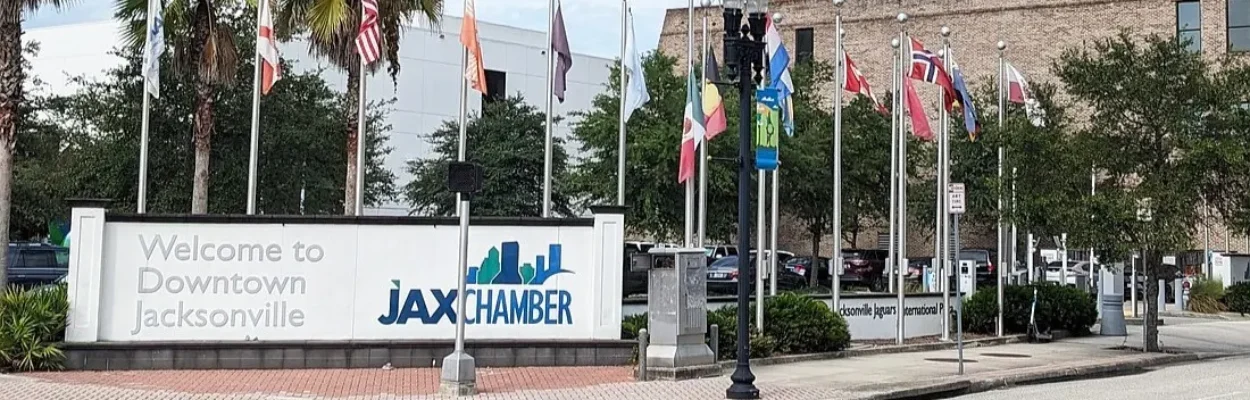
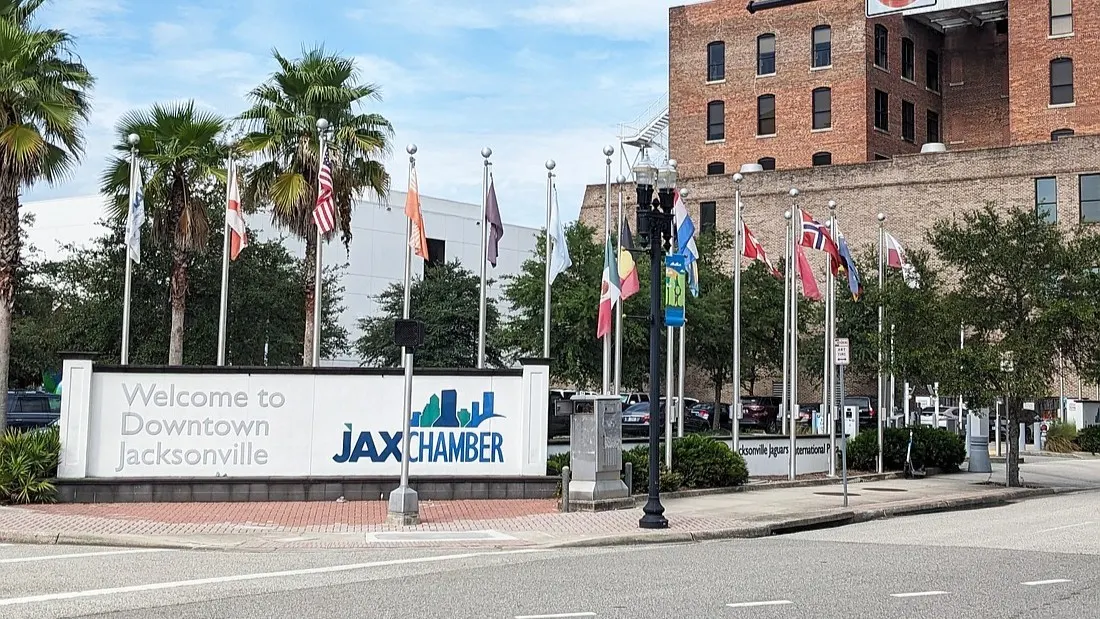
The JAX Chamber in Downtown Jacksonville. | Monty Zickuhr, Jacksonville Daily Record
Published on October 7, 2026 at 1:06 pm
Free local news and info, in your inbox at 6 a.m. M-F. Sign up for the Jacksonville Today newsletter.
The JAX Chamber is the latest to oppose Amendment 3, the proposed constitutional amendment that would reduce property taxes by increasing the homestead exemption.
Voters will decide Nov. 3 whether to increase the homestead exemption from its current $50,000 to $150,000 in Fiscal 2028 and $250,000 in Fiscal 2029.
Jacksonville Today thanks our sponsors. Become one.
The JAX Chamber said it opposes the amendment because it would benefit only people who own homes.
About 40% of Duval County residents and one-third of Florida residents rent their homes and would receive no direct relief under the amendment, the chamber said in a news release this week. Businesses and commercial property owners also would be excluded from the amendment’s primary benefit.
At the same time, cities and counties would need to fund essential services, which could mean reducing services, adding fees, raising tax rates on non-homesteaded property, increasing the property tax millage rate or combing such measures, the news release said.

Jacksonville Today thanks our sponsors. Become one.
“As a result, renters, businesses, and commercial property owners ultimately could bear a greater share of the cost,” the chamber said.
Opposition beyond the chamber
Business and local government officials across the state have opposed Amendment 3, saying it will force cities and counties to severely reduce services.
Opponents include Jacksonville Mayor Donna Deegan, the Jacksonville Association of Fire Fighters, the Jacksonville Fraternal Order of Police and the Jacksonville Civic Council, a coalition of business leaders.
The Jacksonville City Council Auditor’s Office has estimated that if the referendum passes, the city will experience a $200 million drop in revenue for the 2027-28 fiscal year and $300 million by 2028-29.
READ MORE: Council punts on incentives for Downtown Publix until after Amendment 3 vote
Proponents argue the amendment would provide badly needed relief to taxpayers. They say local goverment has recklessly increased spending in recent years.
Jacksonville City Council President Nick Howland is among those who support the amendment.
The JAX Chamber said the Florida Taxation and Budget Reform Commission is a more appropriate forum to review the state’s property tax system and develop a comprehensive solution. The commission convenes every 20 years and will meet in 2027.
“The Commission is specifically charged with examining Florida’s tax structure, the revenue needs of state and local governments, constitutional limitations on taxation and expenditures, and alternative methods of meeting the state’s long-term funding needs,” the chamber said. “Its broad mandate allows it to consider not only how governments generate revenue, but also how those resources are spent.
“This process provides an opportunity to evaluate property tax relief alongside Florida’s entire tax system and to develop solutions that improve affordability without unintentionally shifting costs to businesses, commercial property owners, renters, or other taxpayers.”

Randy comes to Jacksonville from the South Florida Sun-Sentinel, where as metro editor, he led investigative coverage of the Parkland school shooting that won the 2019 Pulitzer Prize for public service. He has spent more than 45 years in reporting and editing positions in Illinois, Iowa, Missouri, Ohio and Florida.