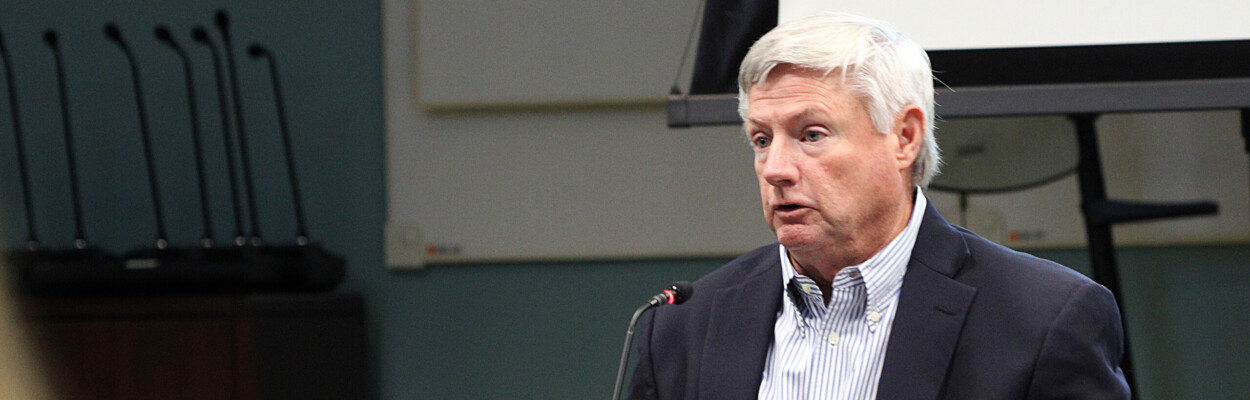
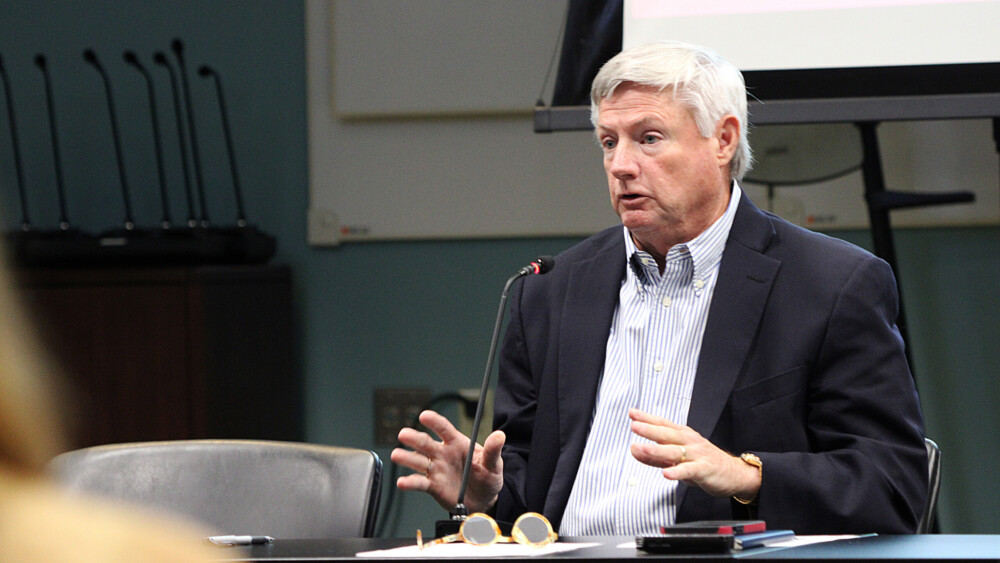
Jacksonville at-large Councilman Matt Carlucci speaks during a meeting he hosted Aug. 19, 2024, at City Hall to allow advocates of an affordable housing financing plan to explain it to council members. | Casmira Harrison, Jacksonville Today
Published on September 9, 2026 at 5:08 pm
Free local news and info, in your inbox at 6 a.m. M-F. Sign up for the Jacksonville Today newsletter.
Jacksonville City Council member Matt Carlucci says he’ll try to persuade his fellow lawmakers to revive $4.9 million stripped from the mayor’s proposed city budget for an affordable housing trust fund.
In a public meeting Tuesday at City Hall, Carlucci said he’s not asking council members to determine how the trust fund dollars are spent by the final budget vote Sept. 22. But he wants to make sure the money is available when the mayor’ office and council are ready to authorize new affordable housing programs.
Jacksonville Today thanks our sponsors. Become one.
Carlucci warns, with “tens of thousands” of Jacksonville homeowners and renters burdened by housing costs, more dedicated city funding is needed.
“What I’m asking for today is that we preserve the $4.9 million for affordable housing by putting it into an Affordable Housing Trust Fund,” Carlucci said during the meeting. “ The council can come back then at the appropriate time and look carefully at our housing needs and determine exactly how those dollars can do the most good.”
Carlucci says he’ll introduce his affordable housing trust in two weeks on the council’s budget night.


Jacksonville Today thanks our sponsors. Become one.
Affordable housing a policy priority?
In August, the council’s Finance Committee decided to pull the $4.9 million from Mayor Donna Deegan’s proposed $2 billion city operating budget, as it tried to limit new spending to prepare for a possible $300 million annual revenue loss if a statewide property tax cut referendum passes in November.
It was Deegan’s second effort to capitalize a permanent fund to make for-sale, owner-occupied housing more attainable for low-income Jacksonville families.
The money would have gone to three different programs — a down payment assistance home-ownership program; developer subsidies to build attainable housing; and assistance for low-income homeowners to cover fees for connecting homes to JEA utilities.
The city has these programs funded and active today.
But city officials say the programs that would pull from the trust fund could benefit households with up to 120% of the area median income — a higher wage cap than existing city-backed housing assistance programs.
Carlucci says those are all programs council could consider, if it reinstates the funding.
There is also more demand than current programs can handle, says Joshua Hicks, the city’s affordable housing director.
“Those are our teachers, our nurses, our police officers, our firefighters, especially when they’re first getting started in their career — before they’ve gotten raises and worked up their salaries, ” Hicks said Tuesday. “Being able to get them into homeownership opportunities will free up the rental market, so that we can get more people into renting and then more of them into homeownership in the future.”
According to Hicks, to meet housing demand, Jacksonville needs another 47,000 units available for renters making 50% of the area medium income or less.
Appearing on WJCT 89.9 FM’s First Coast Connect on Wednesday, Deegan praised the budget hearings overall as less contentious than last year. But she was critical of the committee’s decision to strike the affordable housing dollars.
“If we can’t do everything, we shouldn’t do anything. That’s the argument I heard from the Finance Committee. Well we would get a whole lot done in the city of Jacksonville,” Deegan said.
The committee put the money budgeted for the housing trust into a public safety contingency account that currently sits at about $23.4 million.
Finance Committee Chair Will Lahnen wants to get that account to $26 million to pay for three capital projects requested by the Jacksonville Sheriff’s Office. Those projects include buying down JSO’s building lease balance at its new headquarters location in the Florida Blue tower in Brooklyn and $10 million to consolidate its warehouse space into one facility.
Funding for other programs was held back in a contingency fund in case Amendment 3, the property tax referendum, passes.
“Housing has become top of mind for people,” Deegan said. “When we have these discussions about Amendment 3, people have real concerns about how much the cost of housing is affecting their lives. And we understand that. We want to make affordability better for people. And this is one of the ways we can do that, at least in a piecemeal way and build it up.”
According to city officials, 90,000 renters in Jacksonville spend more than 30% of their income on housing, a level economists consider housing cost burdened. More than 42,000 of those households spend more than half of what they earn to obtain housing.
Council member Jimmy Pelsuo said Tuesday that, although he supports Carlucci’s amendment, he doesn’t think $4.9 million will be enough.
Deegan’s pitch of the trust fund was a compromise with affordable housing advocates who were pressing her earlier this year to budget $10 million for the initiative.
Carlucci’s appeal to the full council to finance the trust fund could be a heavy lift. The Finance Committee voted 7-1 to remove the funding with council President Nick Howland casting the seventh vote. The only Democrat on the committee, council member Rhaman Johnson, voted to retain the $4.9 million.
According to the City Council auditor, it would take approval from a majority of the council present on budget night to restore the affordable housing trust dollars. If all 19 members are present, it would take at least 10 votes.
Lahnen and Howland maintain that affordable housing is a council priority. Council’s recent policy has been to provide low-interest development loans for individual housing projects.
“The affordable housing trust is a great example of sticking to our guidance of nothing new (in this year’s budget). Although it was lumped together in the budget as a single item called affordable housing trust, it was three separate line items, none of which were new, and items that have repeatedly not been put into the budget by the Finance Committee,” Lahnen said.
Jax affordable housing record
If Carlucci is successful, this would be the second consecutive year that he salvaged affordable housing dollars removed from Deegan’s proposed budget .
Last year, his budget-night push revived $900,000 of the $2 million the committee stripped from the mayor’s spending plan for a program to award financial assistance to developers building affordable housing projects.
Carlucci and Deegan’s efforts come weeks after the newly established Jacksonville Growth and Affordability Partnership Fund announced a $20 million fund to finance $80 million in affordable multifamily rental housing using private philanthropic and investor dollars.
The city receives state funding for affordable housing programs, but the city has not always been quick to get that money out the door.
According to a report in May by the Florida Times-Union, the Florida State Housing Initiatives Partnership program — commonly called SHIP — provided $28.5 million to Jacksonville over a three-year period since Deegan took office in July 2023. About $13.4 million of that funding remains unallocated by the city, the report states.