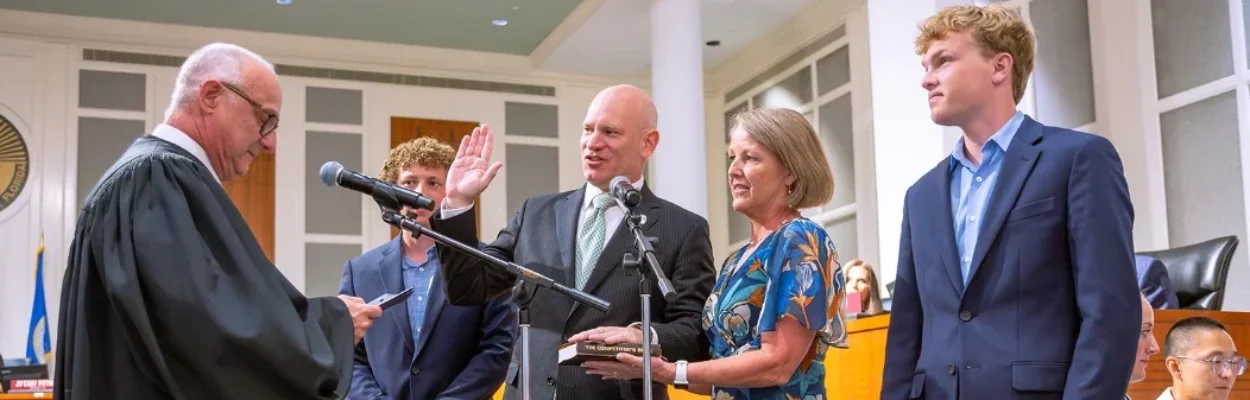
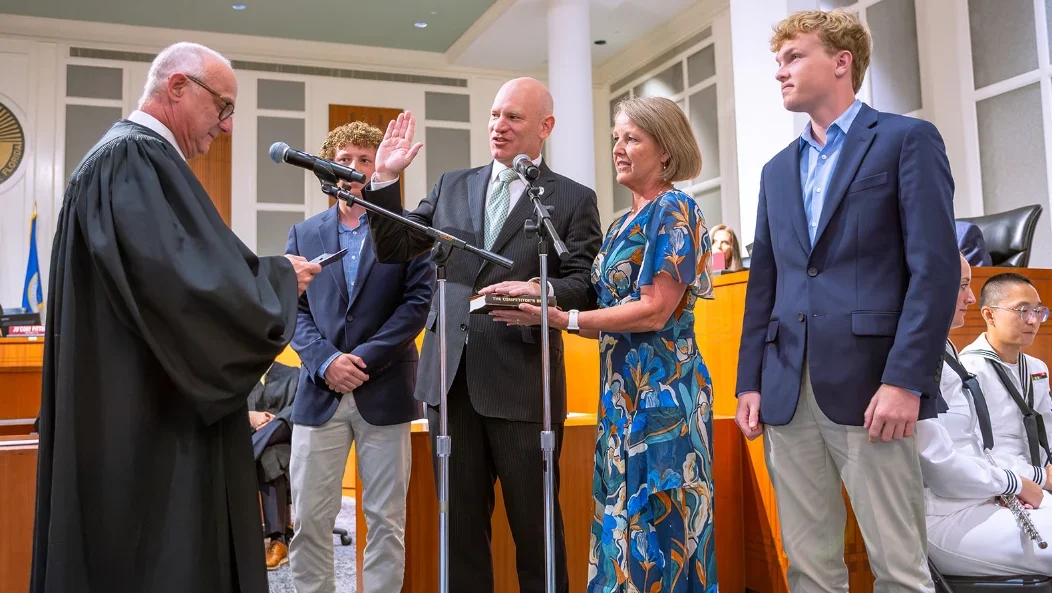
Jacksonville City Council President Nick Howland takes the oath of office June 26, 2026, during an installation ceremony at City Hall. | City of Jacksonville
Published on July 13, 2026 at 5:30 pm
Free local news and info, in your inbox at 6 a.m. M-F. Sign up for the Jacksonville Today newsletter.
Next week, Jacksonville City Council member Nick Howland will gavel in his first meeting as the council’s president to hear Mayor Donna Deegan’s annual budget address.
Howland wants to hit the reset button on the council’s relationship with the mayor’s office after contentious budget hearings last year put its Republican leadership at odds with Deegan on core issues — a cut to the city’s property tax millage rate, funding for her telehealth program for uninsured residents and affordable housing dollars.
Jacksonville Today thanks our sponsors. Become one.
In a 45-minute interview July 2 with Jacksonville Today, the Republican council president said his relationship with the Democratic mayor is “strong.” But he’s already setting the stage for more cuts in this year’s budget.
Deegan has teased a “lean budget” with infrastructure as the top spending priority.
Howland spoke about what it will mean for the city to have less money to spend if voters approve a referendum in November to reduce property taxes — a plan he supports. He said he doesn’t want to wait until 2027 to start scaling back city spending.

Jacksonville Today thanks our sponsors. Become one.
After public safety funding is set, he’s instructing the council’s Finance Committee with ending the hearings in August with a spending plan that comes in less than last year.
The following interview has been edited for clarity, brevity and context:
Q: I wanted to start with a quote from your June 25 installation speech. You said:
“Not long ago, we had neglected downtown. There were drainage problems, deteriorating sidewalks and a riverfront not living up to its potential. All of that is changing. Jacksonville is building again.”
Some of that building started under (former Mayor Lenny) Curry and the former City Council and continued under Deegan and this (City) Council. What do you attribute that momentum to? And what do you think the City Council needs to do to keep that going?
A: I think that momentum is attributable to joint investment by the previous administration, this administration and City Council. We have had good years financially for the city and were investing in infrastructure. And I mentioned building again, but I said also renovating.
It’s important to note that while the headlines cover a lot of the Downtown development, we’re building new bridges over McCoys Creek. We’re fixing drainage problems all over the city. We’re widening roads. We’re improving sidewalks. And all that is just as important, if not more so, than Downtown development. But what everybody sees when they drive over the Main Street Bridge are cranes to the east, to the west, on the Northbank, on the Southbank. And there’s no signs of slowing down.
You’ve seen the Jaguars headquarters go up. You’ve seen the Four Seasons is almost complete. The stadium (renovation) is on track. The Pearl (Square) district is already underway and Brooklyn is fully developed. So, we’re seeing a lot of what were previously renderings now coming to fruition for the citizens of Jacksonville. You’re seeing it now in the parks as well.
Q: A lot of what you were mentioning, particularly with the bridges and sidewalks, is direct public investment in public infrastructure. In your speech you said you hope the voters approve (the property tax referendum). What does that investment look like moving forward if that passes in an environment where there’s a reduced level of property tax revenue?
A: It means fewer dollars out of our operating funds to support Downtown development and infrastructure development. We’ve relied on debt to support a lot of our capital infrastructure investment. But frequently, we do cash grants — either headquarters relocation grants for companies moving here or more commonly completion grants for new developments — as a way to incentivize those developments.
We’ve done that for many Brooklyn entities. We’ve done that for the stadium. We’ve done that for a number of Downtown infill investments. What we are likely facing if that referendum passes is fewer dollars to do just that.
We’ve often thought about three ways to incentivize developers to build Downtown. Completion grants, which are cash grants out of the operating reserves; low-interest rate loans; or REV (Recapture Enhanced Value) Grants, which are tax rebates on future taxes. We have been shifting these developers away from cash completion grants towards low interest rate loans and REV grants. But now we’re starting to see a rash of proposals for completion grants, which are going to be very difficult to fulfill if the referendum passes and we don’t have the dollars. So I have said we don’t just have to look at three options.
I reject the notion that there’s only three. Could we take equity positions in some of these developments Downtown? That’s been done in other cities around the country. But probably more realistically, could we find another way to help those developers make their business cases pencil by what I’m calling third-party development incentive funding. Instead of the city making cash completion grants out of its operating reserves, maybe third parties could make it for us.
The property tax referendum in November is targeting the homestead exemption for residential millage rate tax. It doesn’t touch commercial property tax or a manufacturer or distributor’s property plant equipment. So, the city can pull that financial lever. Could we give them a discount on their future commercial property or property plant and equipment tax in return for helping us pay the completion grant now? And I propose a scenario in my installation speech along those lines.
Q: Is there a model for that? Are there other cities around the country that are doing something like that?
A: Not that we’ve been able to find. City Council Research has been looking for some, and I’ve had many business leaders in town also looking for some. And the devil here is in the details. Legally, we could find it may not work. But we’re certainly going to try. Because in the face of declining property taxes from residential collections, we’re not going to have the cash to do a lot of these grants, and we don’t want development to slow down Downtown.
Q: What do officials in the city Downtown Investment Authority and Office of Economic Development say about this proposal?
A: I talked to OED. I’ve not talked to the DIA. I talked to certain members of DIA about it. Generally, I’ve been talking with Jax Chamber, the Civic Council and many individual business leaders who all think it’s a pretty fantastic idea. Now, there are limitations to it. For example, Budweiser is a large contributor of property plan equipment taxes to the city, Jacksonville. But Budweiser is owned by a public company trade-on stock exchanges. They’re not going to be interested in financing this vehicle. A local company like Swisher, who also is a large payer because of their property plant and equipment to manufacture cigars, could be a contributor. So the universe of folks who could contribute is relatively small. But it’s not tiny. There’s all sorts of options to explore.
We could literally set up a fund to do it. Several companies could contribute to a fund to pay those completion grants. For example, say 10 companies contributed $10 million each. So, it was a $100 million fund and we chose to do a $50 million completion grant. That would then trigger on the back end some partial tax discount off their tangible commercial property or property plant equipment tax.
Q: Would this fund be for a few targeted projects you know are going to be asking for completion grants? Or do you see this as a permanent model for city incentives?
A: I think it could be a permanent model. It’s a new financial instrument that we don’t think has been used before nationwide, which means we’re out on a limb here exploring it. But again, when you’re facing the possibility of $300 million less collections when you’re a little over $2 billion operating fund, you’ve got to start thinking creatively. It’s not just focused on the core, fiscal conservatism, streamlining local government. You also have to get creative in how you spend money.
Q: You released memos in late June ending the City Council’s JEA Special Investigatory Committee and the Duval DOGE committee. You’re merging the two of them into a select committee. The JEA committee still has a final report it was planning to put out. Is that going to happen?
A: If the chair of DOGE wants to put out a report, call a working group to conclude it and finalize it, and issue it. They certainly are able to do so. But, as of July 1, we’re shifting the focus on JEA from investigation to oversight. DOGE separately has concluded the investigations it was looking at. That doesn’t mean there aren’t more things to review across the city. And the special investigatory committee has three open items.
But they’ve figured out how to address two of them. One of them — the toxic environment — that’s being addressed through a council-led independent study and a JEA board-led independent study. And council passed the money for the council-led (JEA employee survey). It’s the JEA board’s job to do personnel oversight. The second issue is the Ballad Partner’s lobbying contract. And that’s being investigated by the attorney general. So we can leave that in their hands.
The third really falls right along the lines of what City Council is responsible for, and that’s financial audit and oversight, not just of the city government, but of all the consolidated government. And that water capacity fee is still an open issue that the auditors are working on. The inspector general just put out a report on. But there’s still work to be done there, including trying to some degree assess how much lost value we’ve had. But to a larger degree, and what matters more to me, is how to charge the right capacity fees moving forward.
Why? Because there is a perception out there — whether it’s right or wrong, and it probably partly is right — if we’re not charging businesses and high volume users the right fees, the residents are suffering on the back end of them. And we just saw JEA increase its rates yesterday.
Q: What’s your final assessment of that (JEA investigative) committee? There was a lot of criticism that some of the process was overtly political.
A: Well, I think the establishment of the financial audit and oversight select committee kind of tones that rhetoric down a little bit and focuses counsel where it should be. And that’s on financial oversight.
I’m happy that we’ve done that with one memo. (The committee) also doesn’t have subpoena power. So that’s why I say it tones down the rhetoric and it takes the politics out of it a little bit. It’s just a council focus on what it should be doing, and that’s financial audit and oversight — says it in the name.
Q: Do you feel like the committee ended up being more of a distraction than it did resolving problems or shedding light on things?
A: If as a council we’re not bringing to light issues that merit investigation, we’re not doing our job. We represent the people of Jacksonville. So if the people of Jacksonville have concerns about any part of the consolidated government, it’s our responsibility to investigate those concerns. And looking at it, I think some of those personnel issues do belong with the board. For example, I’ve taken on (the Jacksonville Aviation Authority) on their budget and on their mission, wanting them to expand what they do to focus and accelerate their investment at Cecil Field.
But I’m not asking for any personnel changes. I’ve not made any allegations of their work environment. The board is in charge of personnel. That’s what the select committee reflects.
Q: What do you think your predecessor, former council President Kevin Carrico’s legacy is going to be as council president when you look back at the last year? How would you define the last year of City Council?
A: Well, I hope it’s a strong legacy, and I personally believe it will be. He led us through a contentious budget that emerged with a fantastic result. We got an ⅛-of-a-mill tax (city property) tax decrease, which provided some relief for Jacksonville families. We fully supported public safety. We delivered record investment in after-school child services. And the budget was balanced. So I think he delivered a great budget.
Along those lines, I think there were some other strong wins. I mentioned that he navigated several contentious rezoning issues. He also helped (a group of council members) pay down and budget out our completion grants over the five-year period. We are on a better financial footing at the end of this year than we were at the beginning of this year.
Q: But as far as the investigation by the State Attorney’s Office and the subpoena (of his records), what do you think that does to the City Council’s trust among the community?
A: There are definitely trust issues between the community and City Council, between the (mayor’s) administration and City Council. And I’d like to find a way to repair that. I think step one was restructuring how we’re working with JEA. That was important. Step two is my relationship with the mayor, which is strong. One thing I think you’ll find during this council year is I’d like to get this council working together as a team. I mentioned that during my installation speech.
I’d like contention and the discussion and the debate to focus on real issues, not personnel issues between two branches of government or between individuals and a branch of government.
It’s my hope that this year will be defined by common sense, collaborative and fiscally conservative leadership. And what I imagine the budget hearings will be is a discussion around what is the definition of core local services for government.
“I expect a fully, friendly and gentlemanly debate. We as Republicans contend nonprofit service A is a great service, but not a core role of local government. And in a time of fiscal uncertainty, we just can’t support funding it. Whereas the (mayor’s) administration, may say “We agree with you (that) it’s a great service, but we also think it’s a core role of government.” So there’s going to be a discussion on what core means of the city of Jacksonville.
Q: I want to ask you about nonprofit spending with that extra scrutiny that’s likely going to happen on the city budget. Clearly the city relies on nonprofits to do a lot of services that range from addressing homelessness to medical services, to veterans services.
A: Absolutely.
Q: What should the nonprofit community expect when they’re coming into this budget year?
A: Well, the nonprofit community understands this already. The local government has to support itself first before it has discretionary money to support nonprofit services And that basically means that if we’re not funding public safety, if we’re not funding core infrastructure and if we’re not funding essential government services like parks and trash pickup, then we’re not delivering for the people of Jacksonville.
We have to fund all of those first before we even consider some external nonprofit investment. And that even means sometimes homelessness and elder care and kids after-school reading programs. Those are all important. And to some degree, some of those should be at the core role of government. Some others shouldn’t.
That doesn’t mean anyone has a cold heart. It just means that people have a different perception of what their taxpayer dollar should be paying for. If property tax relief passes in November, people are going to have a lot of money left over in their wallets, which is so critically important when we have this very real affordability crisis.
But that means that they’re going to have more if they have discretionary income out of those savings to contribute to nonprofits that they like.
Q: Is there a number that you and the (Finance Committee chair) will be operating from? The council auditor has suggested roughly a $300 million (revenue loss). Is that the target?
A: We’re going to work our way there. If this property tax referendum passes, the City Council won’t see the effect of it until the year after my presidential year.
What I would like to do is start working that way to make it less difficult for the next council president. I’d like to deliver a budget in this upcoming budget hearings that’s less than the one we’re currently operating in. That magic number — right now our budget’s about $2 billion — after public safety is $832 million. So I’d like to deliver, if possible, a budget after public safety that’s under $832 million.
To do that, and if we can even start carving back some more, myself, (Council Finance Chair) Will Lahnen, (city Chief Administrative Officer) Mike Weinstein and the mayor have talked about the potential of creating a below-the-line contingency account.
For example, we can’t fully fund (the Kids Hope Alliance) — I think they’re at about $54 million right now — perhaps we could put some into the contingency account and tie it to the referendum passage. If the referendum fails, that money gets funded back to KHA. If the referendum passes, that money doesn’t. It goes into the reserves to help next year’s amount.
And that means that certain nonprofits might have to start living much slimmer next year than they were this year.
Q: Let’s move on to the airport authority and Cecil Airport and Spaceport. Do you think it’s necessary to ramp up the speed at which you’re trying to get companies to expand and build at that facility
A: Yes. Because the aerospace and space market is at $400 billion right now. It’ll double to $800 billion by 2035. You can see that this year we’ll have 120 space launches from Cape Canaveral. Last year, 100. Four years ago, we had 20. The market is expanding fast. And one of the things about the aerospace and space market is Florida is starting to really dominate. My effort with Cecil is not just local City Councilman Nick Holland trying to get more investment at Cecil. It’s part of an overall space strategy that state leaders and federal leaders envision. And Cecil figures prominently in that statewide Florida space strategy.
If you’re launching rockets, every single time you land a rocket, you’ve got to go test that engine. There’s a cost to transporting (and) testing that engine, all the way back to, say, Stennis Space Center, Mississippi. If you have to ship parts for someone to maintain or test, if you’ve got to reassemble things, all of that has a huge cost of transportation, a huge cost of time, particularly with how quickly the space industry is expanding and launches are happening.
I think if (Jeff) Bezos gets Blue Origin up and running as fast as he’d like to, we’re talking about thousands of launches per year, because they have to put mini satellites up there, when you combine them with SpaceX. We need to start investing to attract companies now. And what I’d like to see is accelerated investment to attract companies. Obviously, it’s worked in the past. Boeing keeps expanding. Otto (Aviation) is moving here. We’re probably sitting at a little over 3,000 jobs at Cecil.
But just drive out there and see how fertile the ground is. There’s so much room for expansion at Cecil. There’s so much room to build what I call “Aerospace Logistics Town USA” out there. Retail, residential, supporting the growth of a working airport at Cecil Airport and Spaceport. I’ve had this discussion now going on three years this August. It started when I was finance chair 2023 at the budget hearings. And I noticed that when you compared months of cash on hand between the independent authorities,the Jacksonville Transportation Authority, JEA and the Jacksonville Port Authority, were all between three and six months of cash on hand. The airport had close to 24 months cash on hand. So I started asking how they could use that cash more productively. And along the way, I learned that there are revenue diversion laws implemented by the FAA for all airports across the nation. And the law is basically saying, you have to use any airport revenues generated on the airport for aviation use.
But that means that you can use airport revenues generated at the (Jacksonville) International Airport, at Herlong or Craig Field or Cecil — the four airports and the airport system operated by Jacksonville Aviation Board. So I started to look at ideas, learned what was permissible and not permissible by FAA law and focused on Cecil and investing the money so we can accelerate job growth and industry creation there.
I basically said to the JAA board, coming up into the August 2025 hearings two years later, I would like to see increased investment at Cecil and a plan for how to grow economic development there and create an aerospace industry hub. Well, I didn’t really get it. Yes, they said we’ve done lots of Cecil, and there has been a lot done at Cecil. But when they presented their budget, there was more investment at Craig Field, more capital investment than there was at Cecil airport. And there was zero that year for Cecil Spaceport. So we went ahead and implemented some budget moves to put more investment into their budget for Cecil Field.
(Jacksonville Today’s conversation with Howland happened before the Jacksonville Aviation Authority announced that it’s considering a lawsuit against the city for what it calls the council’s effort to unlawfully divert federal airport dollars in its budget. Howland acknowledged strain between himself and airport leaders that led to a complaint to the Federal Aviation Administration.)
Q: There was some recent news coverage highlighting the Federal Aviation Administration’s concern (in emails) about some (policy) threats (you allegedly made to JAA leadership). You can address that, but is there a differing opinion between yourself and the JAA administrators and how to use and invest that extra capital at Cecil?
A: Yes.
Q: And how do you get past that?
A: I think they need to understand the local and political will is on my side. So let me keep going on what I was saying. We’ve done basically two things. We took budget actions in that August 2025 hearing, putting money into investing in the spaceport, putting money and investing in the airport, and putting money into — because I didn’t get a strategic plan for Cecil — hiring a consultant to create an economic development plan with Cecil Field.
The (J-bill) law also requires that they present an economic development plan to (City) Council concurrent with the budget. And that is in there because when I asked for it last year, they didn’t provide it. So we’ll see what their plan looks like this year. I would like to see someone at the airport wake up every day thinking about how they can bring companies to Cecil. Flying to aerospace conferences and trying to sell Cecil Field. Understanding which airspace companies are winning certain contracts and will need capacity expansion and offering opportunities for them to come to Cecil Field. In other words, find another Boeing that’s doing maintenance repair and overhaul on FA-18s and and P8s. Maybe Raytheon is doing it on spacecraft? Maybe Lockheed Martin is doing it on another jet? Go to SpaceX and say, how can we help you? What suppliers can you help us bring to Cecil Field to be closer to you to help support your growth and launches? Do the same at Blue Origin. They’re not doing that right now.
Q: I see you’re still going to be the liaison to the airport authority in the coming year. As they move forward with that strategy, are you going to continue to push them during those meetings?
A: Well, I’m getting mixed messaging from the airport. The board keeps telling me they’re really interested in this vision and seeing it through, but, for example, I’m seeing the CEO and their chief strategy officer go to the FAA and submit complaints about me, and then an FAA letter comes out. That’s why I’m sticking around. I think (Cecil) is one of the greatest growth opportunities this city has ever had. And the market is moving fast. So if we don’t act with urgency, we’re going to miss the market, and that would be an awful shame for thousands of Jacksonville families that could be supported by wonderful job growth at Cecil Airport and Spaceport.
Q: Every council president always has those one or two big ticket issues that come their way. For Scott Wilson it was the JEA sale attempt. Tommy Hazuri was Lot J. Do you think the pending property tax cut will be yours?
A: Oh, for sure right now. But we don’t know what to expect. The right thing is to just be prepared for the unknown. But we need to prepare for property tax relief going either way. And that’s an important thing for my council. It’s an important reason why I structured my committees the way I did. And I think we’re ready for anything that gets thrown our way.