
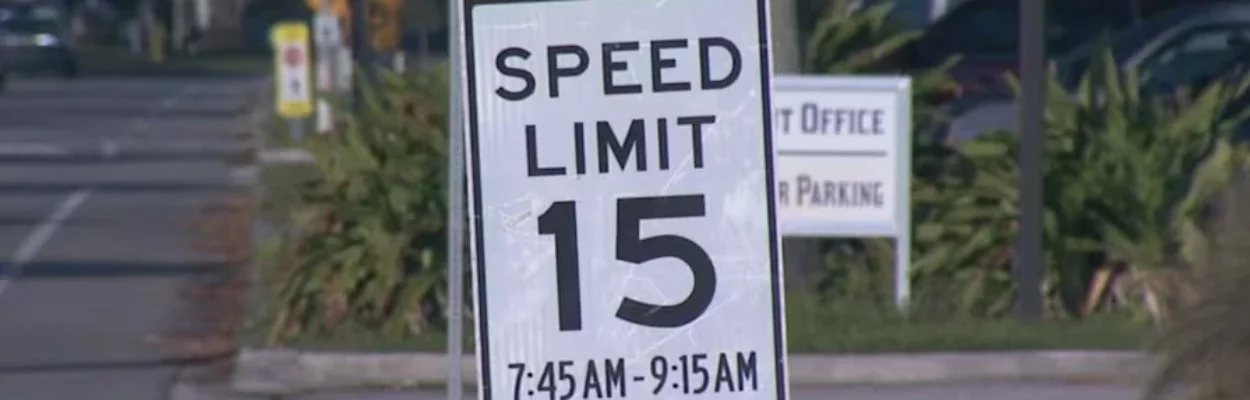
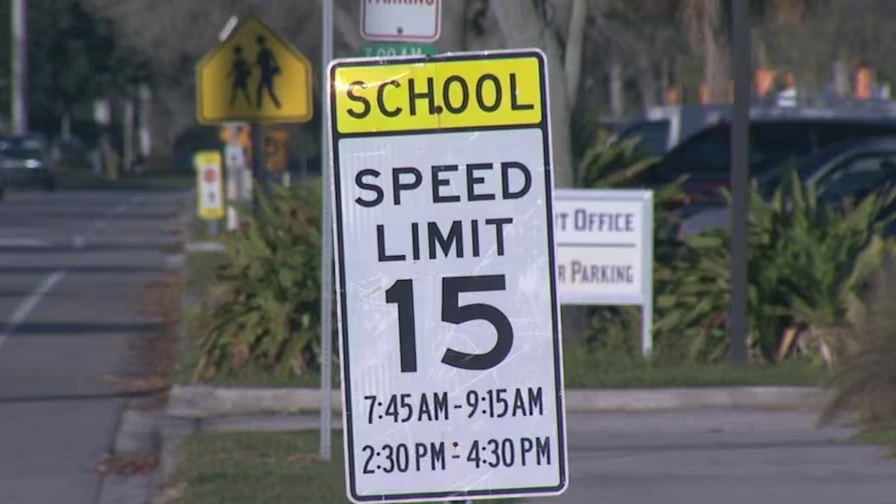
A sign shows the speed limit in the school zone at Neptune Beach Elementary School. | News4Jax
Published on September 2, 2026 at 3:50 pm
Free local news and info, in your inbox at 6 a.m. M-F. Sign up for the Jacksonville Today newsletter.
The Neptune Beach Police Department has ended a program using cameras to monitor drivers’ speed in school zones.
Chief Michael J. Key Jr. says the decision follows a review of public feedback, recent legal developments — including those related to license plate reader technology — and an evaluation of the program’s overall operational data.
Jacksonville Today thanks our sponsors. Become one.
The department had previously announced the removal of license plate readers like Flock cameras along its roadways, and the latest move is an extension of that effort.
“Our commitment to school zone safety remains our top priority,” Key said. “We will continue to emphasize high-visibility, active traffic enforcement and community education in and around school zones to help ensure the protection of our students.”
Shift away from license plate readers
Neptune Beach’s decision is part of a broader movement across Florida to discontinue the use of license plate reader technology like Flock cameras. The Florida Department of Transportation recently revoked permits and licenses it had issued to law enforcement agencies to use the cameras on state roads.

Jacksonville Today thanks our sponsors. Become one.
FDOT cited an “exponential increase” in Flock cameras across Florida roadways, public outcry and “concerning reports of misuse, data privacy concerns and surveillance schemes” as reasons for taking what the department called “immediate action to preserve Floridians’ sovereignty and quality of life.”
The Jacksonville Sheriff’s Office announced it will halt Flock camera use throughout Duval County.
How Neptune Beach cameras worked
The automated speed cameras were placed at two Neptune Beach schools — Beaches Chapel School and Neptune Beach Elementary School — with cameras monitoring eastbound and westbound lanes along Florida Boulevard at each location. The cameras operated only during school hours, when children were traveling to and from school, as indicated by flashing lights in the school zone.
Cameras measured the speed of each passing vehicle, recording video, photographs, the date, time, location, speed and license plate of any vehicle at or above the enforcement threshold.
Citations were issued only to drivers going 11 mph or more over the speed limit. In a 15 mph school zone, a citation wouldn’t be triggered unless a driver was going at least 26 mph.
Every citation was reviewed and approved by a Neptune Beach officer before being mailed to the registered vehicle owner. The citation included violation photos, recorded speed and instructions for contesting or paying the fine.
Fines, points, funding
The $100 fine was set by state law — significantly lower than the typical doubled school zone speeding fine of $200 to $300. Importantly, the violations carried zero points on a driver’s record, meaning no effect on insurance rates.
The department said fines covered all operating costs of the program. The city of Neptune Beach owed nothing even if the program ran at a deficit.
This story was produced by News4Jax, a Jacksonville Today news partner.