

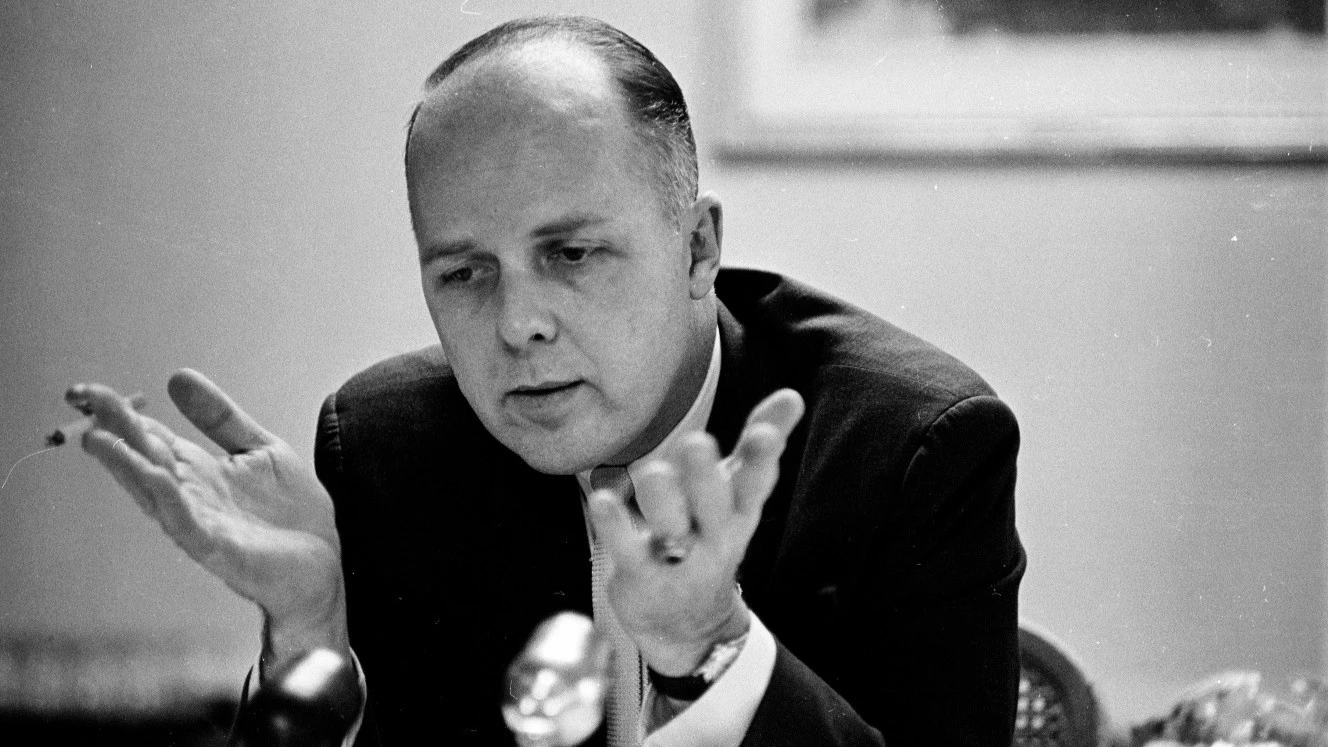
Joseph Mitchell, city manager of Newburgh, New York, gives a talk to the University of Wisconsin Conservation Club about reducing federal and state welfare benefits on Nov. 17, 1961. | Wisconsin Historical Society; Richard Stroda creator; W013E39
Published on July 29, 2026 at 4:10 pm
Free local news and info, in your inbox at 6 a.m. M-F. Sign up for the Jacksonville Today newsletter.
In a 1962 NBC documentary about the city of Newburgh, New York, City Manager Joseph Mitchell attributes the spread of sexually transmitted diseases to a public assistance program that’s too generous.
“We challenge the right of a welfare program to contribute to the rise of social diseases among children and adults. We’ve had social diseases in the slum section of our city among 12-year-olds and 76-year-olds,” Mitchell said. He went on to crack a joke to the seated crowd. “As our funniest councilman Bill Dulan said about the 76-year-old, he said, ‘You’re never safe.’”
Jacksonville Today thanks our sponsors. Become one.
Mitchell was a leader in what became known as the Battle of Newburgh. His ultimate goal was to shrink welfare to avoid increasing taxes, and his strategies included stoking debate around worthiness, race and fraud.
Today, as the Trump administration pushes work requirements for housing benefits while proposing billions of dollars in cuts, researchers say they hear echoes of the Battle of Newburgh. Jacksonville is among the first housing authorities preparing for Trump’s changes.
An opening shot in Mitchell’s battle: Facing a decline in revenue after the end of World War II, Mitchell declared he was cutting almost $80,000 from public assistance to make up a budget shortfall caused by snow removal. It was either that or raise taxes, and the moneyed people of Newburgh knew what they preferred.



Jacksonville Today thanks our sponsors. Become one.
Mitchell went on to decree that every welfare recipient would need to collect checks in person in an effort to weed out “chiselers,” or cheats. The New York Times wrote that in May 1961 everyone “who could walk, including the aged, the blind and the disabled, hobbled to precinct houses to identify themselves and pick up their checks.”
They were fingerprinted and questioned about their closest relationships, hobbies and, of course, their jobs. The inspection was a bust: Not a single chiseler was identified. But Mitchell did succeed in creating a “painful and degrading” experience.
Mitchell, buoyed by 15,000 letters of support from across the country, nevertheless doubled down by unveiling 13 points he called “a new Welfare Plan.” Under the rules, every able-bodied man would need to have a job. But most people on welfare were elderly, disabled or children. That left 11% of recipients. Officials subsequently found only one unemployed able-bodied man out of 900 who could be put to work.
While liberals derided Mitchell, he was lauded by the Wall Street Journal and politicians like Barry Goldwater. But the state of New York released a report in 1962 saying Mitchell’s plan would be more expensive for Newburgh than not, and despite Mitchell’s cries that NBC needed to be investigated for its documentary, growing local backlash led to accusations that Mitchell accepted a $20,000 bribe in a zoning case.
Mitchell was acquitted of the bribery charge but resigned in 1963. He moved to Florida, where he managed both Cocoa Beach and Haines City. He died in Bunnell in 1993.
Evolution of welfare
Historians credit Mitchell with making welfare a “moralistic, racially coded, and taxpayer-oriented” national issue. His tone lived on in the policies of future presidents, including Ronald Reagan and Bill Clinton, who both oversaw cuts to welfare.
Today, the Trump administration is again suggesting sweeping changes in the form of work requirements for most housing aid. The Jacksonville Housing Authority has responded by tentatively adopting a 30 hour-per-week work requirement aimed at able-bodied adults receiving housing benefits.
Locally, officials have approved of what they consider a move toward self-sufficiency. National boosters say the restrictions reduce long-term dependency while protecting taxpayer dollars so they can flow to the truly needy
Fraud continues to be a talking point. But as Joseph Mitchell couldn’t find any chiselers back in the 1960’s, researchers continue to estimate that fraud among families receiving benefits is very low. Lisa Levenstein, professor at UNC Greensboro, said it’s always been convenient to vilify the poor.
“It’s an easy population to blame for problems that are actually much more complicated and require a much different kind of solution,” Levenstein said.
The fraud narrative became intertwined with racist fearmongering. Newburgh was a destination during the Great Migration, a period between 1910 and the 1970s when Black families looking to escape violence and discrimination moved South to North.
Families moved for better lives, Levenstein said, but people like Mitchell tapped into white anxiety by consistently associating Black families with welfare, a linking that persists today even though most people on food stamps are white.
“What’s so important about Newburgh and these cases in the ’60’s is they really solidify the association of welfare with Black people,” Levenstein said.
Elisa Minoff with the Center for the Study of Social Policy said resentment is also a factor in the continued beliefs around fraud.
“There are a lot of people who are struggling and need support and aren’t getting it in this country,” Minoff said. “Many of our programs, you can only access them if your income is very low, so it leads to a lot of concerns like, ‘Why are they getting it and not me?’”
Still, even among very low income people, many families won’t or can’t take advantage of programs. In 2022, only about 22% of families eligible for cash welfare received it.
Benefits for the wealthy
Disabusing people of myths and stereotypes is not always in the best interest of the wealthy, Minoff said. Today, the Trump administration is drawing on lessons like Newburgh that show adding red tape to any program is sure to save money because more hoops always means more people giving up.
Minoff pointed to last year’s “Big Beautiful Bill,” which added work requirements to Medicaid. Unlike Newburgh, politicians were much more straightforward about their goals.
“They were very clear they just wanted savings for tax cuts for the wealthy,” Minoff said.
Today, as housing agencies stare down a $10.7 billion cut to U.S. Department of Housing and Urban Development services, officials are again looking for ways to cut off assistance. Work requirements are politically popular: Even among left-leaning voters, six in 10 approve of some form of work requirement.
“A lot of people think work requirements are reasonable, even people on public assistance,” said Minoff. “Work is a deeply held value in this country. But the issue is the downward spiral that results in people losing assistance.”
Jacksonville’s work requirements for housing assistance will go into effect if a rule from HUD is finalized. The timeline for that is unclear.