
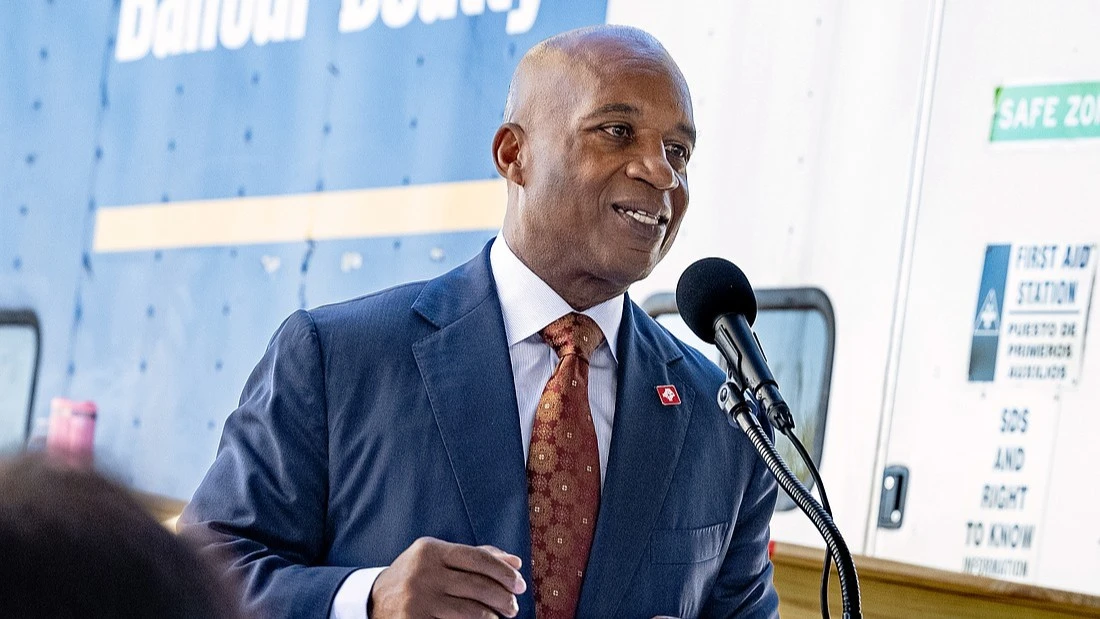
Jacksonville Transportation Authority CEO Nat Ford speaks at the topping-out ceremony for the U2C Autonomous Innovation Center near Broad and Water streets in LaVilla. | Jeffrey Leeser via Jacksonville Daily Record
Published on November 2, 2026 at 5:59 pm
Free local news and info, in your inbox at 6 a.m. M-F. Sign up for the Jacksonville Today newsletter.
The former CEO of the Jacksonville Transportation Authority will face questions from City Council members about the agency’s $40 million deficit but not until early next year.
City Council member Rory Diamond, who’s leading the effort to secure Ford’s testimony, says the former CEO has agreed to comply with a subpoena issued by city lawmakers in January. But a specific date when he’ll appear before the committee has not been set.
Jacksonville Today thanks our sponsors. Become one.
“I’ve been going back and forth with Mr. Ford about his appearance before the Finance Committee and expect that to happen in January,” Diamond told members of the council’s Financial Audit and Oversight Committee at a meeting Monday.
The announcement comes nearly two weeks after the council’s Finance Committee issued the subpoena to compel Ford to testify, as the city tries to piece together how and why, within two years, JTA went from a solvent agency with a budget surplus to recording the multimillion-dollar deficit.
The budget hole forced 200 layoffs, eliminating and scaling back some bus routes that went into effect Monday, and the need for a $30 million loan from the city to pay off a line of credit it used for past-due bills.
Jacksonville Today thanks our sponsors. Become one.
Ford is not in Jacksonville. He resigned his post in July and was later named CEO of the Dallas Area Rapid Transit. But he remained on JTA’s payroll as a consultant until Oct. 21 In the subpoena, the Finance Committee gave Ford the option to testify in person or virtually.
On Monday, the Oversight Committee heard from two of the transit agency’s last three chief financial officers — Greg Hayes and Heather Obora. The third — Raj Srinath, who was CFO from October 2023 to June 2025 — did not appear at the meeting.
Getting those CFOs to appear has been a priority for council members. Hayes said when his tenure from March 2017 to September 2023 ended, JTA had seen seven consecutive years of surplus with $187 million of cash on hand. He said there was a written board policy to keep 25% of its operating costs in reserves, and the board received quarterly financial reports.
He said toward the end of his tenure, costs for the Ultimate Urban Circulator autonomous vehicle program were starting to rise, and there was not a solid cost projection to build out all three phases. He said that project was a priority for Ford and, by extension, the agency.
Hayes said his time at JTA ended from “involuntary separation.” The committee asked Interim CEO Cleveland Ferguson, who was Hayes direct supervisor, why the former CFO was let go.
Ferguson said the CEO — who, at the time, was Ford — told him to let Hayes go. But when the committee asked him to give the reason, he declined out of concern from disclosing exempt information.
Obora was interim CFO for two weeks after Hayes’ departure. At that time, she said JTA’s financial situation appeared strong. When she was named CFO again in July 2025 after Srinath’s departure, she said JTA fiscal status was “a disaster.”
“The reserves had been depleted by over $20 million. Grants accounting was not doing any of the billing in a timely basis to federal and state funding agencies,” Obora said. “There was a third controller that had just started in June. He was trying to get his feet wet, and the finances were a mess.”
Obora said revenue could not cover rising costs for the on-demand paratransit service Connexion Plus. She also said JTA also did not include in the 2025 budget the $3 million in operating cost to run the NAVI autonomous vehicle shuttle service maintenance facility that had launched. And the cost to build the NAVI project had already jumped from about $44 million to $67.5 million, she said.
Wages and benefits were also under budgeted by nearly $7 million, she said. Obora had to bring a $14.2 million budget amendment to the JTA board in February 2026 to make up for the lack of revenue.
At the time, capital projects for IT infrastructure, safety and facility upgrades also had to stop because JTA did not have the cash flow to pay vendors, she said. According to Obora, the JTA’s capital projects fund had only $11,000 when she took the CFO job.
She also told council members that she had inherited a practice of not having true revenue projections from her predecessor, Srinath. Between her two turns as CFO, Obora worked as a procurement officer. She told council members on Monday that during that time in 2025, the CFO told her, “We’re going to be broke.”
“If any independent authority board member is listening here, and you’re not getting balance sheets on a monthly basis or … the base amount of cash you have on a monthly basis, send your CFO and your CEO back to the drawing board,” council President Nick Howland said. “Shut down the meeting and have them come back.”
Council members could issue a subpoena for Srinath. Oversight Committee Chair Chris Miller said he’d been in contact with Srinath, who appeared to be willing to answer council members’ questions.
According to Miller, Srinath’s attorney contacted him over the weekend. Miller said nothing in the conversation made him think the former CFO would not appear Monday.
By city code, the Finance Committee of full City Council would have to vote on issuing the subpoena before it can be served.
Strain within JTA
Howland ordered the formation of the select committee in September and has received bipartisan support, including from Mayor Donna Deegan. The Finance Committee issued the subpoena because the select committee does not have the legal authority in city code to compel testimony.
Ferguson said last week that the revolving door in the transit agency’s CFO office — three in the last three years — made it difficult to establish a strategy and clear picture of JTA’s finances.
Last week, Ferguson announced he would not seek the permanent CEO position after board member Daniel Vallencourt issued an open letter saying he lacked trust in the senior leadership team members under Ford who remain at JTA.
But during a speech at the board meeting, Ferguson — who has enjoyed support from council members and others on the JTA board since Ford’s departure — detailed a picture of overly optimistic revenue goals at the agency. He said there was a focus on quickly legacy projects like its autonomous vehicle program against the advice of senior executives.