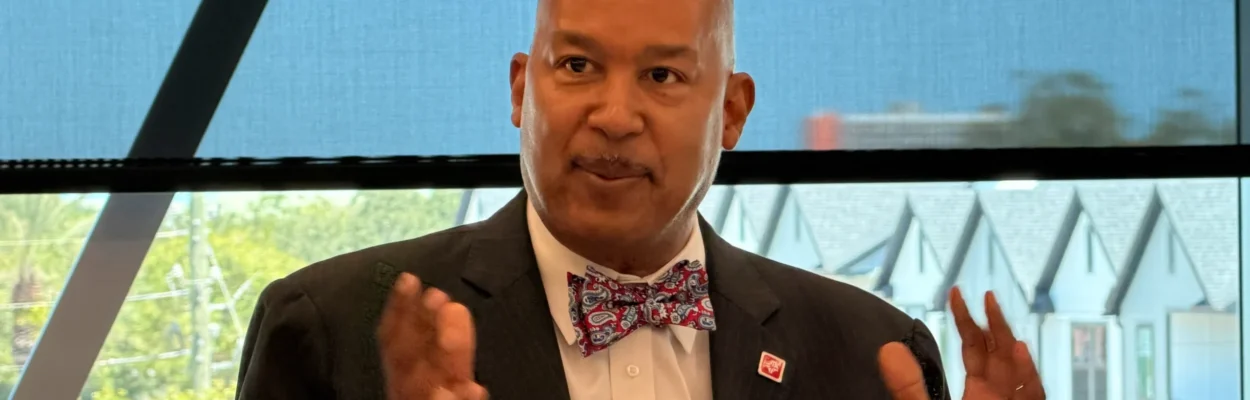
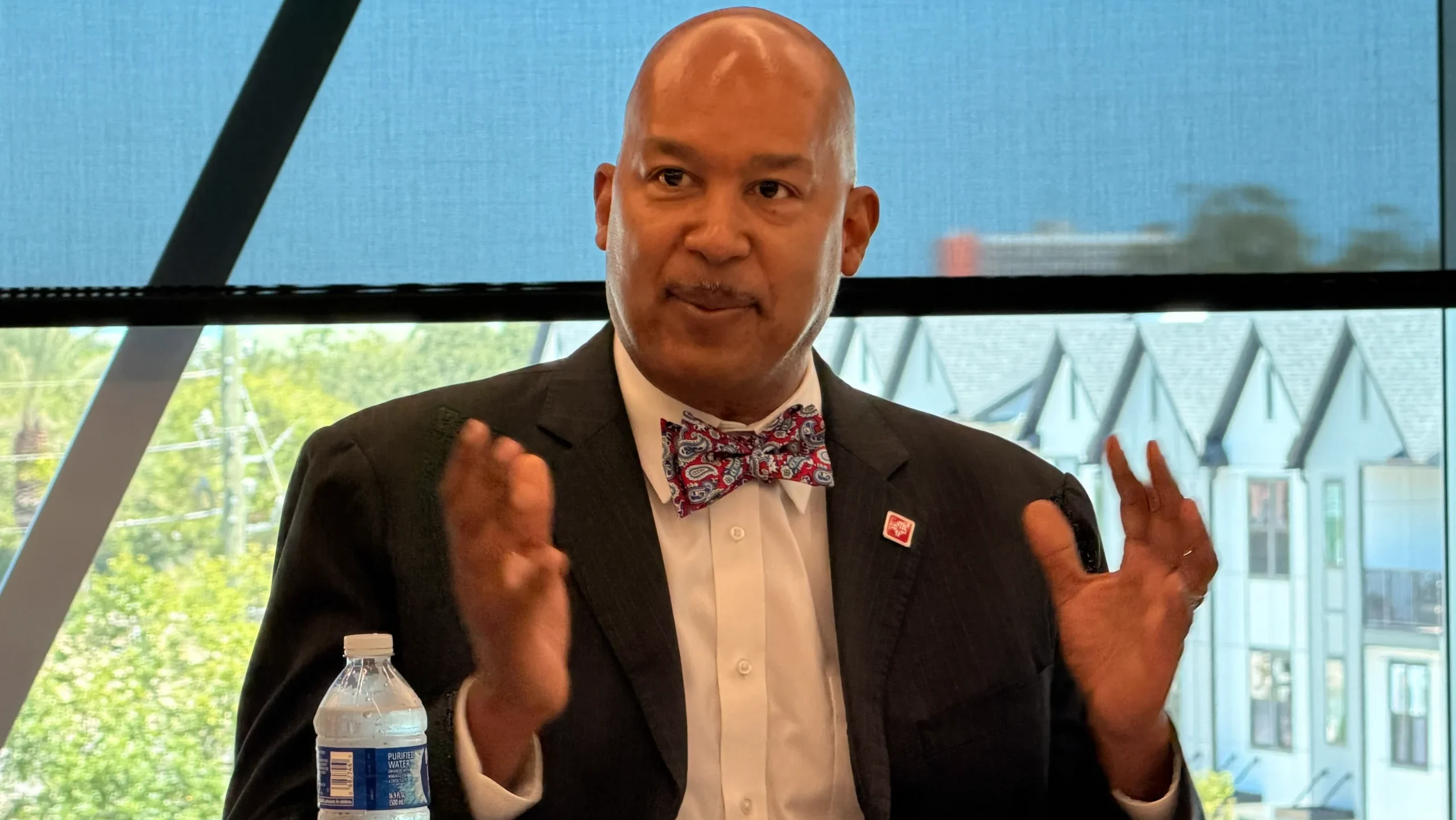
JTA Interim CEO Cleveland Ferguson III speaks to news reporters Thursday, Sept. 17, 2026, at the transit agency's headquarters in LaVilla. | Mike Mendenhall, Jacksonville Today
Published on October 29, 2026 at 5:40 pm
Free local news and info, in your inbox at 6 a.m. M-F. Sign up for the Jacksonville Today newsletter.
Jacksonville Transportation Authority Interim CEO Cleveland Ferguson III made it clear Wednesday whom he holds responsible for the decisions that led to JTA’s $39 million budget shortfall.
“Chapter 349 of the Florida statute has one employee in the statute — the executive director. And everyone else works for the executive director. And the only employee of the board is the executive director,” Ferguson said during the JTA board meeting. “So God bless me. I’m accountable for everything that has happened on my watch from Aug. 27, 2026. But God bless us all, from December of 2012, the buck stopped with the CEO of this agency. All the way through to Aug. 27, 2026.”
Jacksonville Today thanks our sponsors. Become one.
During a 23-minute oration Ferguson called “off script,” he didn’t name his former JTA CEO, Nat Ford. But Ferguson tried to answer some questions about how the decisions made over the last two to three years led to the agency’s financial decline.
Ferguson painted a picture of a rush to put JTA’s autonomous vehicle program NAVI into service and push to extend the Downtown Skyway’s life cycle beyond what was workable against senior executives’ recommendations.
“In public transportation it is sometimes said that you are only as good as your last rush hour. And there are those who believe that that’s not visionary. That it is better to do the kinds of things that give the ribbons to be cut, and to build legacy,” Ferguson said. “But the core of what we do for the 1.3 million, 87% of our riders depend on the JTA to get to those places. That is what made me stay. And to me, that is the crux of service, the crux of leadership.
Jacksonville Today thanks our sponsors. Become one.
“So as you all go through your analysis and so forth, this is a masterclass in leadership, a masterclass in community, a master class in accountability and a master class in not running away from the hard work,” he said.
Ferguson said grants expected to true-up budget holes never materialized, and a revolving door at JTA chief financial officer position — three CFOs in three years — all led to the agency’s current situation.
“We were entering our third CEO in as many years and as many controllers in as many years. With that turnover occurring throughout the finance department, that instability made it difficult to establish a clear, consistent and reliable picture of our finances,” Ferguson said.
The interim CEO began his speech Wednesday by announcing his withdrawal from consideration for the permanent CEO position. He said the decision was so he could focus on rightsizing the agency, where he’s worked for more than 11 years.
Ferguson’s decision came less than two days after JTA board member Daniel Vallencourt, in an open letter, called on Ferguson and two of the agency otter top executives who served under Ford to resign. In the letter, Vallencourt also took some blame for the fiscal crisis for falling short on his oversight duties as a board member.
Ferguson says he intends to remain at JTA at least until the board can appoint a permanent CEO. He defended what he and his senior leadership team have done to stabilize JTA since he took over as interim CEO in July.
Wednesday’s meeting was the first time JTA’s board of directors has met since the Jacksonville City Council Audit and Financial Oversight Select Committee began holding hearings to examine what brought JTA to its $39 million deficit, and since city lawmakers issued a subpoena to compel Ford to testify.
Ford, who started his new job this week as CEO of Dallas Area Rapid Transit, has been defending his record, according to the Dallas Morning News. That defense includes criticism of overseas travel he and JTA senior leaders took while pulling millions from the agency’s reserves to cover expenses.
Although he left his position in September, Ford’s employment contract with JTA had him remaining on the payroll in an advisory role at his annual $475,950 salary through his official end date of Oct. 21.
But Ferguson said Wednesday that the JTA board chair and the city’s general counsel informed him when he assured the interim CEO role on Aug. 27 that Ford was “asked to take a step back and allow me to lead.”
“That allowed us to begin the work of stabilization immediately rather than waiting until Oct. 21,” Ferguson said. “Since then my focus has been straightforward — put this agency on a firmer, financial, and operational footing while keeping employees focused on safely transporting our customers and communicating clearly with the people who depend on us.”
In a report from current CFO Randall Barnes — who along with Ferguson has received praise from council and JTA board members for their actions over the last two months — the agency shows a deficit in nearly all its expense and revenue categories in 2026.
The biggest deficits are in JTA’s services and labor costs, and less money than budgeted came in from local option gas tax nontransportation revenue, and federal state and local grants.
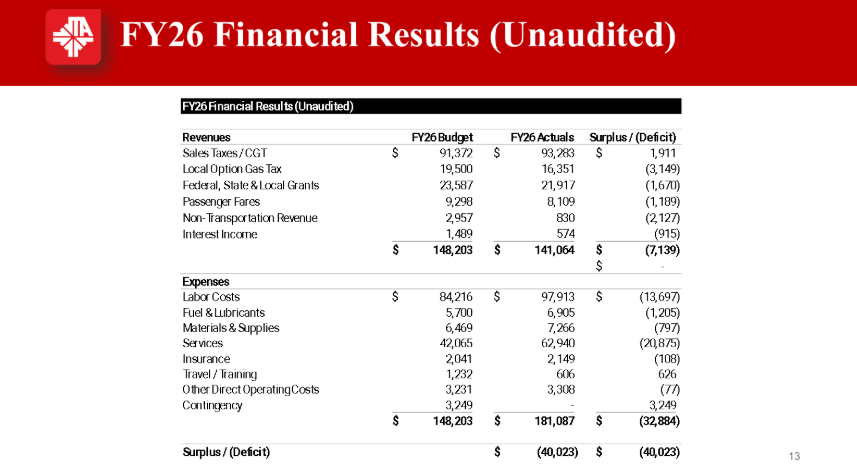
“I’ve got some choice four letter words that I can’t use in public. But the one word I will use is pissed,” JTA Board Chair Aundra Wallace said. “See actual numbers and you not getting that information is what has pissed me off.”
City leaders have allowed JTA to access an interest free $30 million loan from local option gas tax revenue to help pay off a line of credit it used to pay its debts.
On top of 200 layoffs announced in September, JTA has cut nearly $24.9 million in contracts in addition to bus route changes and cuts and suspension of the NAVI and Skyway services, according to Barnes.
That leaves the agency with a budget for fiscal year 2027 of $139.3 million.
NAVI and Skyway warnings
On Wednesday, the JTA board voted unanimously to approve its plan to pause the Downtown Skyway and NAVI autonomous vehicle service as part of its austerity plans.
The agency has worked for years to get its estimated $500 million to $600 million autonomous vehicle plan, the Ultimate Urban Circulator, to replace the Skyway on the road. About $247 million of that was expected to come from gas tax revenue approved by council in 2021.
JTA has always been hesitant to halt Skyway service in fear it would have to repay federal grant money used to build the system in the 1980s.
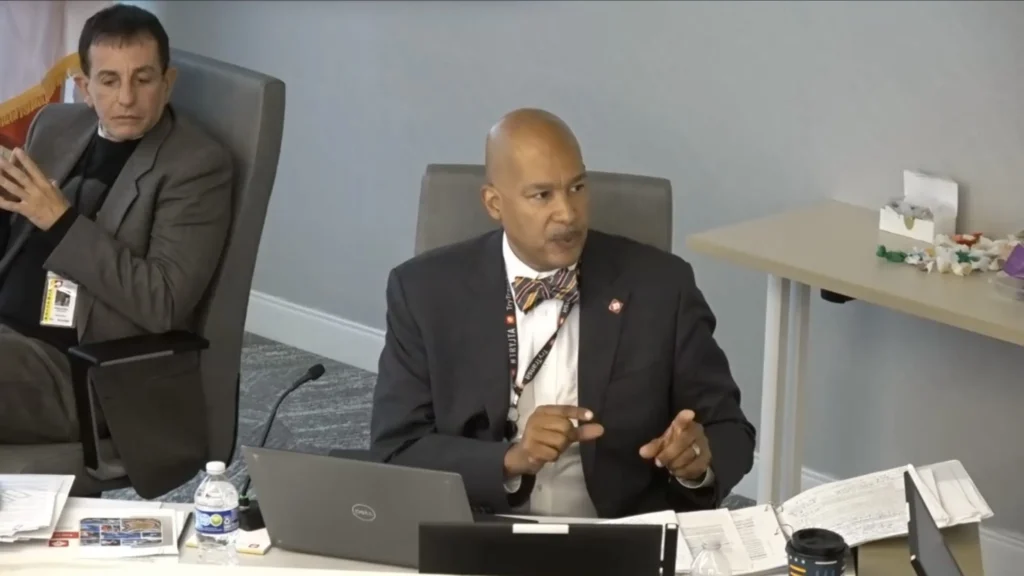
Ferguson said JTA employees were pushed to extend the Skyway’s life despite recommendations from some senior leaders not to.
“We are using our ingenuity with the private sector to manufacture parts to make sure that they’re safe and that we can deliver the system, but at a certain point, you just can’t do it,” Ferguson said.
Ferguson highlights a similar attitude toward the NAVI autonomous vehicle systems. JTA is supposed to put autonomous vehicles from the German company Holon into service as part of the U2C.
But there have been delays in the company breaking ground on its $100 million Jacksonville manufacturing facility.
Ferguson said decision-makers did not follow the executive leadership team’s recommendation to wait for the private sector to “catch up with what we were doing” with autonomous vehicles to fulfill the project’s original design pitched to secure a federal grant — a U.S. Department of Transportation Better Utilizing Investments to Leverage Development Grant, known as BUILD.
“It wasn’t supposed to be just public (dollars). Private investment needed to occur in order for this to work,” he said.
Ferguson said leaders at JTA felt working with the private sector would have persuaded federal regulators to change the laws necessary to get JTA’s permanent choice for autonomous vehicles on the street.
“But instead, we leaned in on our innovation and our know-how and found a retrofitting manufacturer to produce something by what I would consider an artificial deadline in order to meet a mandate. Again, over the objections of this leadership team,” Fergson said.
Audit search
On top of the active investigations by council and the State Attorney General’s Office, the JTA board also plans to have an outside auditor examine the agency’s governance and financial issues.
It also voted unanimously Wednesday to approve a process to procure an independent financial assessment, governance review and financial recovery consulting firm.