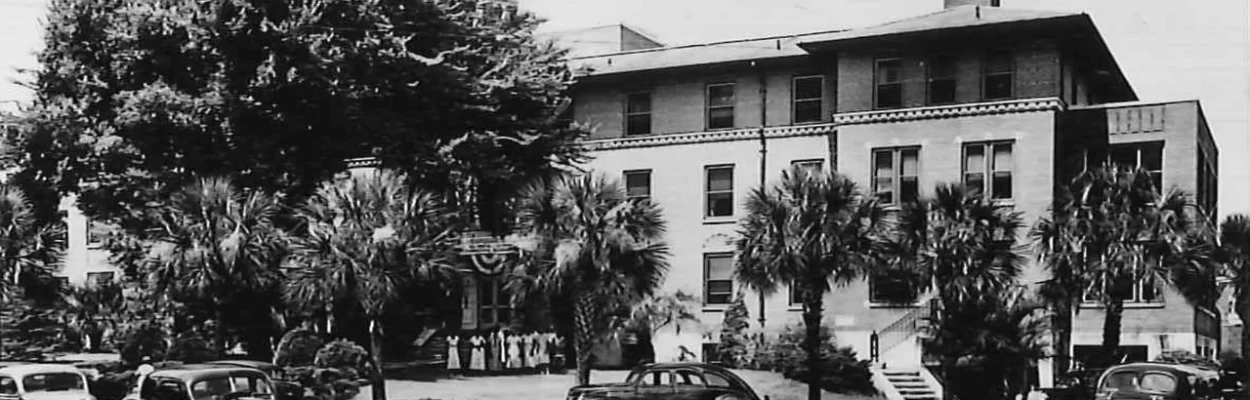
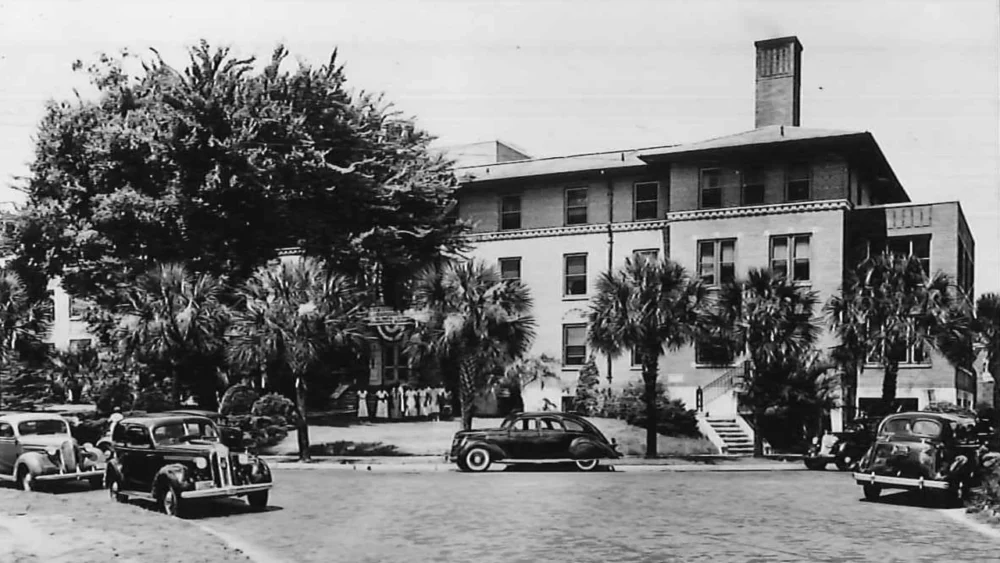
Brewster Hospital, seen here in the early 20th century was an anchor of Sugar Hill, which stood among Jacksonville’s most prosperous and influential African American neighborhoods | General Commission on Archives and History of The United Methodist Church
Published on September 15, 2026 at 10:41 am
Free local news and info, in your inbox at 6 a.m. M-F. Sign up for the Jacksonville Today newsletter.
Historic photographs from the General Commission on Archives and History of the United Methodist Church offer a rare glimpse into Sugar Hill, once one of Jacksonville’s most prominent African American neighborhoods.

During the early decades of the 20th century, Sugar Hill stood among Jacksonville’s most prosperous and influential African American neighborhoods. Located just west of Hogans Creek and Springfield, the community developed around West 8th Street during an era when segregation severely restricted where Black Jacksonville residents could live, work, receive an education and obtain medical care.
Jacksonville Today thanks our sponsors. Become one.

Despite those barriers, Sugar Hill flourished. Its streets became home to prominent Black physicians, educators, business owners and civic leaders, along with institutions that served African Americans from across Jacksonville and beyond. Two of the neighborhood’s most significant landmarks, the Cookman Institute and Brewster Hospital, were closely connected to the Methodist Episcopal Church and its efforts to expand educational and healthcare opportunities for African Americans.

Today, much of Sugar Hill has disappeared from the landscape, its former blocks consumed by institutional expansion, highway construction and redevelopment. Yet an extraordinary collection of photographs preserved by the General Commission on Archives and History of the United Methodist Church provides a window into the neighborhood as it appeared during the 1910s, 1920s and 1930s.
Together, these images help restore a visual record of a community that played an important role in Jacksonville’s Black history.



Jacksonville Today thanks our sponsors. Become one.
Remembering Sugar Hill

Sugar Hill emerged during the late 19th and early 20th centuries as Jacksonville’s African American population rapidly expanded beyond the older neighborhoods surrounding Downtown. Situated west of Springfield and Hogans Creek, the neighborhood extended through an area centered on West 8th Street. Its location placed residents within convenient reach of LaVilla, while providing space for substantial homes, churches, schools and other institutions.

By the early 20th century, Sugar Hill had developed a reputation as one of the city’s leading Black residential communities. Its residents included members of Jacksonville’s growing African American professional and middle classes at a time when Jim Crow segregation excluded them from many predominantly white neighborhoods.

But Sugar Hill was more than a collection of residences. Institutions established within and around the neighborhood made it an important center for education, healthcare and community life.

Seen today, these images provide something written records alone cannot: glimpses of the people, buildings, streets and everyday environment of a Black Jacksonville neighborhood at its height. They also illustrate how institutions created during segregation became anchors of community advancement. Among the most important was the Cookman Institute.
The Cookman Institute: Educating a generation

The story of the Cookman Institute began before Sugar Hill itself reached its prominence. Founded in Jacksonville in 1872 by Reverend S.B. Darnell, Cookman was Florida’s first institution of higher learning established for African Americans. The school was named in honor of the Rev. Alfred Cookman, whose financial support helped fund its first building.
Its original campus stood at Beaver and Hogan streets in Downtown Jacksonville. Affiliated with Atlanta’s Clark University, the institution offered both day and evening classes and initially focused on preparing African American teachers in religious and academic studies.

Disaster forced the institution to begin a new chapter. The Great Fire of 1901 devastated much of central Jacksonville and destroyed Cookman’s original campus. Rather than disappear, the school rebuilt on a spacious site near North Davis and West 8th streets in Sugar Hill. The new campus became one of the neighborhood’s defining landmarks.
Cookman’s curriculum expanded to include elementary through high school education along with instruction in music, domestic science, business, agriculture and the trades. Enrollment eventually reached approximately 250 students.

Among the school’s most consequential students was Jacksonville native A. Philip Randolph. Randolph later moved to Harlem and emerged as one of the nation’s most important Black labor and civil rights leaders, organizing the Brotherhood of Sleeping Car Porters and helping lead the 1963 March on Washington.
Historic photographs of Cookman preserved by the General Commission on Archives and History provide a particularly valuable visual record of the institution during its Sugar Hill years. Images of students, teachers and campus buildings document an educational environment created for African Americans at a time when opportunities elsewhere were sharply restricted.

Cookman’s independent existence in Jacksonville ended in 1925, when the institution merged with Dr. Mary McLeod Bethune’s Daytona Normal and Industrial Institute. The combined institution became the Daytona-Cookman Collegiate Institute and was renamed Bethune-Cookman College in 1931.

Today, that institutional legacy continues through Bethune-Cookman University in Daytona Beach. Education also remained part of the former Jacksonville campus. The site eventually became Darnell-Cookman School, preserving the names of the pioneering institution and its founder in Sugar Hill long after Cookman’s college-level operations had moved away.
Brewster Hospital: Black Health Care in the Jim Crow South

Another Methodist institution would become one of Sugar Hill’s most important landmarks during the 1930s. George A. Brewster Hospital originated in LaVilla in 1901 as part of the Methodist Episcopal Church’s efforts to provide education and vocational training for African Americans. The hospital was established with financial support from Matilda Brewster of Connecticut and named in honor of her late husband, the Rev. George A. Brewster.

Brewster’s origins were modest. Brewster developed from nurse-training courses associated with the Boylan Industrial Home and School. With only two cots, a table and a few chairs, 18 young women paying 50 cents in tuition received instruction from Iowa Benson and volunteer physicians.
The need for their training became dramatically clear during the Great Fire of 1901. Located only a few blocks from where the fire began, the school was transformed into an emergency hospital. Nursing students helped care for approximately 75 patients as the disaster swept across Jacksonville.

From those beginnings, Brewster evolved into one of Black Jacksonville’s most significant institutions. It became Florida’s first hospital established for African Americans, where Black physicians could treat Black patients. During segregation, it also provided African American nurses and medical professionals with opportunities that were frequently unavailable at white institutions.
By the early 20th century, Brewster had outgrown its original LaVilla facilities. In 1931, the hospital relocated to a larger facility in Sugar Hill. Its arrival strengthened the neighborhood’s position as an institutional center for Black Jacksonville.

For decades, generations of African American residents received medical care at Brewster while Black doctors and nurses practiced their professions within its walls. Until the desegregation of Jacksonville’s healthcare system during the Civil Rights Movement era, Brewster provided a vital service that other local hospitals often denied African Americans.
Historic photographs preserved in the Methodist archives capture Brewster during this period. Images of the hospital, medical personnel and nursing students help document not simply the history of a building, but a broader story of Black medical professionals creating institutions capable of serving their own community under segregation.

Brewster Hospital closed in September 1966, as Jacksonville’s hospitals integrated and rising medical costs made maintaining the institution increasingly difficult. The Sugar Hill facility subsequently became part of Methodist Medical Center, representing another major transformation for the neighborhood.
A neighborhood nearly erased

The institutions that helped make Sugar Hill prosperous also contributed, ironically, to the disappearance of much of its historic landscape. During the decades following World War II, highway construction, urban renewal, hospital expansion and other large-scale redevelopment projects transformed Jacksonville’s urban core. Blocks that once contained Sugar Hill residences gradually gave way to institutional campuses and transportation infrastructure.
Methodist Medical Center expanded significantly in the area formerly occupied by the neighborhood. Through subsequent mergers and institutional changes, that medical complex ultimately evolved into today’s UF Health Jacksonville campus.

As a result, little of the historic Sugar Hill documented in photographs from the 1910s, 1920s and 1930s remains intact today.
That makes archival collections especially important. The General Commission on Archives and History of the United Methodist Church preserves historical materials documenting the denomination’s religious and institutional history, including records reflecting the social and cultural circumstances in which Methodist missions operated. In Jacksonville, those collections preserve another layer of history: visual evidence of a Black neighborhood largely removed from the contemporary cityscape.

The photographs of Sugar Hill, Cookman Institute and Brewster Hospital are more than images of vanished buildings. They document students pursuing an education, nurses learning their profession, physicians caring for patients and African American residents building institutions during an era structured to deny them equal opportunity.

They also remind us that places can disappear physically without disappearing historically. Sugar Hill may be difficult to recognize on Jacksonville’s landscape today, but through these surviving images, the people and institutions that made the neighborhood significant can once again become visible.
Photographs courtesy of the General Commission on Archives and History of the United Methodist Church.