
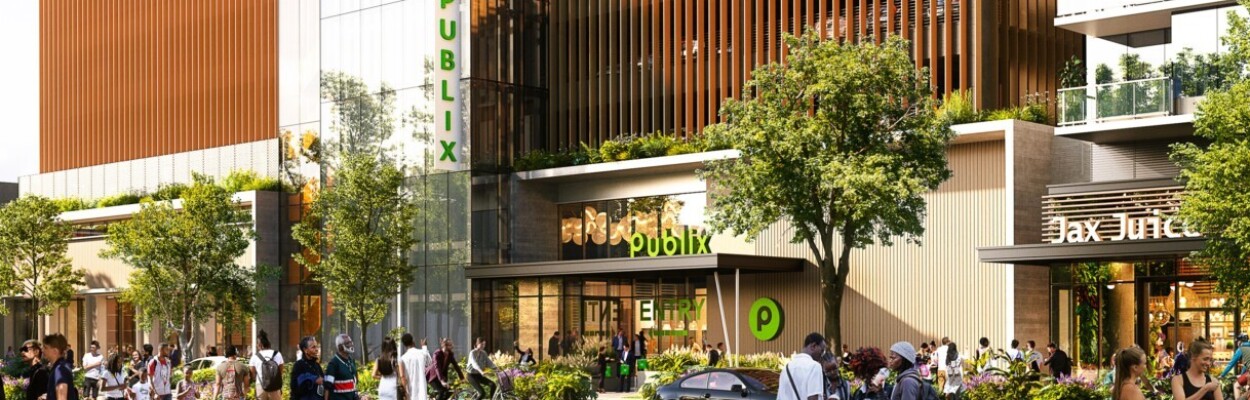
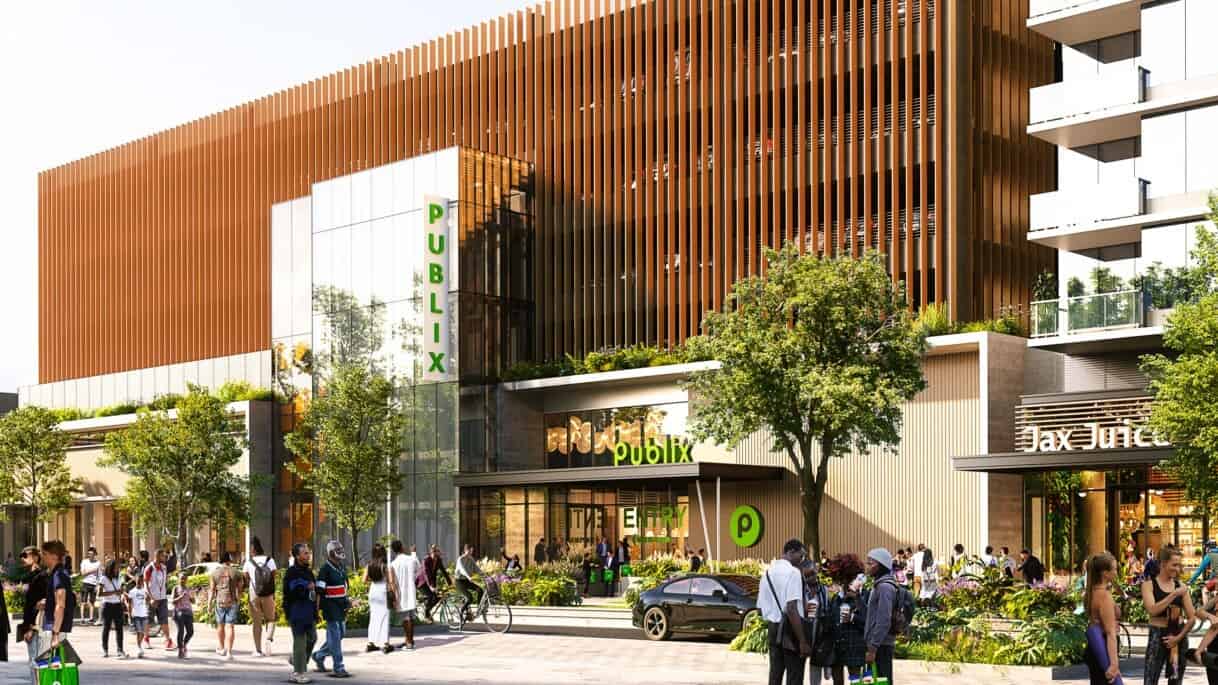
An artist's rendering of the planned 31,000-square-foot Publix at 119 W. Beaver St., part of a new building that will also include a 15-story residential tower and 400 parking spaces. | Gateway/Pearl Square
Published on November 13, 2026 at 4:15 pm
Free local news and info, in your inbox at 6 a.m. M-F. Sign up for the Jacksonville Today newsletter.
Q: The city of Jacksonville is now an investor to the tune of $49.65 million in developer Gateway Jax’s Downtown high-rise apartment building that will include a ground-floor full-service Publix grocery store, after City Council’s approval of a compromise incentive package deal this week.
Of that top-line incentive number, $28.25 million is a cash grant that Gateway will receive once the project is completed.
Jacksonville Today thanks our sponsors. Become one.
By 2031, Gateway will be on the receiving end of more than $50 million in cash completion grants for its various Downtown projects.
The awards are meant to help close financial gaps to get the apartments, parking garages and retail spaces built in the developer’s $1.1 billion Pearl Square Project plan.
Gateway is also asking for another $20 million cash grant from the city Downtown Investment Authority for its next project — a $250 million luxury hotel, condo and apartment high-rise at Riverfront Plaza.
Jacksonville Today thanks our sponsors. Become one.
Committing millions in taxpayer dollars to private developers and companies to build up Downtown always brings opinion from proponents and critics. That debate has ramped up over the last week with Florida voters’ passage of the Amendment 3 homestead property tax cut, which is expected to drop city revenue by $300 million annually by 2029.
One question on both side of the public-incentives debate, whis is echoed by Jacksonville Today reader Tim T., is “What is the return on investment to the city for this grant?”
“What is the return on investment to the city for this grant? ”
“Why must we reward completion of a project?” Tim wonders. In his mind: “If Publix thought there was profit in having a store in that location now, it would pursue it on its own.”
So, what does Jacksonville get in return for spending nearly $50 million in taxpayer money on this one project?
A: According to the Downtown Investment Authority, for every $1 the city invests in the Publix-anchored high-rise project, the city would receive between $1.10 to $1.45 in return over 30 years.
The calculation looks at cash and other assets going out and new tax revenue that will be coming in as a direct result of the project.
In some projects, publicly owned property and infrastructure improvement costs covered by the city as part of development agreements can be considered part of the incentives package.
In the case of the Publix project, the city’s investments are only the cash and property tax refund.
Gateway and the city estimate the grocery store and residential project will generate $2.2 million per year in new local property and sales taxes.
Gateway says building the high-rise and retail development will bring 549 construction jobs and 125 permanent jobs. The company also projects $58.7 million in direct and indirect spending as a result of building the grocery store.
For an independent review of the city agency’s ROI calculations, the DIA turned to Andres Gallo, a University of North Florida professor and director of the International Business Flagship Program.
His report says building a new supermarket produces a nationwide average increase in nearby real estate values of 4% to 7%. Gallo estimates the Publix on Beaver Street in Jacksonville’s Downtown will bring $3.4 million to $3.8 million in annual property tax gains, between an influx of new residents and increased property values — that’s an extra $320 million to $340 million over the 30 years of the agreement.
The Amendment 3 effect: Downtown Jax and Publix
Downtown developers, business owners, restaurants and residents have long called for a full-service grocery store in the Downtown core. They see it as a missing piece to making residential growth in the Northbank core sustainable.
The DIA and Gateway saw the grocery store as a priority. To convince a majority of council members to support the incentives in a post-Amendment 3 world, DIA officials agreed to shift grant money from a previously approved park project with a riverfront restaurant.
And Gateway said it would shift $7 million from a completion grant it was awarded in 2024 for another Pearl Square apartment high-rise, called N8.
Gateway CEO Bryan Moll told Jacksonville Today, after Amendment 3’s passage, his company is committed to not asking for any more cash completion grants from the city’s general fund — the $20 million for the Riverfront Plaza project would come from property tax dollars generated Downtown and paid into the Northbank Community Redevelopment Area fund, managed by the DIA.
And he thinks Downtown is nearing a point where incentives may no longer be needed to attract development.
“I think we’re getting close,” he said. “Candidly, having the grocery store deliver and having that project deliver, I think will go a really long way in demonstrating that people are willing to pay rents for those types of things, which helps justify the construction. But I’ll be honest with you, I think institutional investors have been watching for this.”
Will Publix get incentive money?
None of the incentive dollars will be paid to Publix, the developer’s intended tenant. The money will go toward development and construction costs.
Moll declined to say what Publix will pay to lease the 31,000-square-foot space. According to the real estate firm Colliers North Florida’s 2025 report, Jacksonville’s average rent for retail space was $25.65 per square foot. Because grocery stores tend to be a low-profit margin businesses, Moll says, they have a hard time paying typical urban retail lease rates.
“It really doesn’t matter what grocery store you are,” Moll said. “…“No grocery store that I’ve ever known of has ever paid more than low $20… rents per square foot.”