
Developed during the early years of Florida’s great land boom, the Panama Gardens neighborhood represented an early attempt to combine suburban living with the benefits of country life. | The Jaxson
Published on September 23, 2026 at 3:49 pm
Free local news and info, in your inbox at 6 a.m. M-F. Sign up for the Jacksonville Today newsletter.
In the neighborhoods north of Downtown Jacksonville, the quiet streets of Panama Gardens preserve a century-old vision of suburban life that was remarkably ambitious for its time.
Developed in 1923 during the early years of Florida’s great 1920s land boom, Panama Gardens was conceived as something more than a collection of residential lots. With spacious homesites, paved streets, sidewalks, fruit trees and enough land for families to maintain gardens and raise poultry, the subdivision represented an early attempt to combine suburban living with the benefits of country life. A century later, much of that original residential character remains.
Jacksonville Today thanks our sponsors. Become one.
A Stockton Development

Panama Gardens was developed by Telfair Stockton and Co., one of the most influential real estate firms in Jacksonville’s history. Established by Telfair Stockton Sr. in 1884, the company became a major force in real estate development, property management and brick manufacturing. His son, James Roosevelt Stockton Sr., joined the family business after serving in the Marine Corps during World War I and eventually assumed control of the firm in 1932.
Over the decades, the Stockton organization and its successors played an important role in shaping the growth of Jacksonville and Northeast Florida. Its developments included Avondale in 1920, San Marco in 1925, Ponte Vedra Beach during the 1930s, Deerwood Country Club in 1960 and Sawgrass in 1970.
The company eventually merged with the Whatley Davin Development Co. to become Stockton, Whatley, Davin & Co., better known as SWD. The firm continued operating until 1983, when its real estate portfolio was sold to Gate Petroleum. Panama Gardens was one of the company’s earlier experiments in suburban development.


Jacksonville Today thanks our sponsors. Become one.
The Florida Land Boom comes to Jacksonville

James Stockton laid out Panama Gardens in 1923, as Florida was entering one of the most extraordinary periods of real estate speculation in its history.
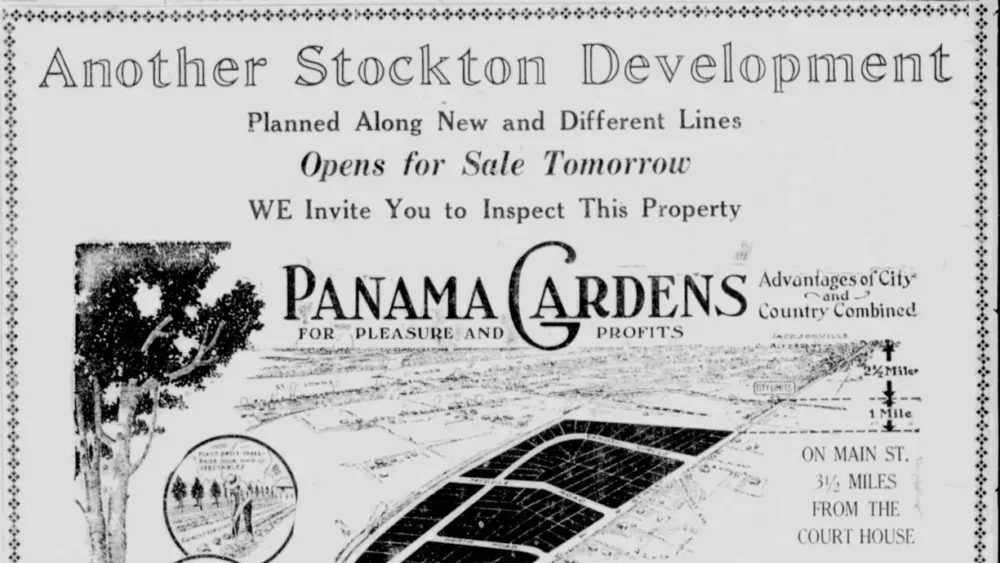
Fueled by the economic prosperity of the 1920s, population growth and widespread speculation, the Florida land boom transformed communities across the state. Although many of the era’s most famous developments were concentrated in Central and South Florida, Jacksonville and Duval County experienced their own wave of subdivision development. Panama Gardens emerged during this period on approximately 55 acres just outside Jacksonville’s city limits.
Located roughly three and a half miles north of Downtown, the property occupied land between Main Street, the Seaboard Air Line Railroad and East 63rd Street. The Telfair Stockton and Company planned and developed the subdivision, while construction was undertaken under the supervision of engineers Ellis, Curtis and Kooker. Visitors arriving from Main Street encountered ornamental entrance gates constructed by the Art and Ornamental Stone Company, then located at Market and 14th streets in Springfield. Sales officially opened in November 1923.
Bringing the country to the city

Panama Gardens contained 75 lots, but the developers deliberately avoided squeezing as many homes as possible onto the property. Instead, the typical single-family lot contained approximately two-thirds of an acre. The generous dimensions were promoted as providing residents with privacy and comfort while leaving enough ground for gardens, flowers, fruit trees and chickens. In this respect, Panama Gardens blurred the line between a conventional suburban subdivision and a small-scale agricultural community.
Residents could use their properties for residential, horticultural and poultry-raising purposes. Even larger animals were permitted within limits: no more than two cattle and two horses or mules could be kept at a residence. Swine, however, were prohibited.
The neighborhood itself became a horticultural demonstration project. Six acres of Satsuma orange trees were planted to demonstrate that citrus could be successfully grown in Duval County. Experimental plantings also included pears, plums and Japanese persimmons.
The concept reflected an era when suburban development could promise both modern infrastructure and a degree of household self-sufficiency, a place where a family might live within easy reach of Downtown Jacksonville while maintaining a garden, orchard or poultry yard at home.
More than $40,000 in improvements

The developers invested heavily in Panama Gardens before and during its sale. More than $40,000 was reportedly spent improving the 55-acre property. Infrastructure included paved asphalt streets, approximately 8,000 feet of concrete gutters and curbing, two miles of sidewalks and some 2,000 fence posts. Hog-proof wire fencing was another notable feature. The improvements distinguished Panama Gardens from the more rural surroundings that then existed beyond Jacksonville’s municipal boundaries.
The subdivision also came with an extensive set of development restrictions intended to protect its residential character. Homes were required to maintain a 50-foot front setback, with the area in front of residences kept free of chickens and other potential disorder. The objective was to create a uniform and attractive streetscape throughout the development. Residences were required to cost at least $2,500, establishing a minimum level of investment for new construction. Developers also prohibited flats, apartments, hospitals, sanitariums, asylums, businesses and manufacturing establishments. Panama Gardens was intended to remain a neighborhood of detached residences.
These private restrictions were particularly significant because Panama Gardens predated Jacksonville’s modern land-use regulations. Before comprehensive municipal zoning determined where different uses could locate, developers frequently relied upon deed restrictions and covenants to control the character of new subdivisions.
Telfair Stockton and Company even attempted to discourage real estate speculation within a development born during Florida’s great speculative land boom. The company declared that lots were not intended for “land hogs,” buyers who purchased property simply to hold it in anticipation of rising land values. Panama Gardens was promoted instead as a community for people who intended to build, cultivate and live on their property.
From country suburb to Jacksonville neighborhood

Panama Gardens did not remain beyond Jacksonville’s boundaries for long. In 1925, only two years after sales began, Jacksonville annexed the subdivision and surrounding territory. As Panama Gardens became integrated into the expanding city, its original street names were eventually changed to conform with Jacksonville’s larger street grid. Garden Circle, the neighborhood’s principal roadway, became portions of East 56th Street and Oakwood Street. Middle Road became East 59th Street, while North Road became East 61st Street.
The transition also placed Panama Gardens within Jacksonville’s emerging system of municipal planning. As part of Jacksonville’s first Comprehensive City Plan, the neighborhood was zoned for single-family residential use. That designation helped reinforce the residential pattern that its private developers had established several years earlier.
Its location makes that legacy particularly noticeable today. During the mid-to-late 20th century, commercial and industrial development spread across significant portions of Jacksonville’s Northside, particularly along major transportation corridors and African American neighborhoods zoned for unrestricted uses. Yet Panama Gardens largely escaped the commercial and industrial encroachment experienced by many nearby areas.
A surviving landscape of the 1920s

Today, the citrus experiment, poultry farming and promotional excitement of the Florida land boom have largely faded from memory. The former country suburb has long since become part of Jacksonville’s urban fabric.
However, the physical form envisioned by its developers remains surprisingly recognizable. The spacious lots, detached homes, deep setbacks and predominantly residential streets continue to distinguish Panama Gardens from much of its surroundings. What was once advertised as a suburban refuge beyond Jacksonville’s boundaries is now a century-old neighborhood within the city itself.
Panama Gardens also offers a window into an important transitional moment in Jacksonville’s growth. It was developed when automobiles were expanding the practical boundaries of the city, private developers were experimenting with planned suburban communities, and formal municipal zoning was only beginning to emerge. Its developer, the Telfair Stockton and Co., attempted to combine two worlds: the infrastructure and accessibility of the modern suburb with the space, gardens, fruit trees and small-scale agriculture traditionally associated with rural life.

More than 100 years after James Stockton laid out its streets, Panama Gardens remains one of Jacksonville’s lesser-known surviving examples of that vision, a Northside neighborhood whose landscape still tells the story of how the city expanded during the transformative Florida land boom of the 1920s.