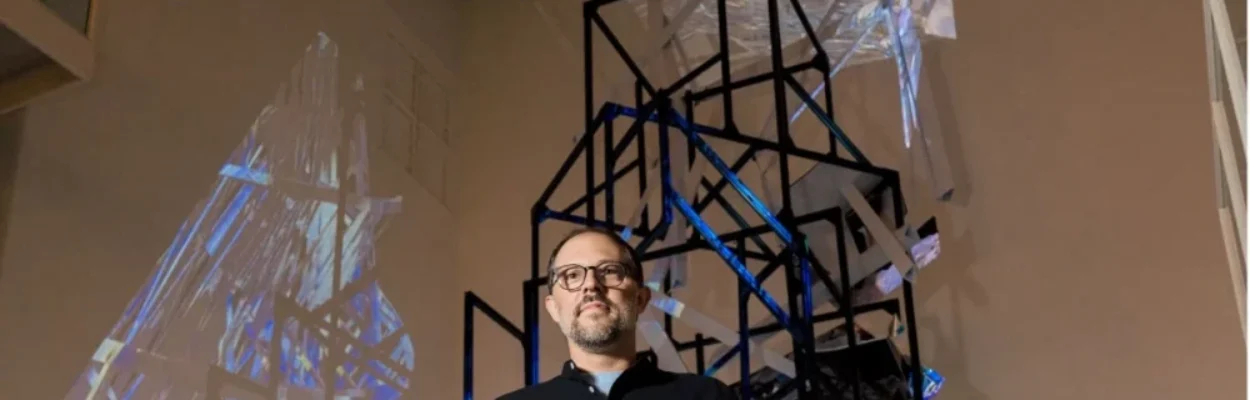
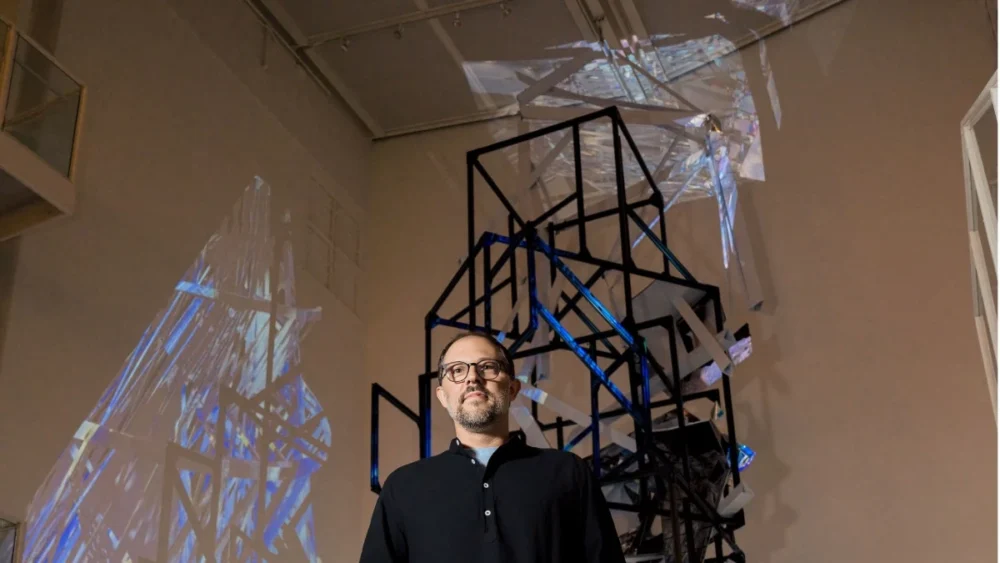
North Carolina-based artist Ryan Rasmussen's Glitch: Architecture Undone explores the interplay between our digital and physical existence | Sarah Hedden, MOCA Jacksonville
Published on September 10, 2026 at 10:49 am
Free local news and info, in your inbox at 6 a.m. M-F. Sign up for the Jacksonville Today newsletter.
In 1942, the artist Lee Krasner introduced her future husband, Jackson Pollock, to her art teacher Hans Hoffman. In a famous dustup, the influential pedagogue inspected the allusive, non-representational paintings that filled the walls of Pollock’s studio, and asked why the soon-to-be art-world rock star didn’t derive inspiration from traditional sources – still lifes, models, plein air environs.
“You do not work from nature?” the old-school German-American master wondered, remarking that such an approach would surely leave Pollock bereft of inspiration. To this Jackson responded with the world-shaking, albeit self-absorbed, quip: “I am nature.”
Jacksonville Today thanks our sponsors. Become one.
More than three-quarters-of-a-century later, it’s hard to imagine that Jackson – let alone Hoffman – could have conceived of our modern, digitally mediated existence.
Sure, today’s social media influencer might be philosophically aligned with Pollock’s maxim. Rather than “I am nature,” though, a user with a respectable following might declare “I am content.” Meanwhile, the average American spends roughly half their waking hours staring at their phone, consuming images as small, static squares or short clips in an infinite, repetitive scroll. Hoffman might wonder: “Where is nature?”
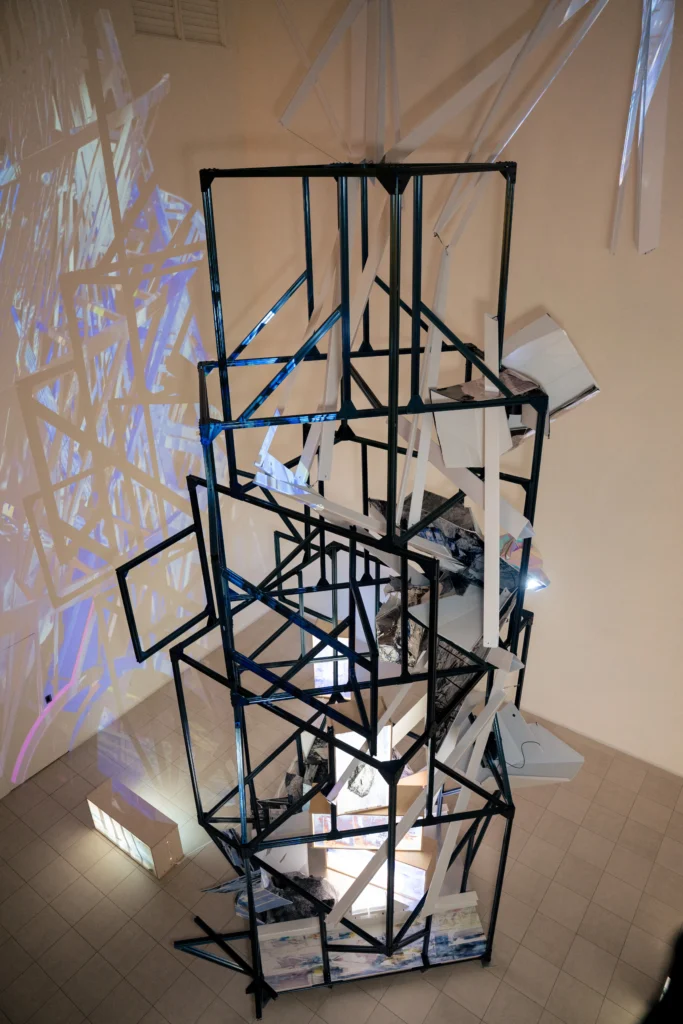
The interplay between our digital and physical existence is at the heart of Ryan Rasmussen’s Glitch: Architecture Undone, an imposing, large-scale mixed-media sculpture he’s created for MOCA Jacksonville’s Project Atrium. Made from a base of extruded aluminum, the free-standing structure wends through the atrium’s white-walled expanse, the mostly orthogonal lines of its black frame meeting the piece’s asymmetrical second story: a burst of tangled white metal dangling precariously above the museum floor. Attached to, and emerging from, this primitive host structure, Rasmussen’s added colorful backlit panels, kaleidoscopic projections and other sculptural works in a simulation of accumulation.


Jacksonville Today thanks our sponsors. Become one.

From a literal conceptual framework, Glitch interprets the digital-physical paradox and asks, given our evolving relationship with nature: What are we?
“I think about technology as simultaneously like a prosthetic and an amputation,” Rasmussen says, paraphrasing the 20th century media theorist Marshall McLuhan (of “the medium is the message” fame). “We gain some new ability with it. And it’s amazing. A profound change. But at what cost? What are we losing? What gets cut off?”
Glitch also engages in perspective trickery. In a feat of architectural ingenuity and artistic imagination, the structure’s inception point is left to the eye of the beholder, evincing a kinetic ambiguity despite its sturdy, static framework.
“It’s not one finished work,” Rasmussen says, calling it instead “a momentary expression” of the possibilities in those materials.
“I’m really interested in how an idea can morph through different manifestations,” he says.
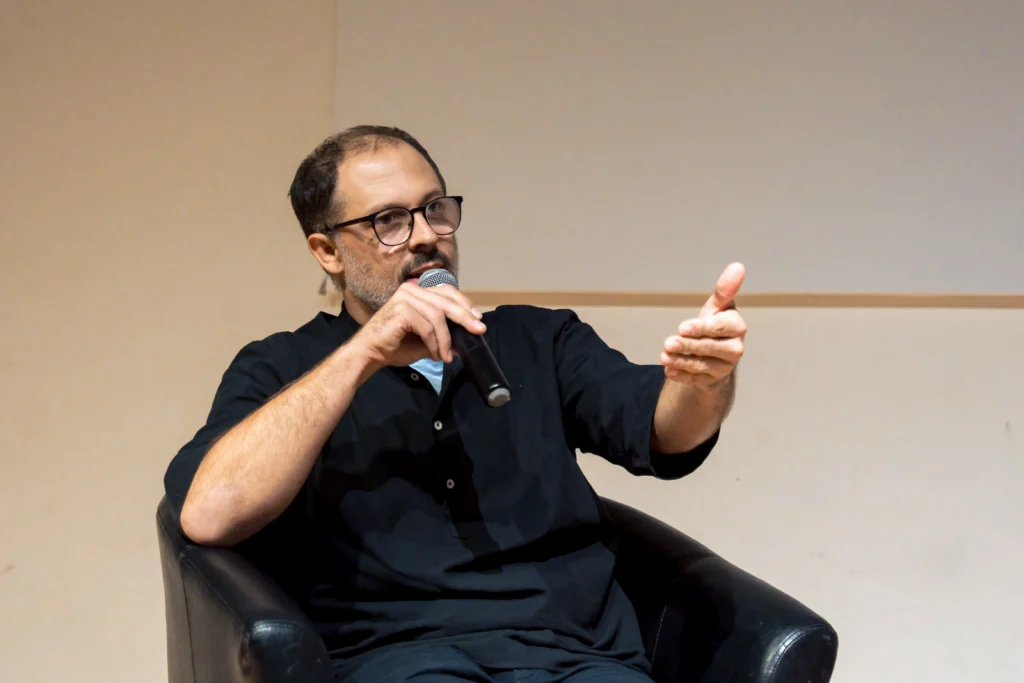
I’m talking to the North Carolina-based multimedia artist and associate professor of intermedia at Elon University just days before the museum hosts a community preview of Glitch. Sitting at a table in the cafe adjacent to the atrium, as gallery assistants on hydraulic lifts are busy putting the finishing touches on his sculpture, he says he makes a conscious effort to keep technology at bay in his own life, adding “I also resist shunning it completely.”
Indeed, his oeuvre proves he’s comfortable straddling, as he calls it, “the liminal space between digital and analog.” In his work, computerized animation and projection interact with corporeal mediums – painting, sculpture and assemblage, even performance art.
Like much of Rasmussen’s work, Glitch started as a doodle, emerging from his sketchpad before he rendered it with computer-aided design software. Its integrity was approved by a structural engineer. But though the foundational elements of his work are meticulously diagrammed and plotted, Rasmussen leaves room for improvisation.
The material accumulation – the wood scraps and other found objects – were attached to the sculpture’s frame or added ain an ad hoc process, one that was highly influenced by the space in which it exists, and developed in real time – in online parlance, the IRL to the piece’s virtually conceived framework.
“I’m sculpting in situ,” he says of the process. “I have the primary form figured out but then, like the parasitic form, the stuff that’s growing into it, that’s all built on site.”
The concept of a “glitch” in Rasmussen’s work, then, has a neutral if not positive connotation. Though it’s no doubt born of a dysfunction or malfunction, a glitch can also present an opportunity.
“It’s not an error,” he argues. “It’s often a revelation – it reveals something about the underlying structure.”
Before pursuing an arts degree, Rasmussen originally considered going into drafting. And architecture ranks as one of his most consistent muses, evident in his work from both technical and conceptual perspectives. He says he’s fascinated by buildings “not individually as static material objects but as systems that have lots of different functions.”
He cites glitch artist Rosa Menkman and the experimental architect Lebbeus Woods, design-minded artists interested in the underlying structure of systems, ideas and concepts, as influences on his own thinking. The famed Monument to the Third International, Vladimir Tatlin’s unrealized 1920s structure, too, was an archetype for Glitch.
“It lives as a dream, as an idea, and it still has echoes and implications,” he says of Tutin’s never-built design. “Ideas can often be more powerful than the forms themselves.”
Given the conceptual underpinnings of Glitch, Duchamp’s Nude Descending Staircase, No. 2 is arguably a spiritual antecedent to Rasmussen’s sculpture. It too tampered with perspective, and used its title as a provocation, sparking viewers’ own internal monologues. One early-20th-century newspaper cartoonist depicted a viewer of Nude standing on his head, the caption reading something to the effect of “Now I get it.”
As we exit the cafe and walk back toward Glitch, it’s clear that taking the full measure of Rasmussen’s towering work in progress requires the viewer to engage the piece from multiple angles. Earlier in our conversation, Rasmussen argued that “a building is never done, it’s always in flux.”
“Architecture begins when people inhabit those spaces,” he said. “It’s responsible for a lot of what humans do and a lot of ways that they behave in the world.”
There are no rules forbidding headstands in the Project Atrium gallery, at least none posted. So visitors to the gallery should be sure to view the structure from multiple angles. Pull out your phone if you must, and attempt to center the piece in your device’s vertical frame. Better yet, flip the phone’s camera around and contort your body into the foreground just below Rasmussen’s installation. Post it to social media as proof of your existence.
Glitch: Architecture Undone is on view at MOCA Jacksonville through February 14, 2027.