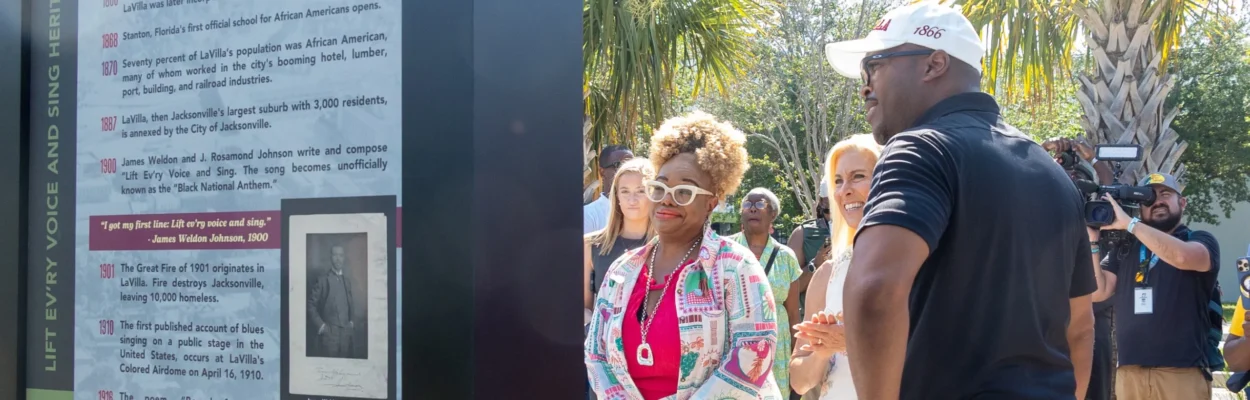
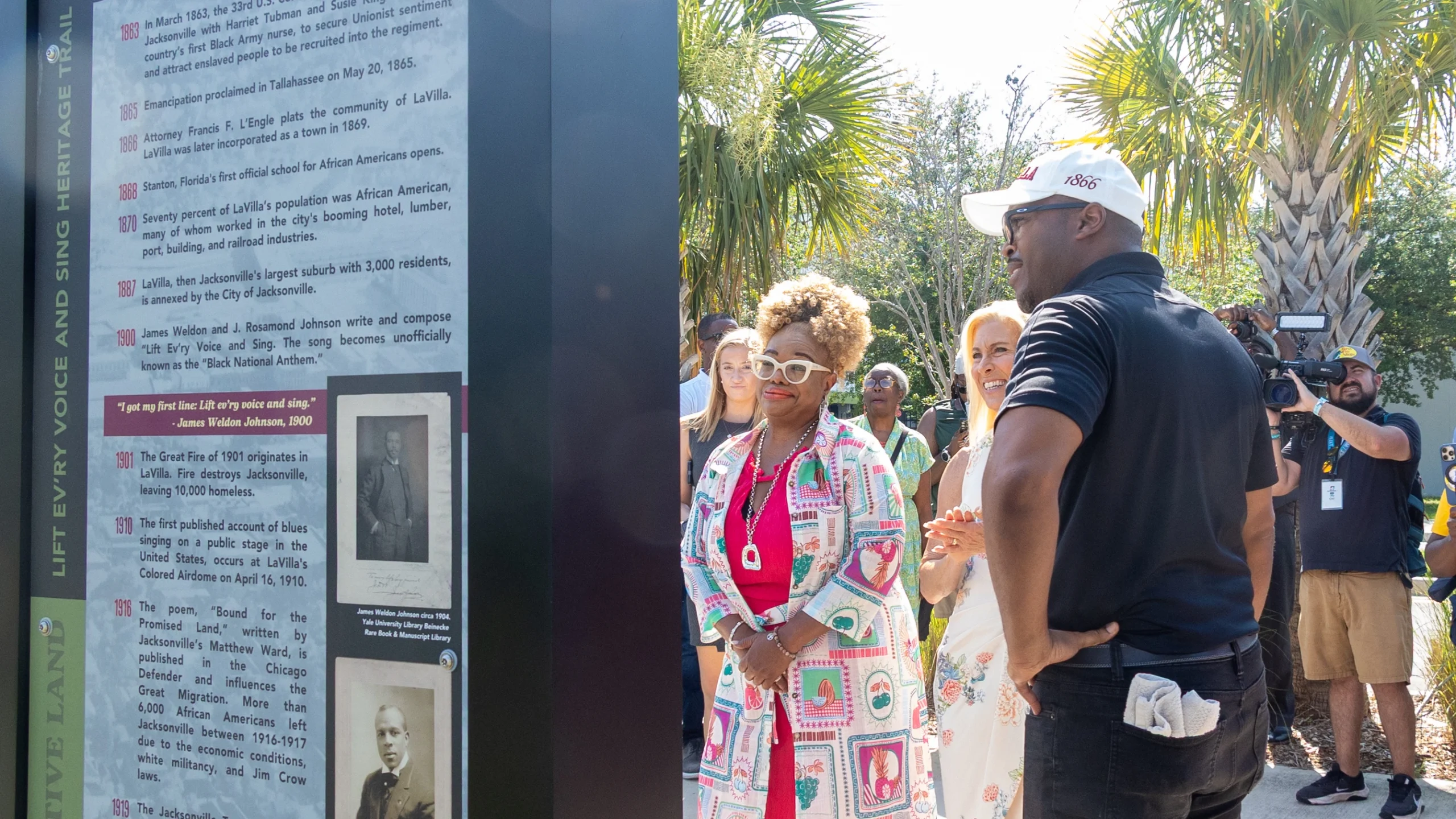
From left, Jacksonville City Council member Ju'Coby Pittman, Mayor Donna Deegan and urban planner Ennis Davis observe one of the heritage markers that were placed as part of the LaVilla Lift Ev’ry Voice & Sing Heritage Trail. | Will Brown, Jacksonville Today
Published on June 12, 2026 at 4:19 pm
Free local news and info, in your inbox at 6 a.m. M-F. Sign up for the Jacksonville Today newsletter.
LaVilla is a cornerstone for the history and culture of Jacksonville. Those contributions will be celebrated in the LaVilla Lift Ev’ry Voice & Sing Heritage Trail that was unveiled Friday morning.
Urban planner Ennis Davis notes there is far more history in LaVilla than the 22 markers that were unveiled. For Davis, whose book Jacksonville’s Gullah Geechee Heritage was published in April, the unveiling was a beginning, not a culmination.
Jacksonville Today thanks our sponsors. Become one.
After Friday’s fanfare subsided, Davis led nearly three dozen people on a walking tour of LaVilla. Noelle Barber was among those who participated. Barber will host an art installation about Black life and autonomy that opens at The Ritz Theatre & Museum on June 18.
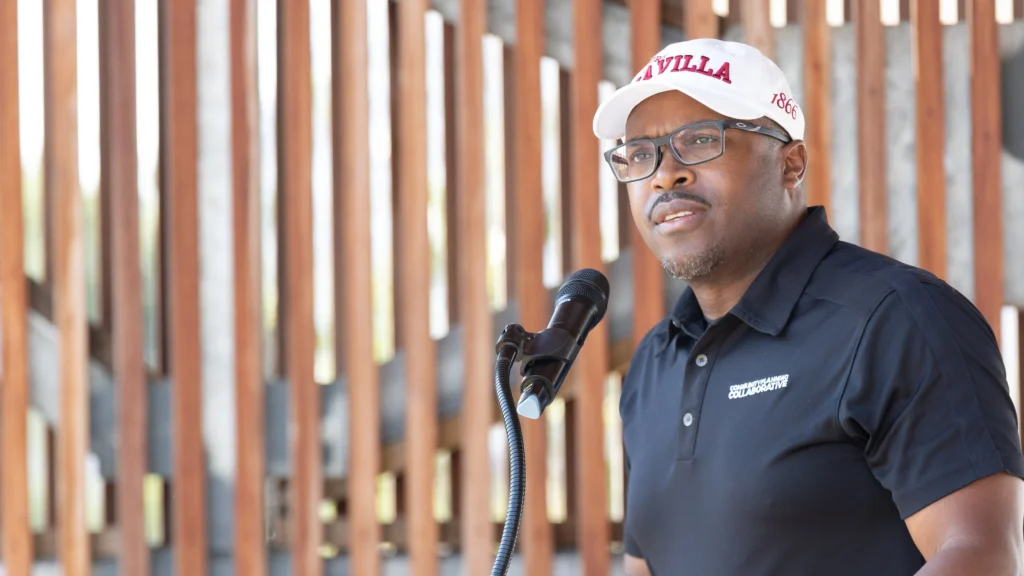
“Today is more than just a ribbon cutting,” Jacksonville City Council member Ju’Coby Pittman says. “It’s about being intentional and getting to the finish line. It is our homecoming today. … Long before many of us was born, these streets were filled with entrepreneurs, educators, nonprofits, musicians, faith leaders, railroad workers and visionaries.”
These markers will highlight local legends like Eartha M.M. White and John Rosamond Johnson.


Jacksonville Today thanks our sponsors. Become one.

Read more: The Blacksonville 100
It’s also an opportunity for people to learn about the likes of Thomas Long, an African Methodist Episcopal church leader who was once enslaved in Jacksonville, settled in LaVilla and, eventually, became the superintendent of public schools in Madison County, Florida, during Reconstruction.
Markers were erected to memorialize Brewster Hospital, the Richmond Hotel, old Stanton High School, Ritz Theatre & Museum and more.
They are in a 1.7-mile loop that could take visitors from Lift Ev’ry Voice and Sing Park, along Davis Street, across Beaver Street and weaving through blocks of Broad, Ashley, Duval and Jefferson streets.
They were grouped into themes that incorporate the lyrics of Jacksonville’s most famous song.
- Out From The Gloomy Past, celebrated LaVilla’s connection to resistance and resurrection following the American Civil War.
- Let Our Rejoicing Rise chronicles the impact of the Black church and the hope that the Old Stanton High School provided.
- True to our Native Land spotlights Lift Ev’ry Voice and Sing Park and the residences in the once-thriving neighborhood.
- Sing A Song remembers those on the Chitlin’ Circuit, and later Ray Charles, who performed in LaVilla.
If one were to walk along Bay Street from the marker that recognizes the importance of the Jacksonville Terminal, east toward the marker that remembers the impact the First South Carolina Volunteers made in establishing Union headquarters during the American Civil War, they would pass the intersection of Clay Street and Bay Street. That location was the site of the first successful challenge of Southern segregation laws on public transportation in 1905.
The LaVilla Heritage Trail and Gateway Committee devoted years ensuring the history of the historic Black community is shared with new generations.
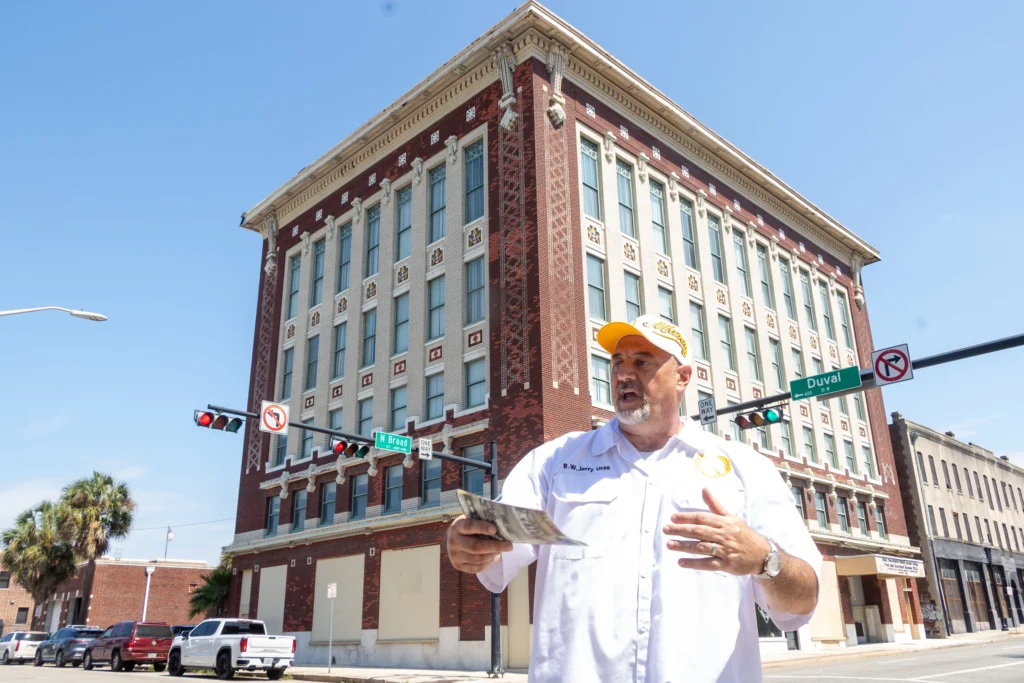
Pittman, the longtime CEO of the Clara White Mission, was on the committee. Davis was as well. Historians, urban planners, cultural leaders, community griots and others on the committee pressed the Downtown Investment Authority, as well as the city of Jacksonville, to ensure the history was thoroughly and accurately presented.
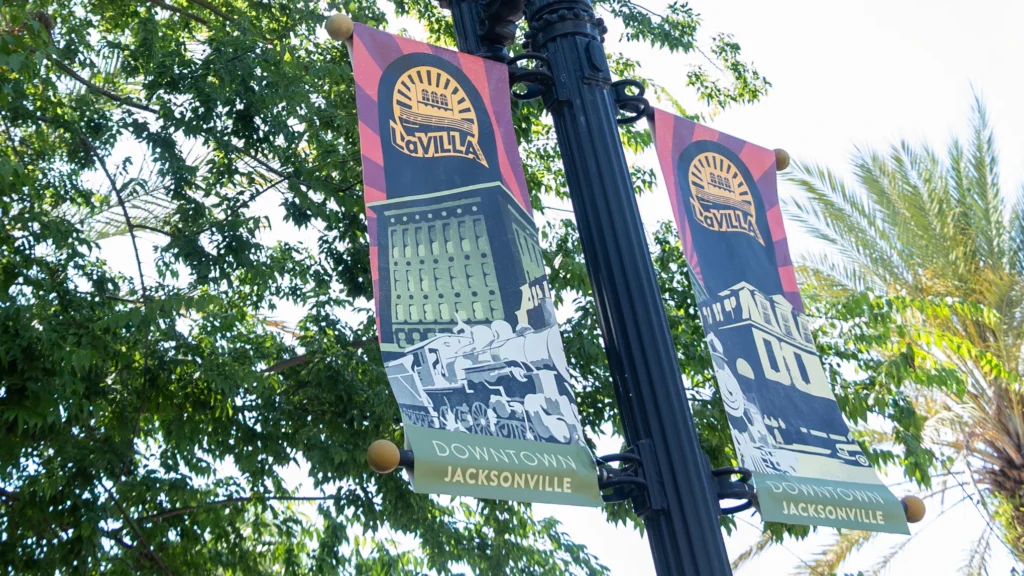
Jacksonville-based photographer Malcolm Jackson was instrumental in creating the request for proposal that allowed local artists and storytellers to design the markers, the banners that hang along streetlights in LaVilla and more.
“The DIA actually listened to our feedback and gave us the ability to create a committee of stakeholders that were actually connected to the story,” committee member Adrian Swanigan said. “I want to thank them again. Hopefully, in the future, we could take this example that was displayed here in LaVilla and apply it to some of our other projects around town — where we have local hands and local people who are connected to these stories to actually tell our own story.”
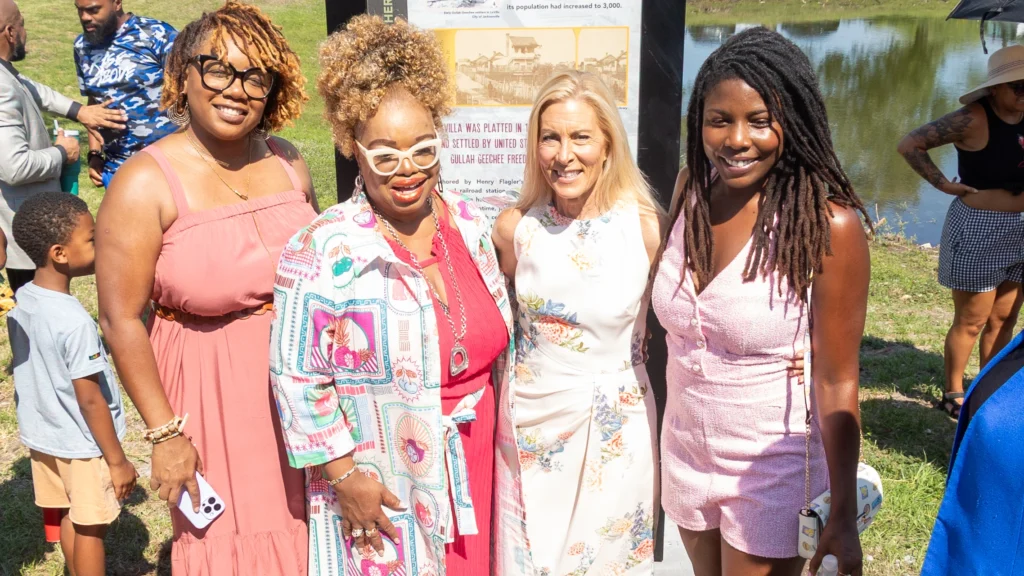
Erin Kendrick was among the artists who conjured the graphics for the trail. She considered it an honor to be tasked with helping tell LaVilla’s story to a new generation and to visitors.
“It’s important to preserve these stories, because we can see, clearly, how all of these stories are being erased.” Kendrick says.
“It’s legacy work for me. Putting these markers up in these neighborhoods makes information available to anybody. It was very important to us to put actual pictures on the marker so people could see the living history as well as read about the living history.”