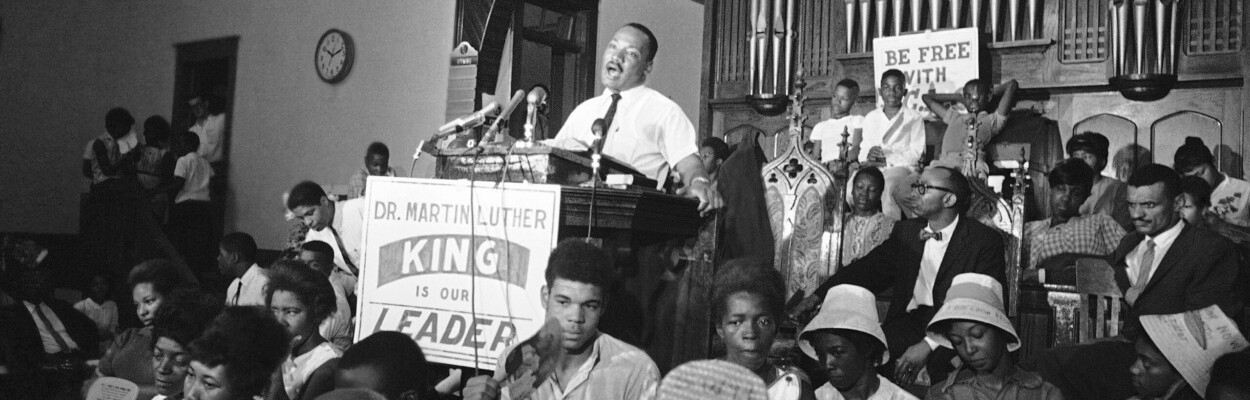
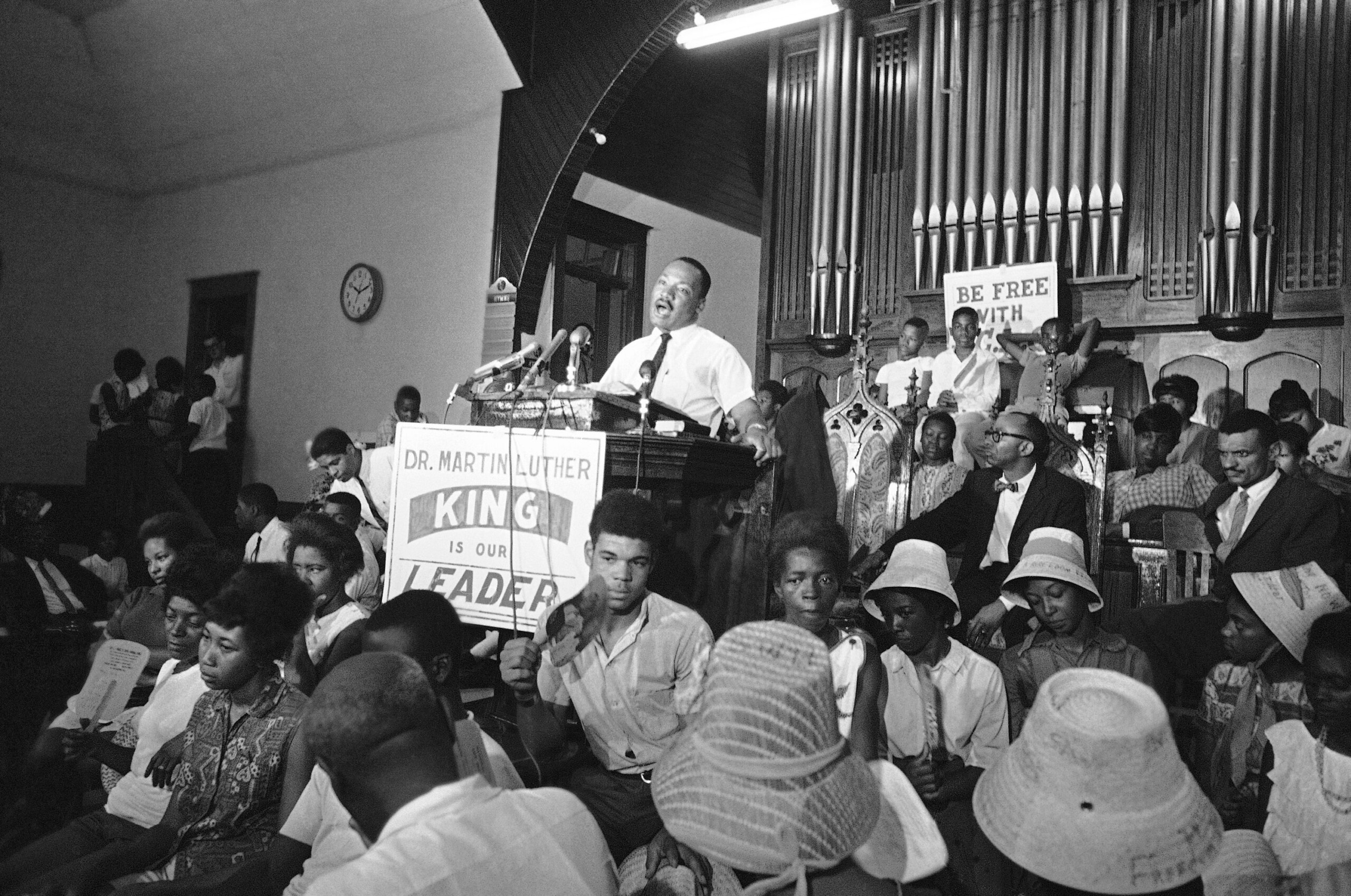
The Rev. Martin Luther King Jr. speaks at a rally at St. Paul AME Church in St. Augustine on June 11, 1964. | AP
Published on June 15, 2026 at 11:39 am
Free local news and info, in your inbox at 6 a.m. M-F. Sign up for the Jacksonville Today newsletter.
More than 60 years after he was arrested in St. Augustine for protesting segregation, Rabbi Allen Secher will come to town this week to participate in two events remembering the role a group of Jewish faith leaders played in the Civil Rights Movement.
Secher, a radio host and lifelong civil rights advocate, will take questions after the performance of a stage play dramatizing his own life, and then he will participate in a reading of a letter he helped write while imprisoned in St. Augustine.
Jacksonville Today thanks our sponsors. Become one.
The letter, titled Why We Went, was penned from a St. Augustine jail cell June 19, 1964 — the same day that is recognized as the formal end of slavery in 1866 and the same day Congress passed the Civil Rights Act of 1964, formally outlawing segregation.
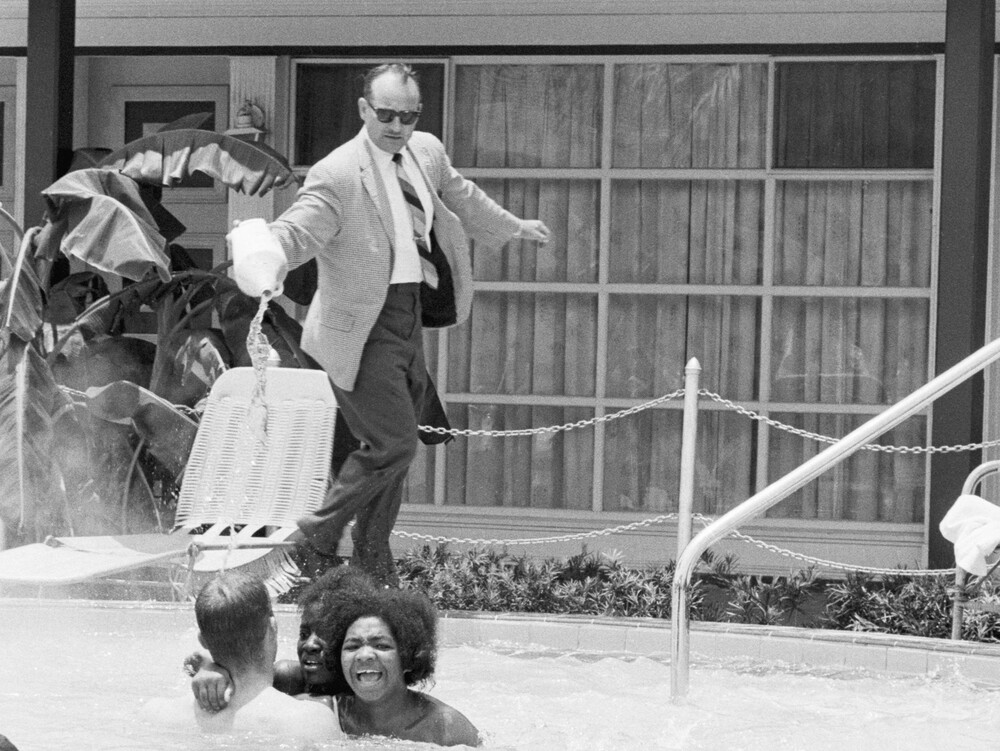
Secher, now 91, is the last surviving member of a group of rabbis who answered a call to action by th Rev. Martin Luther King Jr. to travel to St. Augustine to protest segregation. He was arrested in what was the largest mass arrest of rabbis in history during a protest at the Monson Motor Lodge on Avenida Menendez in downtown St. Augustine.
Getting involved in the Civil Rights Movement was “automatic,” Secher says.


Jacksonville Today thanks our sponsors. Become one.
“You have to make a move in life that says, ‘I’m going to make life better,’” he says. “You have to look at things and say, ‘This isn’t right, and what can I do to correct it?’”
Since his visit to St. Augustine 62 years ago, Secher says he has been back only one other time: in 2014, to take place in events surrounding the 50th anniversary of his arrest. During that visit, not as much had changed as he had hoped for. At the time, Secher says there was very little Black representation at City Hall.
In the 12 years since then, voters elected Cynthia Garris, the first Black woman to serve as a member of the St. Augustine City Commission. As of Friday, Garris is also next in line to serve as the city’s mayor.
Since then, the other surviving rabbis who were arrested have died, leaving Secher to tell their story.
Remembering the Civil Rights Movement
Secher is scheduled to take part in two events while he is in St. Augustine, both seeking to keep that story alive.
On Wednesday, Secher will participate in a discussion after a performance of When The Rabbis Came To Town, a one-man show following the rabbi through his life from his participation in protests against segregation into the 2000s.
Although the play centers on Secher, he says it’s important that it not be seen as “the Allen Secher story.”
“I want it to be the story of 17 guys who saw what was right to do and did it,” Secher says. “I am their memorial. I’m the last one standing. And so if I can rehearse their lives and memorialize every one of the 17 of us … I will consider it to be a success.”
Actor Adam Bell stars in the play as Secher. He says he immediately connected with the role, in part because of his own upbringing.
Growing up in Mississippi, Bell says, his father taught at an all-Black school.
“Our family stories include a cross being burned on our lawn and my mother not being able to work because we lived on campus,” he says. “Being at the forefront of these battles is something I was raised to do.”
And while Bell commends Secher’s modesty, he hopes the rabbi’s story will resonate with audiences.
“Change is made up by individuals who choose to make a difference,” Bell says, “who choose to get into the fray, who overcome fear or whatever obstacle to say, ‘I have to make a difference, I have to stand up.’”
The play, produced by Roger Rapoport, begins at 6 p.m. Wednesday night at the Waterworks on San Marco Avenue in St. Augustine. Tickets are available online at the Heartland Independent Film & Drama Forum website.
Rabbi recalls ‘Why We Went’
The following day, Thursday, Secher will take part in a ceremony led by the St. Augustine Jewish Historical Society that will feature a reading of the letter “Why We Went.”
Each year, the Jewish Historical Society gathers to read the letter, and this year it will be held at the St. Johns County Sheriff’s Office’s jail annex, the building where Secher and the other demonstrators were arrested in 1964.
Secher believes that, all these years later, the message of the letter still resonates.
“There’s still an enormous need to make the world better,” he says, “and if that’s a remnant of what we did in ‘64, then we’ve succeeded in leaving a legacy that way.”
Events centered around St. Augustine’s role in the Civil Rights Movement don’t end there.
After the event at the old jail building, the ACCORD Freedom Trail & Civil Rights Museum will present two events Thursday evening.
At 4 p.m., the group will host a screening of Clennon L. King’s award-winning documentary Passage at St. Augustine. The hourlong film chronicles the lead-up to the passage of the Civil Rights Act and the protests that took place in St. Augustine.
After the film, King will take part in a discussion.
The screening will take place at St. Paul AME Church — where Martin Luther King Jr. preached during his visit to St. Augustine — at 85 Martin Luther King Ave. The event is free and open to the public.
Later that evening at the church, the ACCORD will host a free meet and greet event with Robert Swann Jr., who witnessed the swim-in demonstration at the Monson Motor Lodge. Color photos taken by Swann’s brother, Nick, will be on display.
The meet and greet event is scheduled to begin at 6 p.m. with a presentation by Robert Swann at 6:30 p.m.
More information about the events is available at the ACCORD’s website: https://accordfreedomtrail.org.