
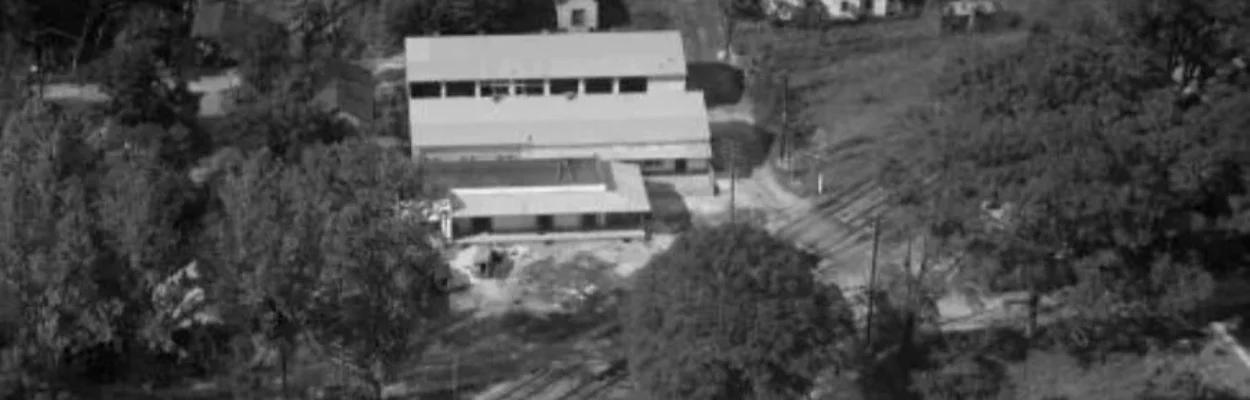
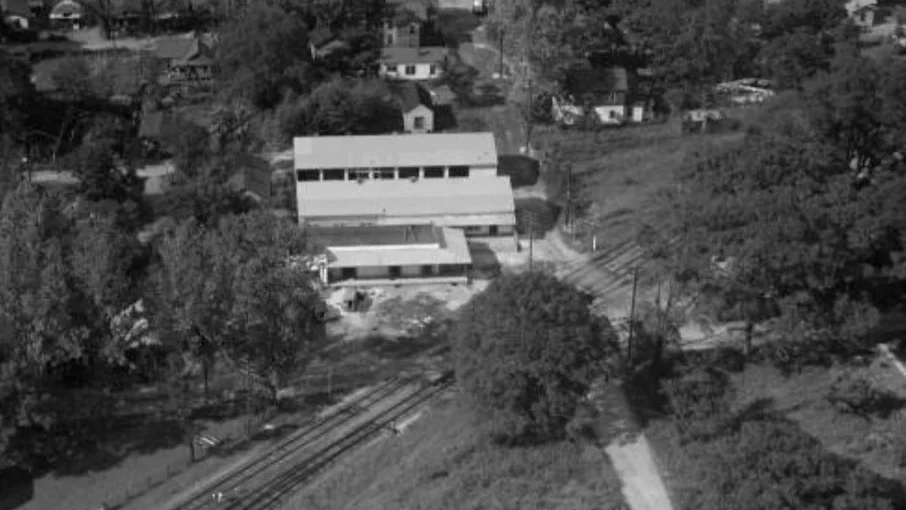
A historic photo shows an aerial view of Draper's Egg & Poultry plant.
Published on June 3, 2026 at 9:49 am
Free local news and info, in your inbox at 6 a.m. M-F. Sign up for the Jacksonville Today newsletter.
For decades, Draper’s Egg & Poultry Co. provided jobs for hundreds of Jacksonville residents. Yet by the late 20th century, the same facility that had helped fuel the city’s economy found itself at the center of a growing debate over environmental impacts, neighborhood quality of life and the future of Mixon Town.
A poultry pioneer
The story begins in 1929 when William Eugene Draper founded Draper’s Egg & Poultry Co. in Jacksonville. During its early years, Draper was closely connected with Painter Poultry Co., another Jacksonville poultry business established the same year.
Jacksonville Today thanks our sponsors. Become one.
By the 1930s, Painter Poultry had become one of the region’s leading poultry distributors. Located at 591 Stockton St., the company promoted itself with the slogan “If You Want the Best.” William Draper served as secretary-treasurer in 1934 and rose to president by 1939. Under his leadership, the company expanded operations, opening a branch store on Kings Avenue to serve Jacksonville’s growing Southside.
The company’s success reflected a broader transformation occurring across the South, where advances in refrigeration, transportation and processing were turning poultry from a seasonal luxury into a year-round staple.
Building Florida’s largest poultry plant

After reactivating Draper’s Egg & Poultry Co. in 1944, Draper embarked on an ambitious expansion that would reshape Mixon Town’s industrial landscape.
Jacksonville Today thanks our sponsors. Become one.
In December 1950, the company opened a state-of-the-art processing facility at 2255 Lewis St. Constructed of concrete and steel and encompassing approximately 14,000 square feet, the facility was promoted as the largest poultry processing plant in Florida and one of the most modern and sanitary operations in the Southeast.
The facility was designed around an assembly-line model that reflected the industrial efficiencies transforming American food production. Separate units housed administrative offices, refrigeration systems, shipping operations, processing lines, packaging departments and live feeding stations. Chickens raised on Draper’s farms in Georgia and supervised farms in Florida moved through a carefully controlled production system before arriving fresh at Jacksonville grocery stores.
The company marketed its poultry under the Flavor-Grown label and distributed eggs under the Sunshine State and Sunnyland brands. The operation emphasized freshness and quality control, boasting that chickens sold in local markets had often been processed less than 24 hours earlier.
In the mid-century, Draper represented the future of food production: large-scale, vertically integrated and increasingly automated.
Expansion along McCoys Creek

William E. Draper passed away in 1965 at age 65 after more than four decades in Jacksonville’s poultry business. Yet the company continued to grow after his death.
A major milestone came in the mid-1970s when Draper’s acquired the former Mullis Poultry plant at 2400 McCoys Creek Blvd. The McCoys Creek facility itself had deep roots in Jacksonville’s food-processing industry. Mullis was founded by Newton Monroe Mullis in 1920 with a retail store on West Ashley Street in LaVilla. Later the firm moved to larger quarters at 1247 W. Adams St. In 1957, Mullis Poultry developed the 15,000-square-foot automated plant along the banks of McCoys Creek with the ability to process 1,800 chickens per hour.
By the mid-1970s, Draper’s operation had become one of Northeast Florida’s largest poultry processors. The company purchased chickens from growers throughout North Florida, including the Lake City and Live Oak regions, and processed between 24,000 and 35,000 birds daily.
The scale of the operation attracted statewide attention. In August 1978, future Florida Gov. Bob Graham spent seven hours working at the McCoys Creek facility as part of his famous “Work days” campaign. Reporting to work at 5 a.m., Graham packed chickens and worked alongside employees on the processing line. At the time, the plant was processing approximately 175,000 chickens per week, roughly 90 birds every minute.
Growing tensions with the neighborhood

As Jacksonville evolved, the relationship between industrial facilities and residential neighborhoods became increasingly strained.
Mixon Town, one of Jacksonville’s oldest historically Gullah Geechee neighborhoods, had long lived alongside warehouses, rail yards, manufacturing plants, and industrial operations. But by the 1980s, residents increasingly questioned whether large-scale poultry processing belonged in the heart of an urban neighborhood.
Environmental concerns became a flashpoint.
In 1987, state regulators cited Draper’s for discharging chicken feathers, blood and grease into McCoys Creek. Residents complained about odors from the plant and about feathers and waste falling from trucks transporting live chickens through neighborhood streets. Investigators found instances where processing waste had entered the creek rather than being routed through the city’s sewer system.
At the time, Draper’s employed approximately 140 workers and processed around 200,000 chickens weekly. The company had recently come under the ownership of Cherry Farms, a major poultry grower based in Madison County.
For residents, however, economic benefits increasingly competed with concerns about environmental quality and neighborhood livability.
The final years

Seeking to modernize operations, Draper’s relocated its sales and distribution functions from its former Lewis Street plant to a former Cargill facility on Commonwealth Avenue in 1989. The move was intended to improve efficiency and boost production.
Yet financial difficulties persisted.
In June 1990, Townsend Farms purchased Draper’s Egg & Poultry Co., along with breeder farms and grower contracts throughout North Florida. The acquisition came with ambitious plans to expand employment and increase production at the McCoys Creek plant.
Neighborhood opposition quickly emerged.
Residents and leaders of the Mixon Town Community Association argued that the poultry processing operation was incompatible with a residential community. While Townsend hoped to grow employment from roughly 250 workers to 400, neighborhood advocates instead pushed for relocation.
As Mixon Town Community Association President James O. Brown bluntly stated at the time: “This is no place for it.”
By late 1991, Townsend announced a temporary shutdown, citing financial losses. The closure soon became permanent.
In January 1992, the company ceased operations at the McCoys Creek facility and laid off approximately 350 workers after negotiations with the city over relocation assistance failed. The closure marked the end of more than 60 years of Draper’s poultry operations in Jacksonville.
What remains today

Following the plant’s closure, city leaders envisioned redeveloping the former industrial property into affordable housing along McCoys Creek. Those plans ultimately failed, and the poultry plant was demolished.
A portion of the former Draper’s site found a new purpose in 2008 when Jacksonville Fire and Rescue Station 5 relocated to the corner of Forest and Osceola streets. The modern station replaced a century-old Brooklyn firehouse and became one of the first major public investments on land once occupied by the poultry processor.
Today, excluding Draper’s abandoned Lewis Street facility, little remains to indicate that hundreds of thousands of chickens once moved through Mixon Town every week. Yet Draper’s story remains an important chapter in Jacksonville’s industrial history.
For more than six decades, the company supplied poultry to households across Florida, provided jobs to generations of workers, and helped shape the economic landscape of Jacksonville’s Westside. Its rise reflected the growth of industrial agriculture in the 20th century. Its fall illustrated the changing expectations communities held for urban neighborhoods at the dawn of the 21st.
In many ways, the history of Draper’s Egg & Poultry Co. is also the history of Mixon Town itself, a neighborhood continually adapting to the shifting relationship between industry, community, and the city around it.