
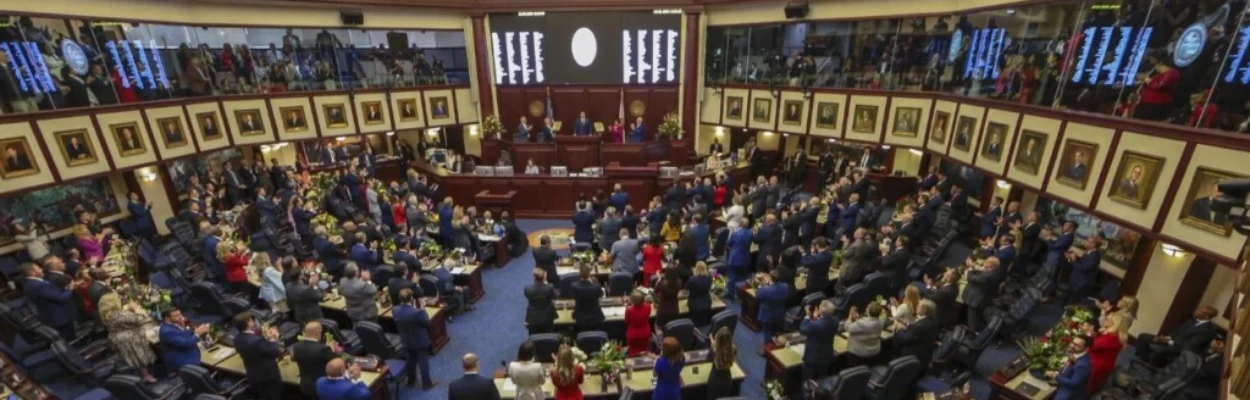
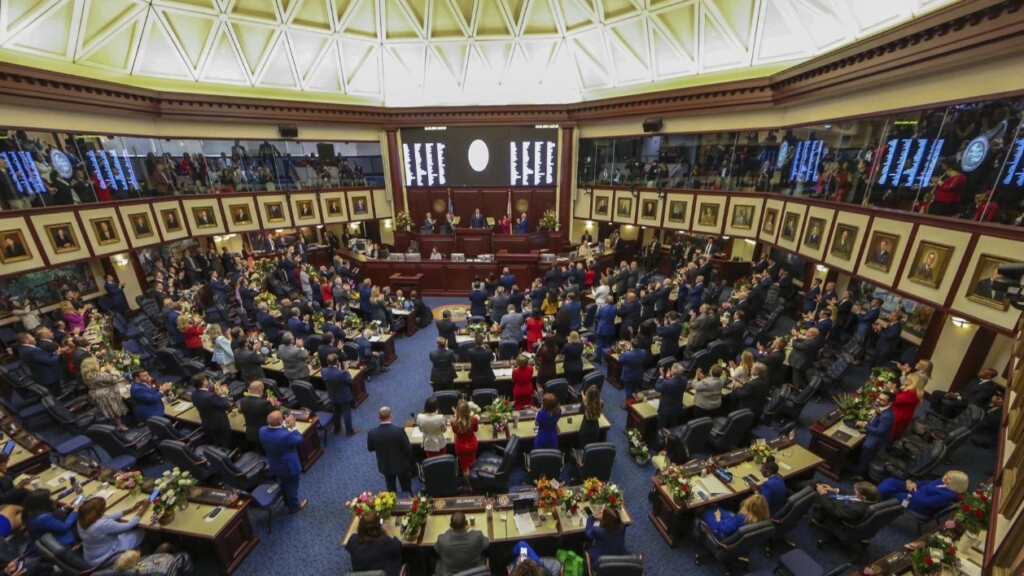
The Florida Legislature passed a $114.5 billion budget Friday, May 29, 2026. | Gary McCullough, AP
Published on May 29, 2026 at 4:36 pm
Free local news and info, in your inbox at 6 a.m. M-F. Sign up for the Jacksonville Today newsletter.
Lawmakers overwhelmingly approved a $114.5 billion spending plan Friday, wrapping up a special session to complete the budget more than two months after they failed to do so during the regular session.
The Senate voted unanimously in favor of the budget (HB 5001-E) and the House voted 99-6 for the plan.
Jacksonville Today thanks our sponsors. Become one.
All legislators from Northeast Florida voted in favor except Democratic Rep. Angie Nixon of Jacksonville. No vote was recorded for Republican Rep. Judson Sapp of Green Cove Springs.
The vast support for the measure belied the tense process to produce it.
House Speaker Daniel Perez, R-Miami, insisted on cutting the current budget of more than $115 billion, while Senate President Ben Albritton, R-Wauchula, preferred to keep funding essentially level.
Jacksonville Today thanks our sponsors. Become one.
“Floridians expect their government to spend responsibly and prioritize the issues that matter most to families across our state,” Perez said in a released statement. “For the second year in a row, the Florida House has led the charge in passing a budget that reduces spending while continuing to invest in public safety, education, environmental protection, health care, and infrastructure.”
For his part, Albritton, a citrus farmer, was pleased with the $196 million in the budget to support the beleaguered citrus industry, which has endured freezes, a greening disease and encroaching development that has led to a massive shrinking in the number of boxes it produces each year.
“Florida citrus is making a comeback, one tree at a time,” Albritton said in a released statement. “This heritage industry is not only vital to our state’s economy, but it is truly a part of our DNA. Mark my words, Florida citrus is not going down on my watch. Citrus matters, and I am running to this fight.”
The budget for schools
The budget includes $30 billion for K-12 schools, with $201 million for teacher pay increases. That raise, though, will go only to teachers with 10 years of experience, with the increase capped at $3,000 per year.
Republicans said they wanted to use the money to prevent veteran teachers from leaving the field.
“That’s a great approach to trying to retain veteran teachers,” said Sen. Danny Burgess, R-Zephyrhills, who chairs the Senate Appropriations Committee on PreK-12 Education.
Democrats, though, said the funding isn’t enough, as many districts faced potential cuts this year due to declining enrollment and teachers struggle to keep up with inflation.
There were funds included to mitigate the effect of enrollment declines for school districts, but Sen. Carlos Guillermo Smith, D-Orlando, said that would still leave Orange County with a $13 million shortfall for its schools.
Smith voted for the budget, but also took issue with the zeroing out of preeminence funding for universities. The University of Central Florida recently qualified for the funding, which is designed to push schools to boost research. But now the school won’t be able to receive the money.
In the current budget, $40 million was set aside for preeminence funding, which went to the University of Florida, Florida State University, Florida International University and the University of South Florida.
“The preeminence framework remains a part of Florida law,” said Sen. Jennifer Bradley, R-Fleming Island, vice chair of the Senate Appropriations Committee on Higher Education, in response to Smith. “This is something that I hope we will revisit next year.”
Other Democrats called for raises for all state workers, instead of the 4% raises targeted only for corrections officers, state law enforcement officials and firefighters.
“Our state employees are having difficult times paying their bills, paying for childcare, paying their car note, paying for property insurance, car insurance, all those things,” said Rep. Bruce Antone, D-Orlando. “There’s nothing we can do about pay raises this year, but for those coming back next year, I hope that we will put this on our radar screen and make sure that it happens.”
Still, only six House Democrats voted against the budget, although the main theme from Democrats was that it doesn’t do enough to help Floridians facing cost of living constraints.
“I don’t know what it’s going to take for us to wake up one day and realize that we are really not doing the things for the people in the state of Florida that we should be doing, as opposed to doing what companies need,” said Rep. Dianne Hart-Lowman, D-Tampa, who voted against the budget.
House budget chief Rep. Lawrence McClure, R-Dover, defended the spending plan as putting the state on a better fiscal path that will avoid the deficits in future years projected by state economists.
