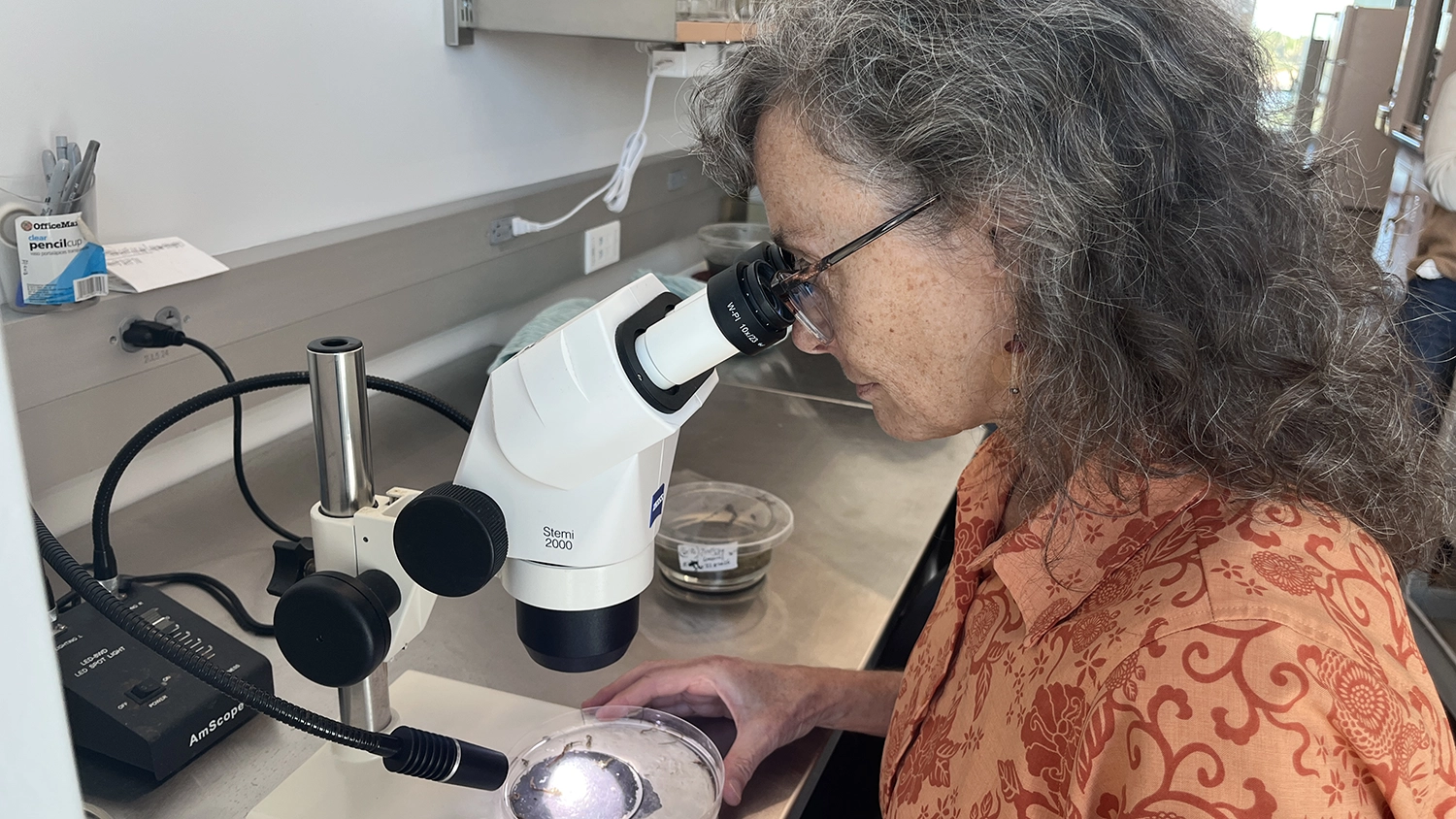
Elaine Seaver heads up research on a small species of marine worm at the University of Florida's Whitney Lab in Marineland. | Noah Hertz, Jacksonville Today
Published on October 5, 2026 at 3:14 pm
Free local news and info, in your inbox at 6 a.m. M-F. Sign up for the Jacksonville Today newsletter.
The small south St. Johns County community of Marineland is well known for its dolphins, but a team of researchers at the Whitney Laboratory for Marine Science is studying a much, much smaller animal.
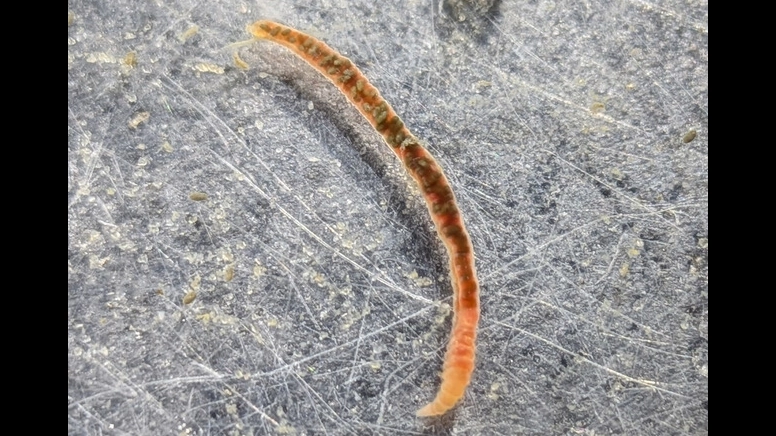
Elaine Seaver heads up research on Capitella teleta, a small marine worm that she hopes will shed light on how organisms regenerate damaged parts of their bodies.
Jacksonville Today thanks our sponsors. Become one.
“It looks a little bit like a miniature earthworm. It’s pink, it’s segmented,” Seaver explains. “This is an animal which is found in a lot of different locations.”
Key to Seaver’s research is the fact that when Capitella teleta is cut in half, it can regenerate the lost chunk of its body from its head down.
“The thinking is that if we study animals that are good at replacing lost body parts, and we study them at a high level of detail, going down to the cellular level and the molecular level, we might be able to start understanding how we could help people who have lost body parts,” she says.

Jacksonville Today thanks our sponsors. Become one.
Get to know the worm
- Adult Capitella teleta average around 2 to 4 centimeters in length.
- The marine worms live for an average of around four to six months.
- They may be easy to miss with the naked eye, but Capitella teleta can be found in muddy sentiment all over the world.
Seaver got her start at the University of Florida’s Whitney Lab in 2012. She came to the area after a stint at the University of Hawaii, where she started her research into marine worms.
Seaver’s excitement about her research was palpable when Jacksonville Today spoke with her, and her office and lab made it obvious what she studies — from a drawing of a worm on her office whiteboard to a message in the lab that read, “Worms are people, too.”
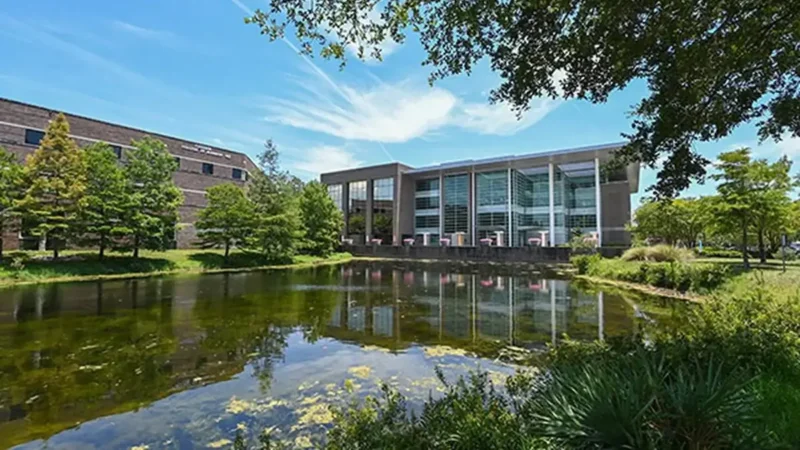
Seaver even has a species of worm named after her: amphiglena seaverae. That worm was discovered by researchers taking water samples from the pond outside of the Whitney Lab in Marineland.
Along with Capitella teleta’s regeneration, Seaver and her team also study the species’ early development.
What worms can teach us
Despite the obvious differences in our physical makeup, studying animals — including worms — can help us better understand human biology.
Seaver cites a number of examples. Much of what we know about neurons, the building blocks of our nervous system, comes from studying squid. Similarly, studying horseshoe crabs has helped researchers better understand how humans’ peripheral vision works.
Part of her interest in working with marine worms came when Seaver realized how their regenerative properties could be beneficial for biomedical research.
“Because there are so many shared features across animals,” Seaver says, “we can use animals to try to understand a lot of these fundamental properties.”
That means that on any given day at the Whitney Lab, while other researchers are studying sea urchins and fish, and the Sea Turtle Hospital is helping to rehabilitate turtles, Seaver and her team can be found checking on and conducting experiments on worms, often by dividing them in half and studying their regrowth.
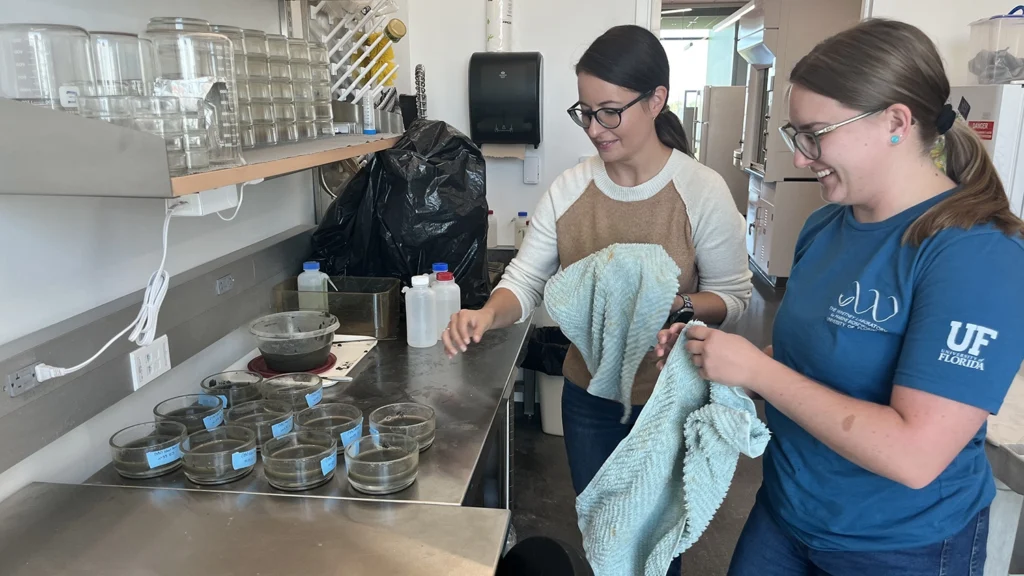
Knowing more about that, research technician Kalie Januszkiewicz says, could be groundbreaking.
“The work we’re doing on Capitella teleta in Dr. Seaver’s lab is interesting because I was surprised to find out that it can grow a new tail but not a new head, which is not the case for other kinds of worms,” she explains. “This is important because if we can figure out how the genes that control regeneration in this worm are turned on for the tail and why they are not turned on for the head, this could one day be applied to human genetics in the hopes to turn on regeneration genes in people.”
Whether those findings come in the next year, decade or century is anyone’s guess, but Seaver and her team are hard at work contributing new research to a body of work that dates back roughly a century.
Interested in volunteering at the Whitney Lab? Visit the University of Florida’s web page for the lab for more information.