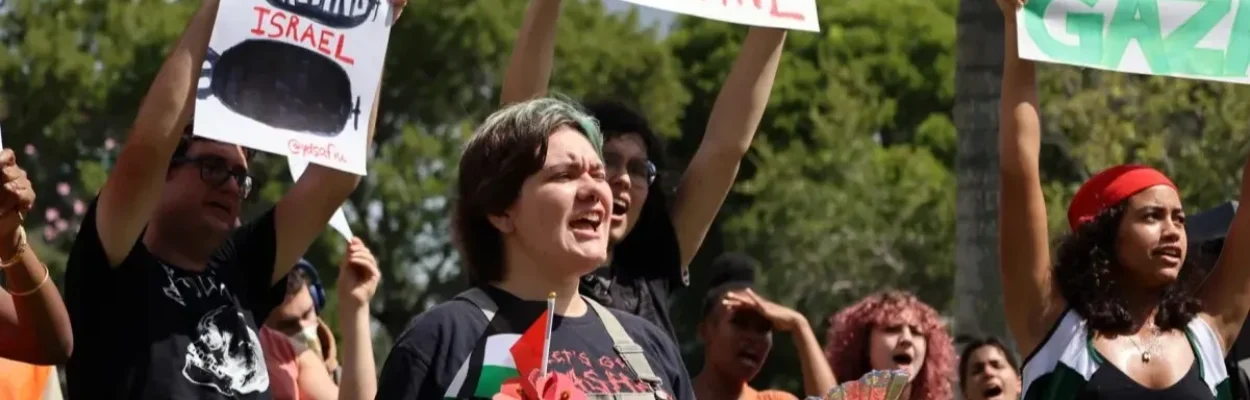
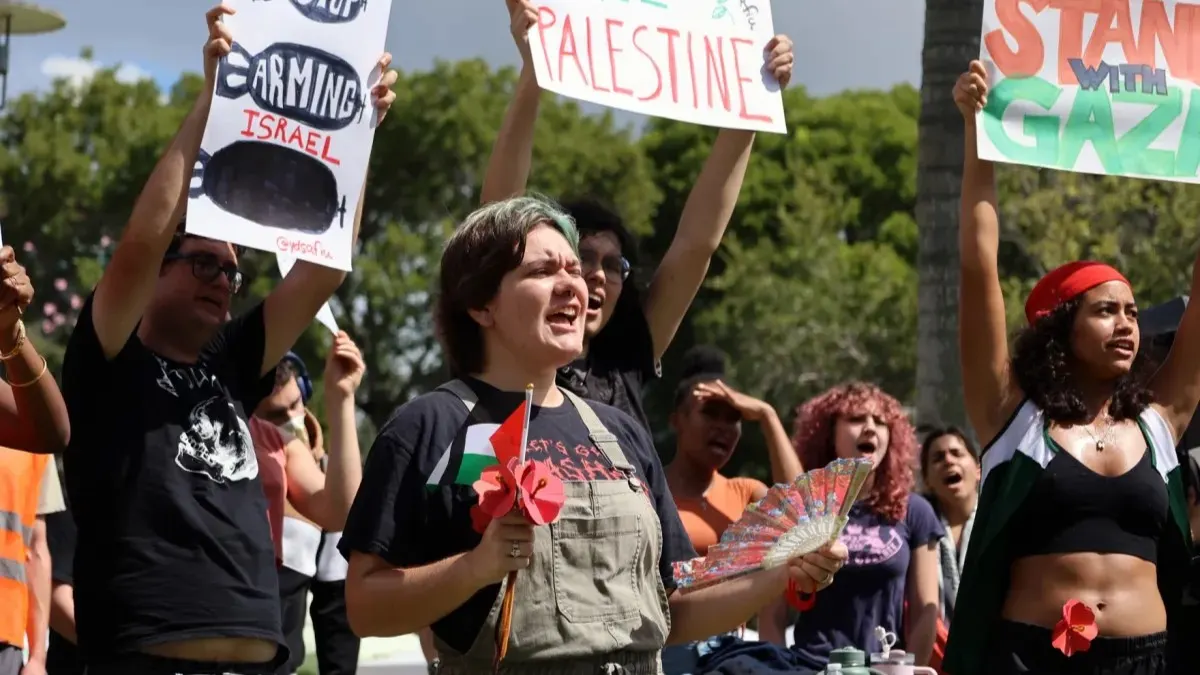
Pro-Palestinian protesters at Florida International University call on the school to divest from Israeli military contractors. | Diego Perdomo, courtesy of WLRN.
Published on October 1, 2026 at 10:56 am
Free local news and info, in your inbox at 6 a.m. M-F. Sign up for the Jacksonville Today newsletter.
This story was originally published by The Florida Trib.
Gov. Ron DeSantis’ administration is plowing ahead with officially designating a leading Muslim civil rights nonprofit, a decentralized movement known as antifa and more than 100 other groups as “domestic terrorist organizations,” in a move that critics are decrying as unprecedented and unconstitutional.
DeSantis and the Florida Cabinet voted to advance the terrorist designations Tuesday, approving the proposal in just over 30 seconds and with no discussion, under a new state law that has alarmed free speech defenders, student advocates and people of faith.
Jacksonville Today thanks our sponsors. Become one.
The legislation represents another expansion of Florida’s state security apparatus under DeSantis, who has opened pop-up immigration detention centers, reestablished the Florida State Guard — of which he is the commander in chief — and created an investigative unit to probe alleged election crimes. The remarkable expansion of police powers has also funneled hundreds of millions of taxpayer dollars to state vendors, including Republican political donors.
There was no public comment allowed at Tuesday’s meeting in the bowels of the state Capitol building, and when an attorney representing one of the groups ensnared by the designation stood up to try to speak on behalf of her client, the governor took no notice.
ACLU plans to continue legal fight
Hina Shamsi, an attorney for the American Civil Liberties Union, is part of the team representing the Florida chapter of the Council on American-Islamic Relations, or CAIR, one of the few U.S.-based organizations flagged by the DeSantis administration for the domestic terrorism designation.
Jacksonville Today thanks our sponsors. Become one.
Shamsi told reporters that CAIR-Florida’s constitutionally protected activities such as “know your rights” trainings and community organizing are at risk.
“Upon designation, a range of otherwise lawful speech and advocacy becomes subject to criminal prohibitions,” Shamsi said, which can result in “harsh criminal penalties” for “virtually anyone who would work with or associate with the designated nonprofit.”
The ACLU plans to continue its ongoing legal fight in federal court aimed at blocking implementation of the law, which Shamsi called “draconian.” If the courts don’t step in, the designation is expected to become effective on Nov. 5.
The new law empowers Florida’s executive branch to label groups as “domestic terrorist organizations,” criminalizes providing “material support” to such groups, and prohibits the use of taxpayer dollars to fund them. The measure also mandates the expulsion of students at public universities who “promote” the designated organizations, giving the governor a new tool to crack down on campus groups that engage in protests, of particular concern for those organizing on behalf of Palestinians. Additionally, private schools that receive taxpayer funded student vouchers are also barred from accepting money from people associated with the designated groups, raising concerns among Muslim schools and their students.
Republican state Sen. Erin Grall, who sponsored the legislation, defended the measure in debate earlier this year.
“I think we should all have the ability to meet, express opinions, advocate for our causes,” Grall said. “I think the criteria in here to meet the designation is a high bar, and it should be.”
But the public and designated organizations have been left in the dark about what warrants the blacklisting, after lawmakers created a public records exemption for certain documents and findings used to justify the label.
“Violent acts can and should be investigated and prosecuted,” said Bobby Block, executive director of Florida’s First Amendment. “But the government must identify unlawful conduct and prove its case. It cannot use the language of counterterrorism to cast a shadow over protected advocacy, religious association, or political dissent.”
More than 100 organizations flagged
The lengthy list of designated organizations spans the globe and includes dozens of international terror cells, drug cartels and guerrilla groups, from the Tamil Tigers, a Sri Lanka-based rebel group, to the Taliban to two offshoots of the Irish Republican Army.
Noticeably absent from the list are U.S.-based white supremacist groups that top law enforcement officials have said pose the greatest domestic terrorism threat to the country.
Members of militias and far-right extremist groups played a critical role in the Jan. 6 attack on the U.S. Capitol, which the Department of Justice has described as an act of domestic terrorism that threatened the nation’s peaceful transfer of power. Five people died as a result of the attack, including a police officer, and prosecutors estimate that 140 officers suffered injuries that day.
Florida has become a training ground for far-right agitators, such as former Proud Boys leader Enrique Tarrio, who was sentenced to a record 22-year prison term for his role in orchestrating the attack on the U.S. Capitol. Tarrio was released from prison and returned to Miami last year after President Donald Trump wiped away his sentence in a sweeping order that benefited more than 1,500 other Jan. 6 defendants.
The Proud Boys and other homegrown extremist groups were not among the organizations flagged by the state of Florida.