
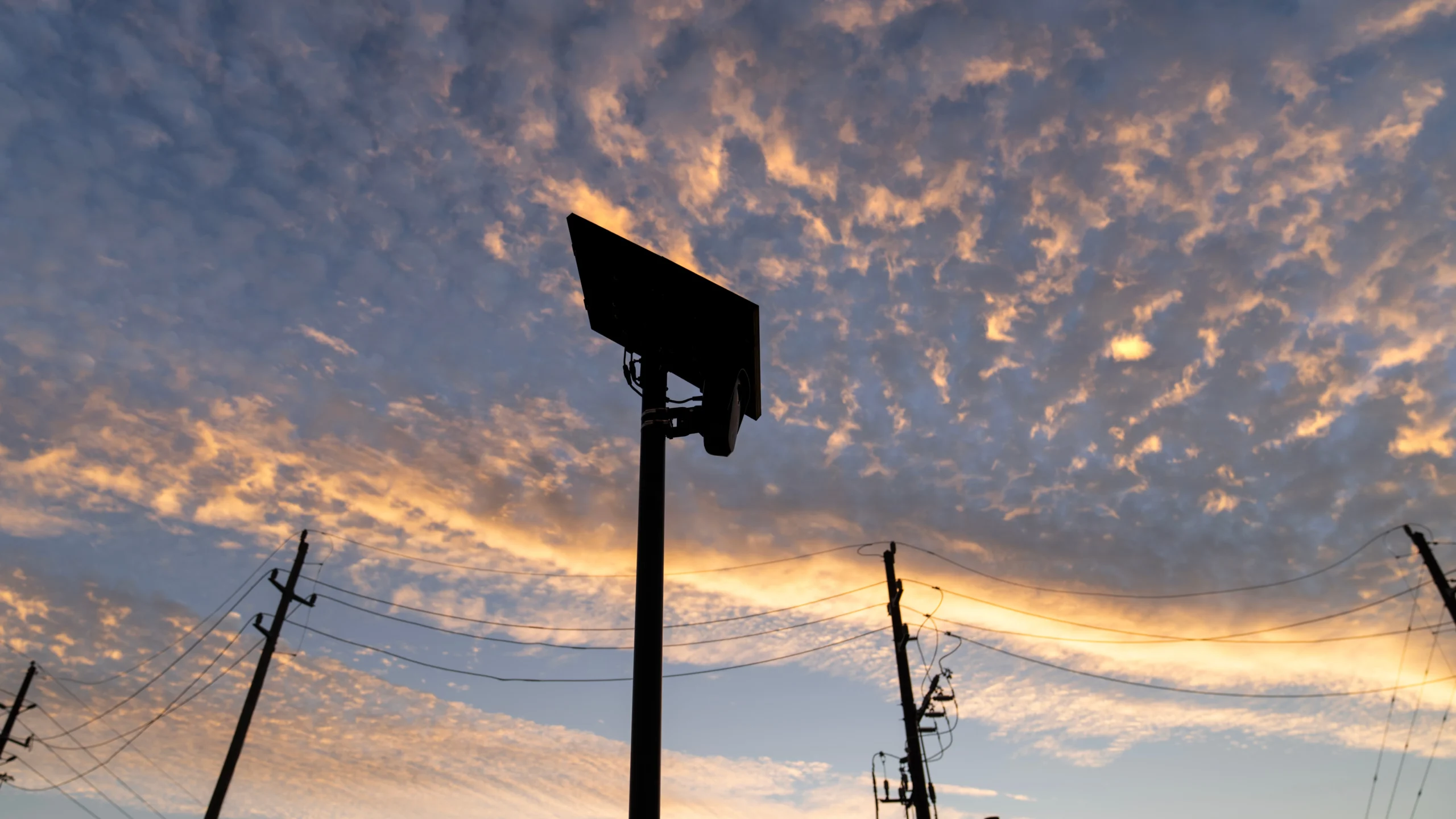
A Flock Safety license plate reader is seen along a public road. | David Goldman, AP file
Published on September 16, 2026 at 11:45 am
Free local news and info, in your inbox at 6 a.m. M-F. Sign up for the Jacksonville Today newsletter.
St. Johns County Sheriff Rob Hardwick made a passionate defense of the department’s use of the Flock Safety license plate reader system at a final budget hearing Tuesday, detailing crimes solved by the technology while acknowledging the department needed to tighten its data practices.
The meeting drew public comment from residents concerned about civil liberties and data privacy — and it ended with commissioners agreeing to take two weeks to review legal options before making any decisions about the cameras.
Jacksonville Today thanks our sponsors. Become one.
The Sheriff’s Office says it began using license plate reader technology in 2017 with a company called Vigilant, which was later acquired by Motorola. The department has since switched to the Flock Safety system.
The Sheriff’s Office said when a Flock camera photographs a license plate, the plate is automatically checked against the National Crime Information Center and the Florida Crime Information Center (FCIC), the same databases law enforcement agencies across the country use to track stolen vehicles, wanted persons and missing people.
“It’s simply one lead of a lot of other investigative techniques that have to be used,” Hardwick said.

Jacksonville Today thanks our sponsors. Become one.
Crimes solved using Flock cameras
Hardwick offered two specific cases to illustrate the technology’s value.
In one case, a man riding a scooter near State Road 16 was struck and killed by a driver who fled the scene. Investigators used a broken headlamp fragment found at the scene to identify the suspect vehicle as a white Honda. Using the Flock system, detectives traced the vehicle’s movements in the hours after the crash.
“Our real-time intelligence unit actually picks up a white Honda that actually crossed that area at the time of the death of the individual,” Hardwick said. “We made contact with the individual. She was physically loading the vehicle with remnants of the man’s body, DNA, hair, fibers on the car, onto a wrecker, to tow it to a repair shop to get it fixed. She didn’t know what she hit.”
READ MORE: St. Johns County will remove at least some of its Flock cameras
In a second case, Hardwick said a 12-year-old girl was sexually assaulted at a bus stop by a man she had met on a social media platform. Investigators used a description of a silver vehicle with visible damage, entered it into the license plate reader system and identified a suspect who was later connected to similar crimes involving 13 other children in Flagler County.
Hardwick also cited statistics from 2026 alone, including 29 stolen vehicles recovered, 23 stolen license tags recovered, 35 wanted persons arrested, 62 persons charged, 132 felony charges cleared, 54 misdemeanor charges cleared and 35 missing persons recovered.
Data practices tightened
Hardwick and Patrol and Operations Division Chief Kevin Cronin acknowledged the department had previously operated with practices that needed reform.
They said the retention period for license plate data has been reduced from three years under the prior administration, then to one year, and now to 30 days, with the system automatically overwriting older data. The number of users with access to the system has also been reduced, and a supervisor must now approve any “hot list” entry — a flag placed on a vehicle connected to a crime.
Perhaps most significantly, the department has ended data sharing with outside agencies entirely.
“We have shared data since the inception with agencies, law enforcement agencies all over the country,” Cronin said. “That is true. That was said here. That’s accurate. We have made changes that we no longer share data.”
Cronin confirmed the Flock system does not use facial recognition and does not collect data from cellphones, addressing questions raised by commissioners.
Cameras coming down from state right of ways
The Florida Department of Transportation sent a notice requiring the removal of Flock cameras from state right of ways, giving departments 30 days to comply. Hardwick said roughly half of the department’s approximately 182 cameras would come down as a result.
Hardwick said he attended a meeting in Orlando with more than 30 Florida sheriffs to discuss the issue and is serving on a committee — selected by the governor’s office and the Florida Sheriffs Association — working to establish clearer statewide standards for license plate reader technology. He said the committee is led by Sheriff Adkinson of Walton County.
The removed cameras will not be relocated to county right of ways, Hardwick confirmed.
“We have no plans of putting them back up anywhere else,” he said.
Commission weighs moratorium
Commissioner Christian Whitehurst argued in favor of an immediate moratorium on the use of Flock cameras, citing privacy concerns and noting that leaders including Gov. Ron DeSantis had called the proliferation of the technology “out of control.”
“I think we need to err on the side of privacy,” Whitehurst said. “Not because I think anybody’s doing anything bad or they’re bad people, but … it might make people easier to catch, but it doesn’t keep us safe.”
The county attorney cautioned commissioners that because the sheriff is a constitutional officer with statutory authority over operations and equipment, a formal moratorium may not be the appropriate mechanism. The attorney noted the board does control the sheriff’s budget and could potentially explore other options related to county right-of-way permits.
Commissioners ultimately reached a consensus to spend two weeks reviewing legal options and directing staff to report back before taking any action.
“I would be more than happy to agree with the sheriff to take these last two weeks to consider our options before we make a decision about that,” commissioner Clay Murphy said.
Hardwick urged the board not to remove the $500,000 in Flock camera funding from the budget regardless of the outcome, saying the money could be redirected to staffing needs — including dispatchers, whose starting salaries have grown from $30,000 to $55,000 during his tenure.
HOA cameras are separate
Hardwick and Cronin also clarified a point of confusion raised by commissioners: Approximately 100 additional license plate readers in St. Johns County are owned and operated by homeowners associations, not the Sheriff’s Office.
“They own the property. It’s their property,” Hardwick said.
Cronin noted that HOA-owned systems may grant data access to community members, but that is entirely separate from how the Sheriff’s Office handles its own Flock data. He said community members have no access to data collected by the Sheriff’s Office’s system.
This story was produced by News4Jax, a Jacksonville Today news partner.