

St. Paul Union Depot | Ennis Davis
Published on August 12, 2026 at 1:15 pm
Free local news and info, in your inbox at 6 a.m. M-F. Sign up for the Jacksonville Today newsletter.
Once one of the busiest passenger rail stations in the Midwest, St. Paul Union Depot sat without passenger trains for more than four decades. Its restoration offers a compelling example of how a historic downtown train station can find new life as a multimodal transportation hub and destination.
For much of the 20th century, the St. Paul Union Depot was a gateway to Minnesota’s capital city, a bustling center of passenger travel and mail service, and one of the landmarks of Downtown St. Paul’s Lowertown neighborhood. Then the trains disappeared.
Jacksonville Today thanks our sponsors. Become one.
For more than 40 years, the historic depot went without passenger rail service as portions of the sprawling property were adapted for other uses. But unlike many grand American railroad terminals that disappeared during the second half of the 20th century, Union Depot survived.

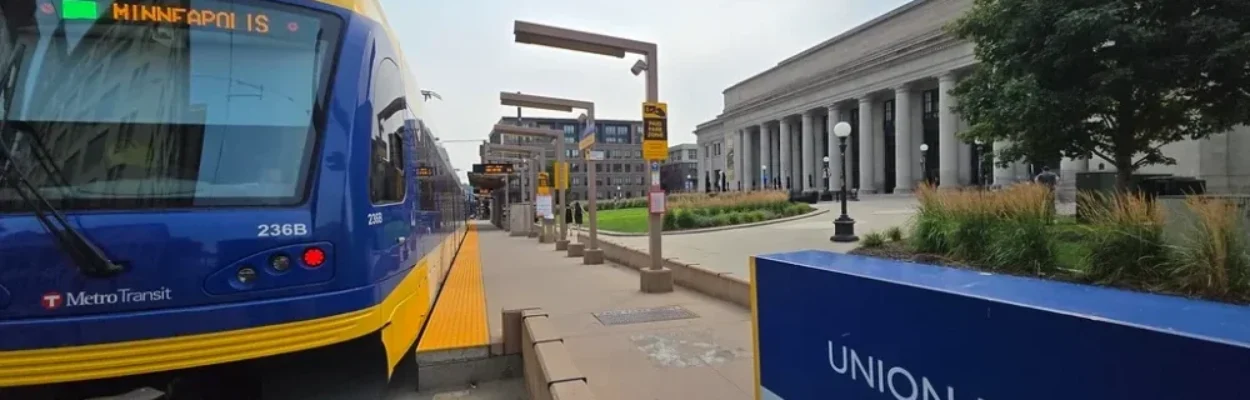
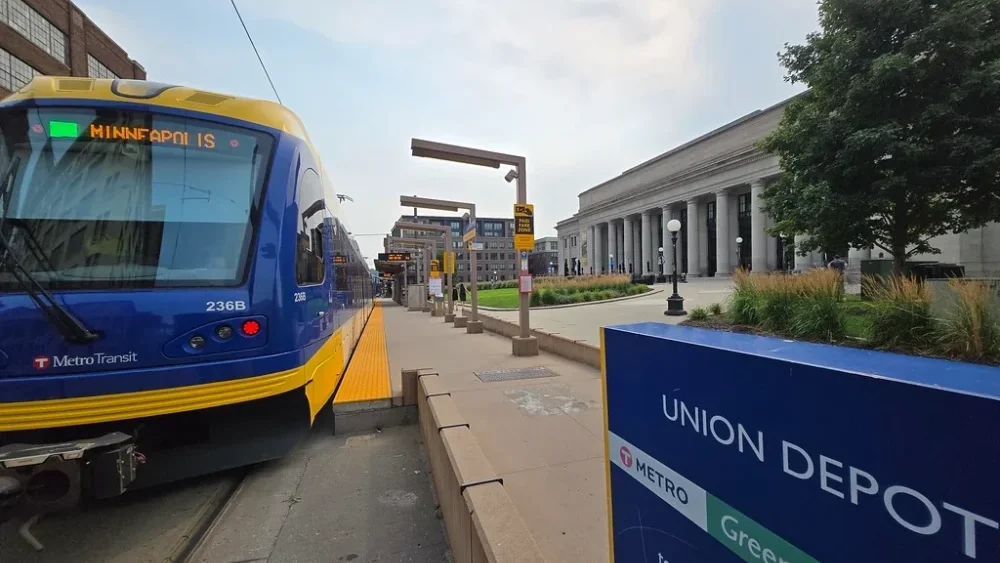
Today, the restored station has again become a transportation crossroads, this time bringing together Amtrak trains, light rail, local and intercity buses, restaurants, shops and other uses beneath one historic roof.
Its journey from railroad hub to closure and rebirth offers an intriguing comparison for cities such as Jacksonville that are considering what a restored Downtown passenger rail station could become.

Jacksonville Today thanks our sponsors. Become one.
Built for the Railroad Age

Construction of St. Paul Union Depot began in 1917 on the site of an earlier station destroyed by fire in 1915. World War I interrupted construction, however, and the new terminal was not completed until 1923. Architect Charles Sumner Frost designed the depot in the Classical Revival style. Frost, a prolific designer of railroad stations, was also the architect behind Chicago’s Navy Pier Auditorium.
The completed Union Depot quickly became an important piece of St. Paul’s transportation infrastructure. During its 1920s heyday, the station handled more than 282 train movements a day. However, passengers were only part of the activity. The depot also handled more than 20 million pieces of mail annually, taking advantage of its proximity to the St. Paul Central Downtown Post Office. Trains, passengers, postal workers and mail combined to make the station and its surroundings a hive of activity.
The depot eventually became a recognized historic landmark. It was added to the National Register of Historic Places on Dec. 18, 1974. By then, however, America’s passenger railroad landscape had dramatically changed.
When the trains left

St. Paul Union Depot closed to passenger trains on April 30, 1971. The timing was significant. The following day, May 1, the newly created Amtrak formally assumed operation of most intercity passenger rail service in the United States. Twin Cities passenger operations were consolidated at Minneapolis’ Great Northern Depot, leaving Union Depot without the trains that had defined it for generations.
Similar to Jacksonville’s train station, which was converted into the Prime Osborn Convention Center in 1985, Union Depot did not disappear. But its role changed. The U.S. Postal Service took over a portion of the property while other areas remained vacant. During this period, a place designed around the constant movement of trains and travelers entered a long period of uncertainty. Still, the idea of trains returning to Union Depot never entirely went away.
A vision takes shape

For decades, advocates pushed for the return of passenger rail service. Momentum began building in the early 2000s. The depot’s upper floors were converted into loft condominiums, bringing a new use to part of the historic complex. A much larger transformation was soon to follow.
In 2005, the Ramsey County Regional Railroad Authority secured funding to begin renovating Union Depot as an intermodal transportation hub. Four years later, the depot was purchased for $8.2 million. The vision went well beyond simply preserving an old train station. Union Depot would become a station on the METRO Green Line light rail system while planners preserved the possibility of eventually returning intercity passenger trains to the property.
A major obstacle remained: Decades of other uses had physically altered the railroad complex. After the U.S. Postal Service relocated its operations in 2010, restoration work could move forward. The project included demolition of a Postal Service building that blocked access to the tracks, an essential step if Union Depot was going to function as a train station again. The resulting rehabilitation represented an investment of approximately $235 million. Work was completed in 2012.
Union Depot was a train station again in appearance and purpose. However, intercity passenger rail service, an important piece of the vision, was still missing. That changed in May 2014. More than four decades after the final passenger trains departed Union Depot, Amtrak service returned to the historic terminal.
The restoration accomplished something larger than reopening an old railroad station. Union Depot had been reinvented for an era in which travelers move between multiple forms of transportation. Today, the Ramsey County Regional Railroad Authority-operated depot brings together Amtrak intercity passenger rail, METRO Green Line light rail, intercity buses and local bus service.
The historic concourse has uses beyond transportation as well, including restaurants and boutique retail offerings. That combination helps make the depot both a transportation facility and a destination.
A potential lesson for Jacksonville

The parallels between St. Paul and Jacksonville are not exact, but Union Depot provides a useful example of what can happen when a city looks beyond simply restoring train service.
Jacksonville’s historic Downtown railroad terminal, now part of the Prime F. Osborn III Convention Center and a future part of University of Florida’s proposed Jacksonville campus, once served as a major gateway to Florida. Like Union Depot, it was built during the golden age of American passenger rail and eventually lost the trains that once made it the largest passenger railroad station in the country south of Washington, D.C.
St. Paul’s experience demonstrates that decades without passenger trains do not necessarily represent the end of a historic station’s transportation role. But Union Depot’s revival required years of advocacy, public investment, property acquisition, adaptive reuse and significant infrastructure work. Its transformation also did not depend on passenger rail alone.

Instead, a place was created where different forms of transportation could converge while restaurants, shops, residences and surrounding development helped give the historic property new life. Nearly a century after Union Depot first welcomed travelers, people are once again arriving and departing by train.
The station’s story is ultimately not just about preservation. It is about reuse, taking infrastructure built for an earlier era and finding a new role for it in the transportation network of the 21st century and the revitalization goals of the community it supports.