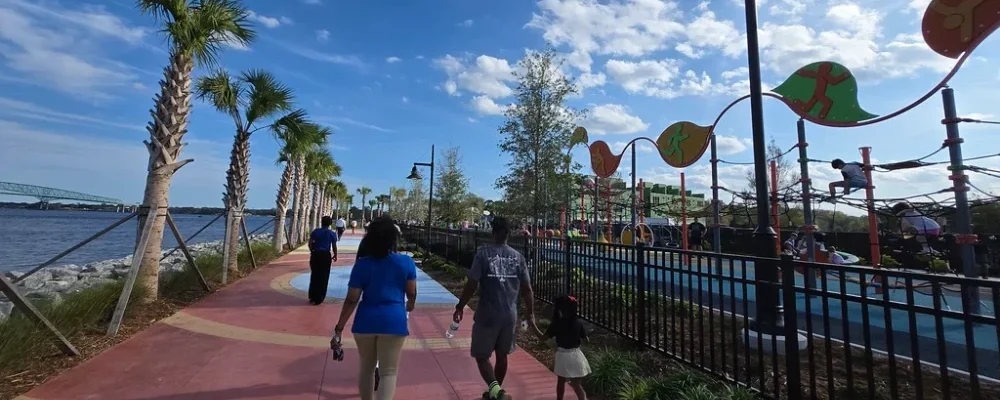
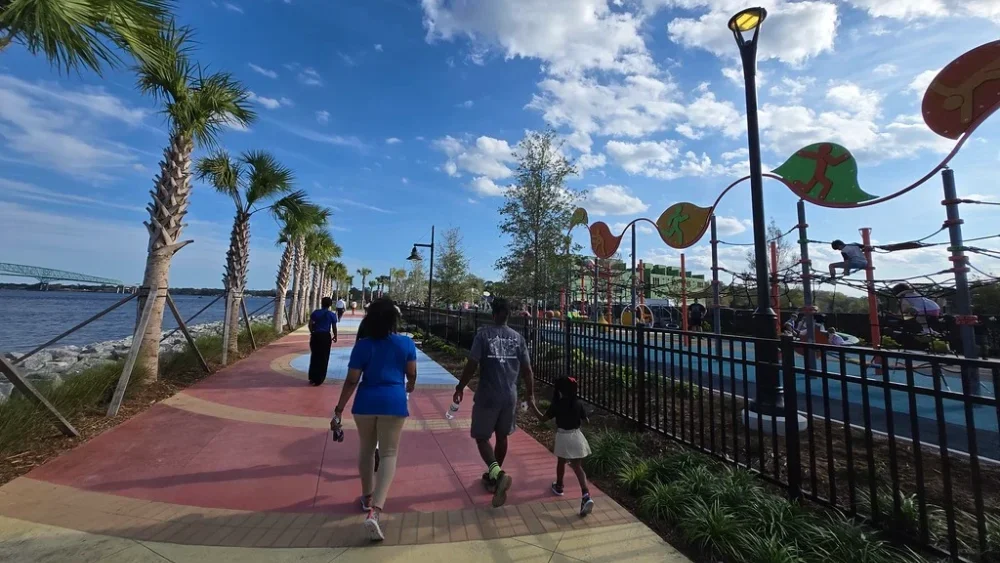
Stretching nearly three miles along both the Northbank and Southbank of the St. Johns River, Jacksonville's Riverwalks offer some of the city's most spectacular waterfront views.
Published on July 23, 2026 at 10:16 am
Free local news and info, in your inbox at 6 a.m. M-F. Sign up for the Jacksonville Today newsletter.
Looking for something to do? Here’s a list of 12 worthwhile Jacksonville activities that are FREE to enjoy.
1. Big and Little Talbot Island State Park
State Road A1A between Amelia Island and the Mayport Ferry
Jacksonville Today thanks our sponsors. Become one.

For nature lovers and outdoor adventurers alike, Big Talbot Island and Little Talbot Island State Parks offer thousands of acres of unspoiled coastal forests, dunes, salt marshes and scenic shoreline. Located just 20 miles northeast of Downtown Jacksonville, within the Timucuan Ecological and Historic Preserve, these neighboring parks protect two of the few remaining undeveloped barrier islands in Northeast Florida, and provide habitat for an incredible diversity of wildlife.
Once home to the historic Spicer and Houston plantations, Big Talbot Island is best known for Blackrock Beach, one of Jacksonville’s most remarkable natural attractions. The beach is lined with weathered tree skeletons that create a dramatic landscape unlike anywhere else in Florida. The island is also renowned for its rare coastal-erosion features and distinctive geological formations.
Together, the Talbot Islands offer more than five miles of beaches, hiking and nature trails, kayaking and fishing opportunities, picnic areas, campgrounds and exceptional wildlife viewing. Whether you’re looking for a peaceful walk, a day on the water, or a chance to experience one of Florida’s most pristine coastal environments, the Talbot Islands provide an unforgettable outdoor escape.
Jacksonville Today thanks our sponsors. Become one.
2. Downtown Riverwalks

Stretching nearly three miles along both the Northbank and Southbank of the St. Johns River, Jacksonville’s Riverwalks offer some of the city’s most spectacular waterfront views. Visitors can stroll or bike along scenic pathways, discover public art, relax in riverfront parks, watch boats cruise by or enjoy breathtaking sunsets over the downtown skyline.
The Riverwalks also connect many of Downtown’s most popular destinations, making them an ideal starting point for exploring the city. Today, both Riverwalks are anchored by a growing collection of family-friendly parks and attractions, including Riverfront Plaza, the Riverfront Music Garden, Friendship Fountain and RiversEdge Park, creating one of Jacksonville’s premier outdoor destinations.
3. Durkeeville History Museum & J.P. Small Memorial Park Baseball Museum
1293 West 19th Street (Durkeeville History Museum) 1701 North Myrtle Avenue (JP Small Memorial Stadium)

Long before the Baseball Grounds of Jacksonville or Wolfson Park, J.P. Small Memorial Park was the heart of early 20th century professional baseball in Jacksonville still stands today. Originally known as Durkee Field, the ballpark opened in 1912 and later became home to the Negro American League’s Jacksonville Red Caps. Early teams that played here included the Jacksonville Tars and the Jacksonville Athletics, a club that counted James Weldon Johnson among its players. Baseball legends including Babe Ruth, Lou Gehrig and Hank Aaron all took the field at J.P. Small.
Aaron made history here in 1953 when, alongside teammates Félix Mantilla and Horace Garner, he helped break organized baseball’s color barrier in the Deep South while playing for the Jacksonville Braves. During his time in Jacksonville, Aaron lived in nearby Durkeeville, where he also met his future wife.
Acquired by the City of Jacksonville in 1932, the stadium narrowly escaped demolition in 1982 after neighborhood residents rallied to save it. The ballpark was restored in 1985, and a museum celebrating its rich baseball legacy was added during a 2006 renovation. Today, the site is undergoing another transformation, with plans for an expanded standalone museum and an interactive baseball-themed children’s playground opening in 2027.
The museum is operated by the Durkeeville Historical Society, which also manages the nearby Durkeeville History Museum. Together, these institutions preserve and share the history of Durkeeville, one of Jacksonville’s most significant historic Black neighborhoods.
4. Fort Caroline National Memorial
12713 Fort Caroline Road

History comes alive at Fort Caroline National Memorial, one of Jacksonville’s most significant historic sites. In 1564, French explorer René Goulaine de Laudonnière established Fort Caroline as a colony for France and a refuge for French Huguenots and free African Moors. Just one year later, Spanish forces from the newly founded settlement of St. Augustine captured the fort, ending France’s brief colonial presence in Florida.
Although the original location of Fort Caroline has never been definitively identified, visitors can explore a reconstructed fort that interprets this pivotal chapter in North American history. The National Memorial is part of the 50,000-acre Timucuan Ecological and Historic Preserve, one of the largest urban park preserves in the country, where visitors can also enjoy scenic hiking trails and the Timucuan Preserve Visitor Center.
The preserve is also home to several other notable destinations, including Kingsley Plantation, the Theodore Roosevelt Area, Cedar Point and the Spanish Pond archaeological site, making it an ideal destination for anyone interested in history, nature or both.
5. Jacksonville Beach Seawalk and Pavilion
75 North First Street, Jacksonville Beach, FL

You don’t have to be a beach lover to enjoy the Jacksonville Beach Seawalk and Pavilion. Stretching 2,800 feet between Beach Boulevard and 7th Avenue North, the oceanfront Seawalk serves as the centerpiece of Jacksonville Beach. The paved promenade connects visitors to the beach, oceanfront restaurants, shops, bars, hotels, and one of Northeast Florida’s most vibrant entertainment districts.
At the heart of the Seawalk is the Jacksonville Beach Seawalk Pavilion, a unique oceanfront venue that hosts free community events throughout the year. From the Great Atlantic Seafood & Music Festival to the Moonlight Movies Film Series, Fourth of July Liberty Fest, live concerts and seasonal celebrations, there’s almost always something happening just steps from the sand. Whether you’re taking a leisurely stroll, enjoying the ocean views or attending one of its many events, the Seawalk offers one of the best free experiences in Jacksonville.
Upcoming events and additional information
6. Jacksonville Farmers Market
1810 West Beaver Street

For an authentic Jacksonville experience, head to the Jacksonville Farmers Market, one of the city’s most beloved and often overlooked destinations. Located just west of Downtown in the Rail Yard District and city’s historic Gullah Geechee neighborhoods, the market has been serving the community since 1938, making it the oldest continuously operating farmers market in Florida. Welcoming more than 25,000 visitors each week, it is also the state’s only farmers market open seven days a week.
The market features dozens of local vendors offering fresh produce, seafood, flowers and plants, local honey, boiled peanuts, baked goods, gourmet sauces and dressings, spices and specialty foods from around the world. Whether you’re shopping for fresh ingredients, enjoying a casual stroll or sampling local flavors, there’s something for everyone. Hours are Monday through Saturday, 7:00 a.m. to 5:00 p.m., and Sunday, 9:00 a.m. to 4:00 p.m.
7. JEA Facility Tours

Go behind the scenes of one of Northeast Florida’s largest public utilities with a free tour of JEA’s facilities. As the largest community-owned electric utility in Florida and one of the largest in the United States, JEA provides electric, water, sewer and reclaimed water services to more than one million residents across Northeast Florida.
The utility traces its roots to Jacksonville’s first municipal water system, established in 1880, and the city’s first electric power station, which began operating in 1895. Following the 1968 consolidation of the City of Jacksonville and Duval County governments, JEA became an independent public authority dedicated to serving the region’s growing infrastructure needs.
JEA offers complimentary guided tours of several facilities, including solar farms, water treatment plants, wastewater treatment facilities and chilled water plants. These educational tours provide a fascinating look at how essential public utilities operate and how clean water and reliable energy are delivered every day.
8. Kingsley Plantation
11676 Palmetto Ave.

History enthusiasts won’t want to miss Kingsley Plantation, one of Jacksonville’s most significant Gullah Geechee cultural heritage sites. Managed by the National Park Service as part of the Timucuan Ecological and Historic Preserve, the site is home to Florida’s oldest surviving plantation house and one of the nation’s best-preserved rows of tabby slave cabins.
The plantation’s story began in 1765, when British colonists established an indigo plantation on Fort George Island. In 1814, the property was purchased by Zephaniah Kingsley Jr., who managed the plantation alongside his wife, Anna Madgigine Jai (born Anta Madjiguène Ndiaye), a Wolof woman from present-day Senegal. Originally enslaved by Kingsley, Anna later gained her freedom, became his wife and emerged as a successful plantation manager, businesswoman and landowner. Her life and legacy later became central to one of the antebellum South’s most significant legal battles over the rights of free Black people.
Today, visitors can explore the plantation house, kitchen house, barn, gardens and the remains of the enslaved community while learning about the lives of the people who lived and labored on the plantation. Ranger-led programs and interpretive exhibits provide a compelling look at Florida’s colonial, plantation and African American history. Kingsley Plantation is open daily from 9:00 a.m. to 5:00 p.m., except on major holidays.
9. LaVilla: Lift Ev’ry Voice and Sing Heritage Trail
120 Lee St.

Step into the story of LaVilla, one of the nation’s most influential historic Black neighborhoods, on the free, self-guided LaVilla: Lift Ev’ry Voice and Sing Heritage Trail. Founded in 1866, LaVilla grew into a nationally significant center of Black culture, education, music, business and civil rights. In addition to being one of Florida’s oldest urban Gullah Geechee communities, it was also home to a smaller diverse community of Cuban, Syrian, Greek, Jewish, Chinese and other immigrant families whose contributions helped shape Jacksonville’s identity.
The 1.76-mile trail features 22 interpretive markers that bring LaVilla’s remarkable history to life. Inspired by the birthplace of Lift Ev’ry Voice and Sing, widely known as the Black National Anthem, the trail explores the neighborhood’s profound influence on American history, from the rise of the Chitlin’ Circuit and the early blues to the Great Migration and the Civil Rights Movement.
Along the way, visitors can discover landmarks including the Jacksonville Terminal, Maceo Elks Lodge, Masonic Temple, Brewster Hospital, El Modelo Block, Lift Ev’ry Voice & Sing Park, the Emerald Trail and numerous other sites that tell the stories of the people, places and events that made LaVilla one of the South’s most important cultural neighborhoods. Today, the trail not only preserves this extraordinary legacy but also invites visitors to experience LaVilla’s ongoing revitalization.
10. Mandarin Museum & Historical Park
11964 Mandarin Road

A visit to the Mandarin Museum & Historical Park is like stepping back into Old Florida without ever leaving Jacksonville. Nestled along the St. Johns River in the heart of Mandarin, the 11-acre riverfront park occupies part of a homestead established by Major William Webb in 1873 and offers a fascinating glimpse into the region’s past.
The park features a beautifully restored 19th-century farmhouse, historic barn, sawmill, African American schoolhouse, nature trails, a scenic riverfront boardwalk, picnic areas and the Mandarin Museum. Museum exhibits explore the history of the Maple Leaf, a Union Civil War steamboat that struck a Confederate mine and sank just offshore, as well as Mandarin’s rich Gullah Geechee heritage and the community’s agricultural and riverfront history.
Operated by the Mandarin Museum & Historical Society in partnership with the City of Jacksonville, the Mandarin Museum is open Tuesday through Saturday, 10:00 a.m. to 4:00 p.m., and on the first Saturday of each month (10:00 a.m. to 2:00 p.m.), visitors can tour the park’s historic buildings with volunteer docents.
11. Sally Dark Rides (The Robot Factory)
745 W. Forsyth St.

For a behind-the-scenes look at one of Jacksonville’s most unique industries, take a free tour of Sally Dark Rides, one of the world’s leading designers and manufacturers of animatronic figures and immersive attractions. Founded in Downtown Jacksonville in 1977 by John Wood, John Fox and John Holland, the company has spent nearly five decades creating award-winning experiences for theme parks, museums, zoos and entertainment venues around the globe.
During the guided tour, visitors can watch artists, engineers, sculptors and technicians at work as they design and build lifelike animatronic characters, special effects and ride systems. It’s a fascinating opportunity to see how imagination, art and technology come together behind the scenes.
Free group tours are available by reservation on Tuesdays and Thursdays, with hourly departures from 9:00 a.m. to 1:00 p.m. Tours are not offered during June, July and August. Participants must be at least seven years old.
12. Sweet Pete’s Candy Factory
400 N. Hogan St.

Sweet Pete’s Candy is one of Jacksonville’s sweetest attractions and a must-visit destination for families, couples and anyone with a sweet tooth. Whether you’re planning a summer adventure, a rainy-day outing or a fun stop while exploring Downtown, there’s something for everyone to enjoy.
Housed in the beautifully restored 1903 Seminole Club building, Sweet Pete’s is one of the nation’s largest candy stores. Visitors can browse colorful displays of handcrafted sweets, watch candy being made through viewing windows when production is underway, explore the whimsical décor or enjoy a meal or dessert at the on-site restaurant. Even if you don’t buy a treat, it’s a fun and memorable place to explore.