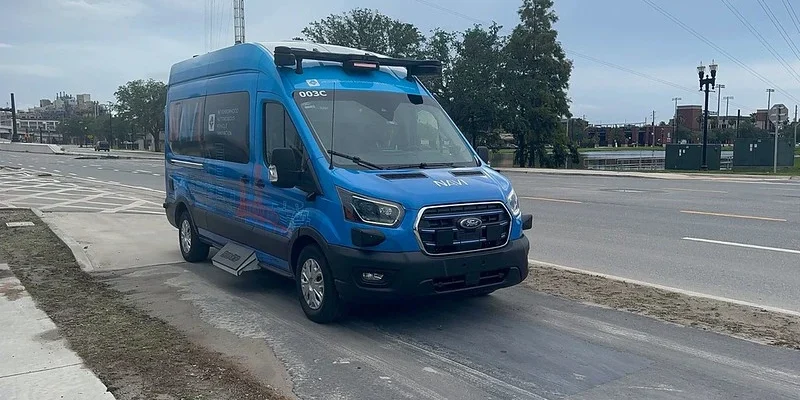
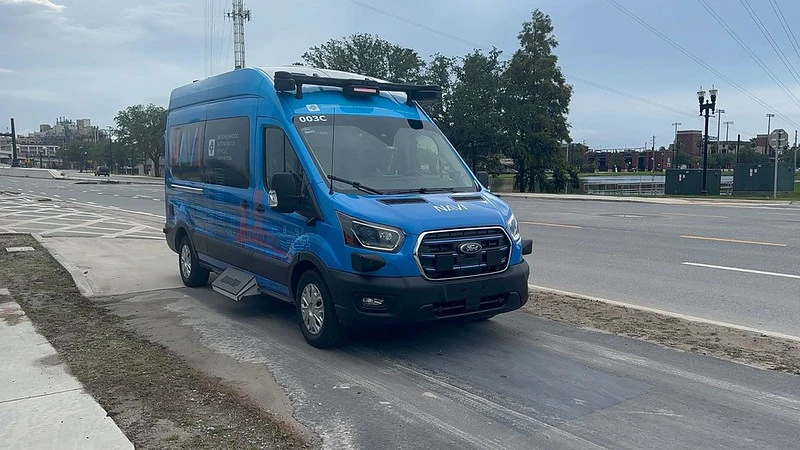
Outgoing JTA CEO Nathaniel P. Ford's oversaw major changes and new initiatives, including the introduction of Neighborhood Autonomous Vehicle Innovation, or NAVI (pictured)
Published on July 16, 2026 at 8:58 am
Jacksonville Today seeks to include a diverse set of perspectives that add context or unique insight to the news of the day. Regular opinion columnists are independent contractors who are not involved in news decisions. Want to submit your own column on a matter of public interest? Email pitches to jessica@jaxtoday.org.
After 14 years leading the Jacksonville Transportation Authority, CEO Nathaniel P. Ford announced on this month that he would be departing JTA in January of 2027. Across three mayoral administrations, Ford was a steadfast leader of the transit agency, while overseeing dramatic change.
Ford’s tenure saw major victories, including the rollout of the First Coast Flyer Bus Rapid Transit system, construction of the Jacksonville Regional Transportation Center at LaVilla, and the agency’s adoption of the St. Johns River Ferry. He was also subject to controversy, including over his compensation and publicly-funded travel, but most of all over his signature project: the Ultimate Urban Circulator, an ambitious program to replace the Skyway monorail with a network of self-driving shuttles in Downtown and other neighborhoods. That program’s first phase, Neighborhood Autonomous Vehicle Innovation (NAVI), launched service along Bay Street last year.
Jacksonville Today thanks our sponsors. Become one.
Ford leaves his successor with daunting challenges ahead. JTA’s board of directors approved a budget in May with severe cuts to transit service, driven by declining sales tax revenue. That board has been reshaped by state legislation that expanded representation to the three counties surrounding Jacksonville, with major implications for the authority’s future. JTA’s bus service has struggled to rebound after the COVID-19 pandemic, with a fare reduction pilot in early 2026 doing little to make up for lagging service quality despite new residents flocking to the region. NAVI, while acclaimed by visiting officials and strongly backed by Mayor Donna Deegan, has been widely panned for its struggle to attract riders and lingering questions over its technical practicality for urban transit needs. And the system NAVI was intended to replace, the Skyway, is struggling with age and the need for longer-term solutions as Downtown development rises around it.
Amidst many questions over the future of JTA, here are some potential courses of action for its next CEO to set a path forward:
Running better buses more

For now, JTA’s bus services will remain the backbone of Northeast Florida’s transit system. With higher fares, riders won’t be impressed by flashy renderings and futuristic promises. The basics of reliable, frequent service may be the most important thing JTA can do to build public trust going forward, after notable instances of falling short.


Jacksonville Today thanks our sponsors. Become one.
JTA’s next CEO may appreciate one gift from their predecessor: the successful passage of the Local Option Gas Tax (LOGT) expansion in 2021, providing more than $48 million in funding to enhance bus stops throughout the county, including a focus on Northwest Jacksonville.
In an era with limited operating funding, it will be key to utilize capital funding opportunities when they exist to stretch the value of every trip, with greater efficiency and ease to attract new riders. JTA must leverage its ability to fulfill its most basic responsibility: running buses people can ride.
Taking advantage of active transportation

JTA is already responsible, as part of the LOGT expansion, for supporting the development of the Emerald Trail, an extensive trail network throughout Jacksonville’s urban core. Nearly $132 million is dedicated to the continued development of the system. Meanwhile, Jacksonville has repeatedly been ranked as one of the nation’s deadliest cities for pedestrians, illustrating the need for greater separation from fast automobile traffic.
With safer paths and trails for pedestrians and cyclists, better access to transit hubs can serve as a low-cost way to expand the usefulness of transit service. JTA can further support such access through expanded bike- or scooter-share programs, already available Downtown, or added amenities like secure bike storage at transit hubs.
Realizing common sense Skyway solutions

JTA began planning to modernize Downtown’s Automated Skyway Express more than a decade ago. That program would evolve into the Ultimate Urban Circulator, with the intent in Phase 2 to reconfigure the elevated “guideway” for autonomous shuttles to operate upon.
Despite years and tens of millions spent by JTA on “Test & Learn,” fundamental questions remain about the value proposition of the U2C program, especially as private sector firms continue to need billions of dollars in investment for developing self-driving solutions. While JTA struggled to get NAVI into service, the Skyway continued to degrade, notably appearing to fall to a single operating train by April of 2026. Throughout this, Ford was steadfast in his insistence on autonomous shuttles as a transit solution.
This lack of investment leaves the Skyway on the brink at a critical moment for Downtown Jacksonville. After years of stagnation, there are finally billions of dollars in investment under construction near Skyway stations, from Gateway Jax’s Pearl Square project to the new University of Florida campus in LaVilla.
New leadership is a critical opportunity for a new mindset on the Skyway. With funding already available through the LOGT, now is the time for a sensible overhaul of the Skyway, with repaired trains, a new control system to operate them, and the completion of the long-anticipated extension to Brooklyn. A focused and practical vision could accomplish this for much less than the $246 million or more the proposed expansion of NAVI was slated to require.
A repaired Skyway that can attract Downtown’s new residents and visitors provides a basis to evaluate a larger transition of the people mover, using proven technology to connect more neighborhoods, such as the Sports and Entertainment District or San Marco.
Developing rail transit

Proposals for rail systems in Jacksonville have been in development since the 1970s. Some of the most pivotal studies in the 2000s envisioned expansive commuter rail throughout the region, much like thousands of Central and South Florida residents experience each day.
Northeast Florida is now home to more than 1.7 million people, with that number anticipated to grow to more than 3 million by 2050. Many regions of that size have found value in developing rail transit systems. The next leader of JTA may find an opportunity to join them, by committing to the planning work necessary now.
Rail in Jacksonville could take many forms. One highly anticipated example would be the return of Amtrak long-distance trains to Downtown Jacksonville. A new process to redevelop the former Jacksonville Terminal to support Amtrak operations is underway now, with funding through both the LOGT and a number of federal grants accepted by the city and state. JTA leadership could refocus on accelerating these efforts to build upon the completed JRTC and developing UF campus.
The prospect of expanding Brightline’s intercity service along the FEC Railway to Jacksonville has remained of great interest. As early as 2015, plans for the then-developing system included provisions to consider expanding service to northeast Florida. Brightline is presently amidst major shifts as it reorganizes its business, but preparing now for the partnerships needed for service north of Cocoa will be necessary to make key financing possible.
Regional rail can build on intercity services by expanding fast connections to the growing suburbs of St. Johns, Nassau, and Clay counties, including access to Jacksonville International Airport.
Finally, it is clear that growing density within Duval County will put increasing pressure on our roads, beyond what individual cars on highways and traditional bus services can effectively accommodate. Downtown’s revitalization, the University of North Florida’s expansion alongside St. Johns Town Center, and the Beaches demonstrate the need for high-frequency rapid transit, much like we see cities including Honolulu, Montreal, Vancouver, and others globally adopting to manage their growth and get people places. City Councilman Jimmy Peluso has repeatedly called for the development of light rail in Jacksonville. It will take not only vision, but persistence and institutional capability to deliver on these goals.
Making the case for regional investment

Ultimately, new leadership at JTA will be faced by the need to attract funding for better transit, from all levels of government, most of all from the people of Northeast Florida. Doing so will require making plans the public can support, but also the ability to realize those plans on-time and on-budget. JTA’s next leader will need to build on 14 years of Nat Ford’s tenure, but recognize when changing tact will move critical transit programs further.