
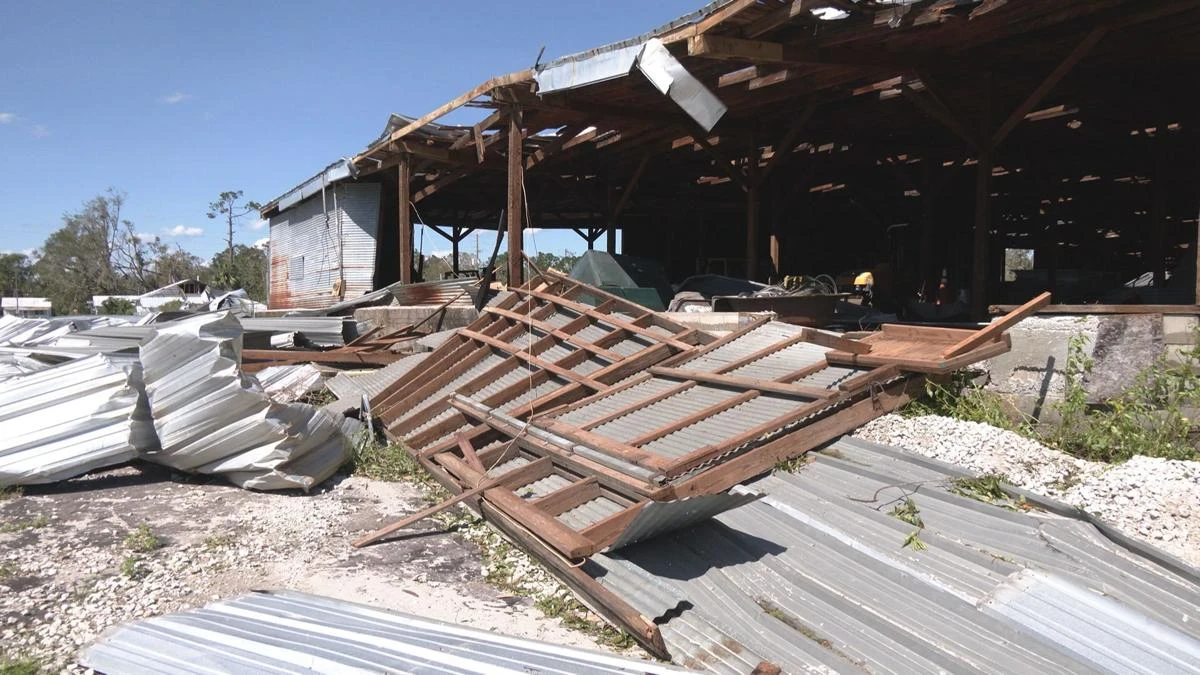
Hurricane Helene left significant damage in Madison County in September 2024. | Mike Exline, News Service of Florida file
Published on July 8, 2026 at 3:44 pm
Free local news and info, in your inbox at 6 a.m. M-F. Sign up for the Jacksonville Today newsletter.
Storm forecasters have further downgraded predictions a little more than a month into the 2026 Atlantic hurricane season, which has so far produced a single named tropical system.
For a season initially anticipated to be “somewhat below-normal,” Colorado State University researchers on Wednesday reduced their projections for the number of named systems and the duration of activity, stating they “now anticipate a well-below-normal season.”
Jacksonville Today thanks our sponsors. Become one.
A day earlier, the private meteorological firm AccuWeather slightly reduced the range of named storms it predicted to develop in the Atlantic basin.
In both cases the forecast is tied to moderate El Niño conditions likely to intensify into a “strong” El Niño by the mid-September peak of the six-month hurricane season, which began June 1.
The term El Niño refers to a warming of the ocean surface waters in the central and eastern tropical Pacific Ocean and resulting low-level surface winds that can disrupt normal weather patterns across the U.S. and globally.


Jacksonville Today thanks our sponsors. Become one.
“Sea surface temperatures across the Caribbean and tropical Atlantic are near their long-term averages,” Colorado State University posted Wednesday. “We anticipate the powerful El Niño being the dominant factor for the upcoming hurricane season, driving high levels of tropical Atlantic vertical wind shear.”
Vertical wind shear usually helps weaken or disrupt storms.
AccuWeather hurricane forecast
“El Niño conditions have always been the driver for why we’re expecting numbers near or below the historical average this year,” said Alex DaSilva, AccuWeather lead hurricane expert. “The stronger the El Niño gets, the fewer named storms we’re likely to get. Back in 2015, we had a strong El Niño and got 11 named storms. I think that is the sweet spot again this year.”
An average storm season has 14 to 15 named storms, with seven reaching hurricane strength.
AccuWeather, which initially forecast between 11 and 16 named storms, now predicts the formation of eight to 14 named storms for the season. Unchanged is the forecast of four to seven hurricanes, with two to four becoming major systems. AccuWeather also forecasts three to five having a direct impact on the U.S.
“The northern and eastern Gulf Coast, the Carolinas, and the northeastern Caribbean remain higher-than-average risk areas, where storms can develop rapidly,” a release from AccuWeather stated.
With a caveat added, the Colorado State University release noted there is a “below-average probability” for a major hurricane to make landfall on the U.S. coastline before adding that “coastal residents are reminded that it only takes one hurricane making landfall to make it an active season.”
The school’s forecast now sits at nine named storms, down from 13 when the initial projections were released in April and 11 when updated in June.
Also, the July forecast has four storms reaching hurricane strength, with winds at or above 74 mph, instead of six as in the pre-season outlook and five when the numbers were revised in June.
The ocean and Gulf waters are expected to be active with named storms for a total of 35 days, down from 45 days in the June forecast. A typical year has 69.4 days of storm activity.
Meanwhile, the number of storms reaching major strength — Category 3 on the Saffir-Simpson Hurricane Wind Scale with sustained winds of 111 mph or greater — was put at one, down from two in the prior forecasts.
As of Wednesday, the only named storm to arise was Tropical Storm Arthur, which brought flash flooding and tornadoes as it made landfall June 18 near Galveston, Texas.
In 2025, the Atlantic produced 13 named storms and five hurricanes, with four reaching Category 3 — winds of 111 mph to 130 mph and storm surge of 9 feet to 12 feet above normal tide.
None of the 2025 storms, though, made a direct landfall in Florida or the U.S.
From 2022 to 2024, Florida took direct hits from six hurricanes, including four that were Category 3 or stronger.