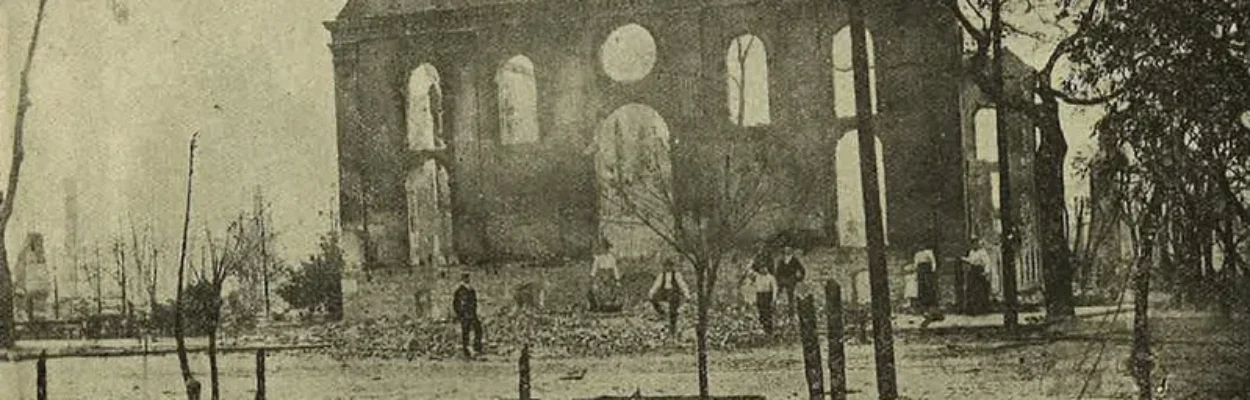
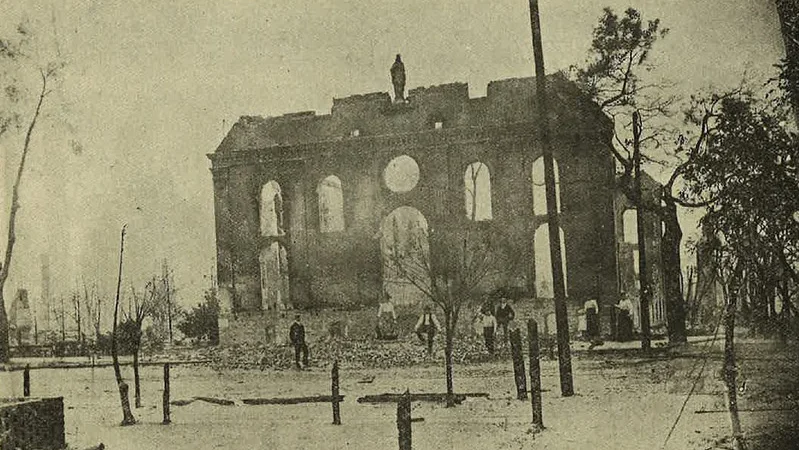
The Church of Immaculate Conception after the Great Fire of 1901
Published on June 24, 2026 at 9:54 am
Jacksonville Today seeks to include a diverse set of perspectives that add context or unique insight to the news of the day. Regular opinion columnists are independent contractors who are not involved in news decisions. Want to submit your own column on a matter of public interest? Email pitches to jessica@jaxtoday.org.
The road to recovery from devastation is never easy. This is the story of Jacksonville’s recovery from four major disasters. In James Weldon Johnson’s lifetime, Jacksonville suffered three major misfortunes. It would experience another and, after Weldon’s passing, resurrect itself.
The Civil War

The first disaster struck as a Civil War tactic, but not at the hands of total-warfare Union Gen. William Tecumseh Sherman nor as the result of a battle in its environs. (There were some skirmishes, but the closest major battle took place nearly 50 miles from Jacksonville in Olustee.)
Jacksonville Today thanks our sponsors. Become one.
Both Union and Confederate forces were a frequent presence in Jacksonville throughout the Civil War. (Federal forces occupied the city four times, and the Confederate three.) As both withdrew, they rendered any building considered a military asset, and some not so designated, useless.
By the time of the last Union entry in 1864, one of its members described Jacksonville as “pathetically dilapidated, a mere skeleton of its former self, a victim of war. Straggling winter weeds grow in the streets and remains of burned houses give a grotesque, Godforsaken and dreary aspect to the town.”
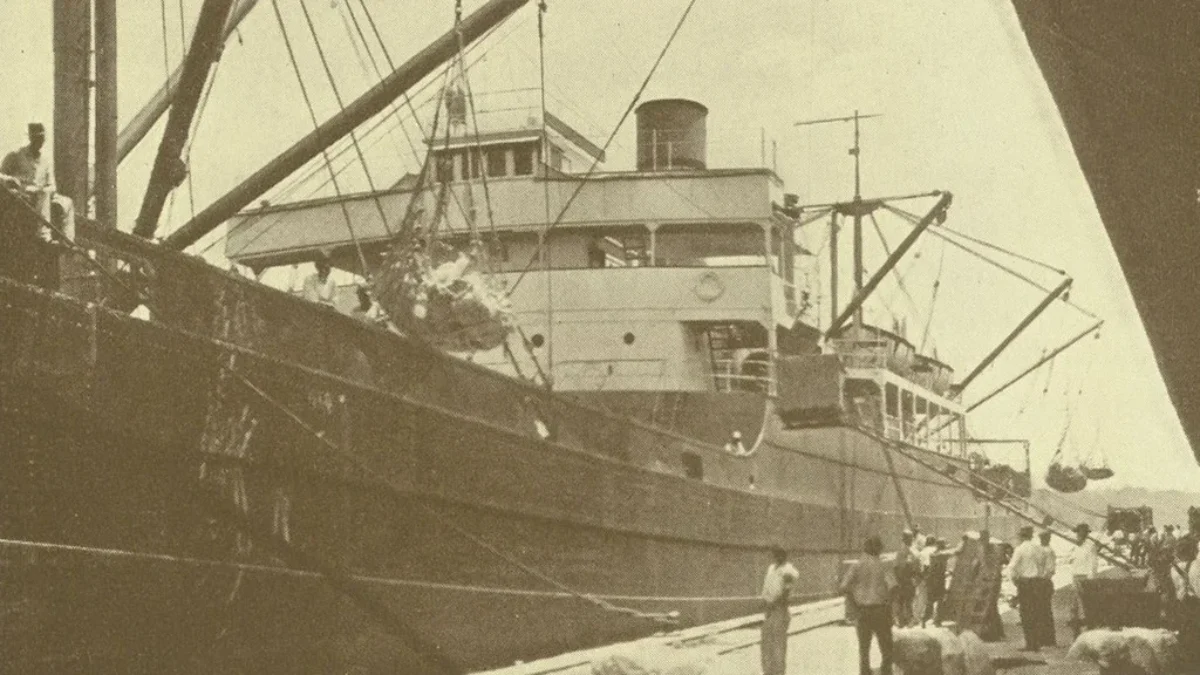
Restoring Jacksonville to its pre-war vitality began soon after Appomattox and was finished by 1870. All but one lumber mill had been eliminated by Federal troops, who considered the city a major supplier of Confederate forestry products. In addition, schooners drawing no greater depth than the 10 feet required to sail over the shore of the mouth of the St. Johns River were hauling cotton and other agricultural products once again.
Jacksonville Today thanks our sponsors. Become one.
Beyond 1870, travel enhancements would power Jacksonville to greater levels of economic and population growth. To admit ships up to 20 feet of depth entry; a pair of granite stone jetties were constructed at Mayport. Permissible ship size was thereby doubled in a development that historian Alan Bliss labeled the “single most important human-created feature in Northeast Florida.”
The other rocket fuel in Jacksonville’s economic engine was its post-war position as the end of the railroad line for tourist travel out of the population-rich Northeast. Grand hotels sprang up to accommodate their style of living. Exotic exhibits and other entertainment venues were offered. For the more ambitious visitor, steamboat excursions were available from the St. Johns River to the Ocklawaha River and on to Silver Springs, as well as trips by local rail line from the St. Johns County settlement Tocoi to the historic sites of St. Augustine.
Yellow Fever of 1888

To exemplify Jacksonville’s status as a powerhouse in business products and tourism, the city mounted a massive Sub-Tropical Exposition in 1888. President Grover Cleveland and his wife found it significant enough to attend an expensive reception at the St. James Hotel, where James Weldon Johnson’s father was maitre d’hotel.
This apotheosis in January of 1888 was soon disrupted by the second of Jacksonville’s great disasters. In the spring a visitor from Tampa brought with him the yellow fever virus that would bring the city to its knees, turning it into a pariah and sending it back to the starting line. There were no preventatives or cures for the virus.
James Weldon Johnson was on break from Atlanta University and wrote of it in his autobiography, “Some people fled at the first notice, but a rigid quarantine quickly made prisoners of the rest, prisoners in a charnel.” Guards were posted at roads leading out of town. “There were efforts at escape, most of them failures, some of them fatal.”
J.J. Daniel wrote, “Business was paralyzed, the churches were closed, and all forums of assembly were restricted. Deaths reached a peak of more than a hundred a day.” Daniel, the city’s most outstanding citizen and designated leader in fighting the great epidemic, died from it near the end of its seasonal run.
There were numerous yellow fever outbreaks in Jacksonville and elsewhere during the 19th century. Yet, if they were tremors, the 1888 epidemic was Krakatoa.
Great Fire of 1901

Jacksonville had barely recovered from the yellow fever epidemic before the worst of its fires occurred. A strong wind was blowing on May 3, 1901, when the fire began at a mattress factory in the Northwest part of the city. It swept through the entire Downtown area.
When the Great Fire of 1901 broke out, Johnson and his brother, John Rosamond, returned to Stanton, hoping to make it a refuge for those who were losing their homes. Both brothers attended Stanton and later, James led the school. What had been a light wind when the fire began soon turned into a gale.
Its eastward pace quickened, fanning north and south. But the school was in the fire’s all-consuming path, so the brothers turned their home into a safe haven for as many as it could hold. “It wasn’t our house for long. Before night, it was the refuge for more than 20 of our friends who have no other roof,” said James.
After the fire, commissary depots were set up for the relief effort. James was given a task. “I was asked to take charge of one. I was kept busy issuing packages of assorted food to destitute families.”
The militia was brought to maintain order after the fire. Their behavior put Johnson’s life in danger. He was arrested for talking to a presumed white woman. After being taken to an administrator who was a friend of his, he was released and received an apology. But the incident haunted him for a full 20 years.
Jim Crow

Jacksonville’s fourth disaster was not limited to the city. It affected the nation at large. Though Jim Crow radicalized every corner of the country to some degree, the South was the most malevolent region. Jacksonville resisted for longer than most of the South and was more accommodating in the early 1900s.
The growth of Jim Crow was fueled by the Plessy v. Ferguson decision of the U.S. Supreme Court and D.W. Griffin’s racist movie, Birth of a Nation, released in 1915. Jacksonville’s two sons, James Weldon Johnson and A. Philip Randolph, were two of the most powerful civil rights organizers of the Jim Crow period. Johnson was an organizer and the first executive secretary of the National Association for the Advancement of Colored People, the NAACP.
Johnson’s efforts in the South included creating an NAACP branch in Jacksonville at a time when the NAACP went from 58 to 310 chapters under his leadership. Johnson raised money to hire attorney, Clarence Darrow, to work on a case for the NAACP. The money raised to hire Darrow became the foundation for the NAACP Legal Defense Fund. Darrow labored mightily in a futile try to persuade Congress to pass an anti-lynching bill.
Protest marching, with one exception, would come during the leadership of A. Philip Randolph and Martin Luther King.
Randolph created the Brotherhood of Sleeping Car Porters in 1925 as an advocacy group to raise the economic status of Black porters who, at the time, were confined to more menial jobs. Randolph was interested in organizing protests in D.C. to end segregation in federal government spending and the military. President Roosevelt integrated federal spending and President Truman integrated the military.
No one was more responsible for the March on Washington that peaked with the Rev. Martin Luther King, Jr.’s “I Have A Dream” declaration than A. Phillip Randolph. He worked with King to organize the 1963 March on Washington. And no influence in shaping the character of the modern civil rights movement was greater than Randolph’s.
Jacksonville has risen from utter devastation on at least four occasions by my count. This dynamism was driven by leaders like A. Philip Randolph, James Weldon Johnson, John Rosamond Johnson and J.J. Daniel. The total effort is a testament to the dedicated thousands who made these recoveries possible.