

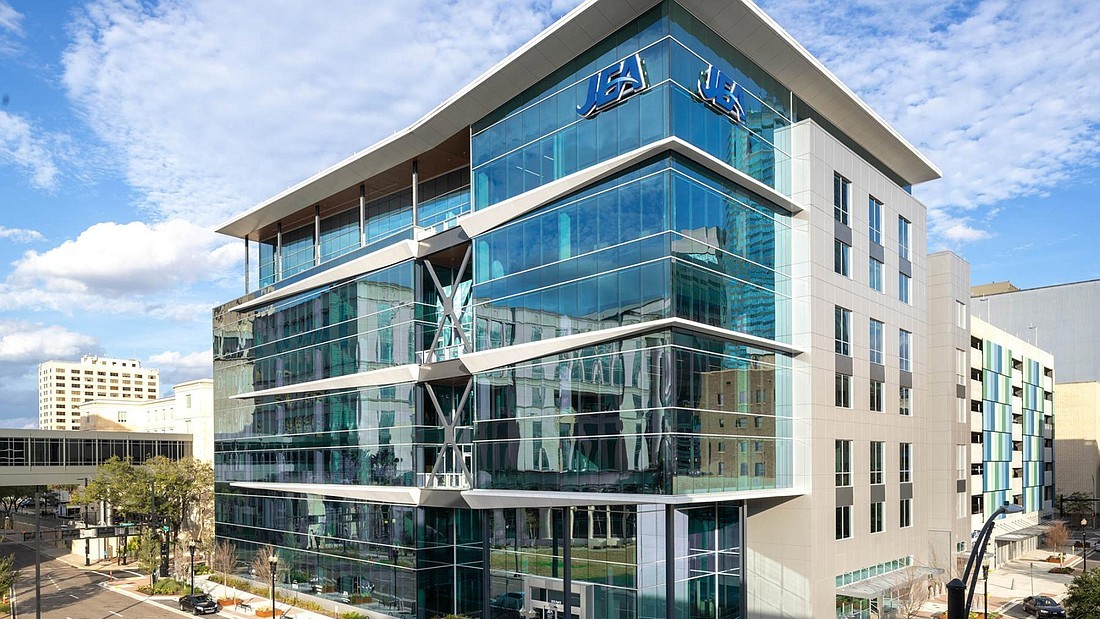
JEA headquarters is at 225 N. Pearl St. | Jacksonville Daily Record
Published on July 27, 2026 at 5:07 pm
Free local news and info, in your inbox at 6 a.m. M-F. Sign up for the Jacksonville Today newsletter.
JEA may have underbilled its commercial customers for water capacity fees by $55 million since 2003, according to a new report from the Jacksonville City Council Auditor’s Office.
The auditor’s findings were outlined Monday at the first meeting of the council’s newly created three-member Financial Audit and Oversight Committee.
Jacksonville Today thanks our sponsors. Become one.
JEA first started investigating the issue internally in 2022, but legal documents show that the policy on collecting water capacity fees has been inconsistent since before JEA was formed, as far back as 1986.
In the last 18 months, the city-owned utility ramped up its review into why companies and development projects undergoing expansions or growth were not being charged the added fees to connect to water and wastewater plants.
The issue came under more scrutiny at City Hall early this year when the Office of Inspector General asked council auditors to help it investigate the issue, what it has cost the utility and whether JEA had the legal recourse to recoup any of the losses from its commercial customers.


Jacksonville Today thanks our sponsors. Become one.
Former City Council President Kevin Carrico wrapped the water capacity investigation into his broader charges for the politically controversial JEA Special Investigatory Committee. The committee, now ended, investigated JEA leadership’s handling of workplace culture.
Days before current council President Nick Howland took over leadership July 1, he announced his intent to let the investigative committee sunset. In its place, he formed the 60-day select committee with the sole charge of working with the auditors and JEA to understand the cost the unbilled fees had on the utility and to find policy changes to fix it.
The committee includes Chair Ron Salem, council Vice President Joe Carlucci and council member Chris Miller.
JEA uses revenue from the capacity fees to pay for new water and wastewater treatment plants, expanded and modernized facilities, and any infrastructure linked to these services.
“When you build a new plant, as people connect to it, they kind of purchase their portion of the plant, their little slice of the pie,” JEA Chief Water Systems Officer Rob Zammataro told the committee. “Those capacity fees help pay for that infrastructure that we have bonded up front. So whenever somebody pays for a capacity fee, whether it be water or wastewater, it’s specific to the capacity and the capital improvement.
“It has nothing to do with their consumption. They’re a monthly bill.”
Salem said Monday that he recognizes that the capacity fees are independent of rates JEA charges its residential and commercial customers for the amount of water and wastewater they use.
But he says the optics of JEA having millions in unbilled fees right after it approved a rate increase in June are a problem.
“We don’t want the perception that we’ve got $55 million here that we’re not going to collect and we just raised the rates on the rank-and-file homeowners,” he said.
Can JEA collect past fees?
In a three-page memo, council auditors said they used the research done by JEA officials as a starting point to calculate the total amount of underpaid fees.
JEA has more than 25,000 business accounts, but the auditors targeted 1,697 meters that had 3-inch or bigger connections to the water plants. Any business that exceeded daily water flows by 20% or more than what it paid for when it started its water service connection was noted.
The memo gave a $75 million ceiling for what JEA could have under-collected. According to auditors, $21 million of that is from multifamily residential complexes that don’t appear to have grown since they were built. That would likely bring the uncollected fees closer to $55 million, auditors say.
City attorneys and the auditors said Monday that its still unclear in JEA’s policy if the utility is solely responsible for determining and billing for the additional fees or if the businesses have a reporting obligation.
The example used by the JEA Investigatory committee in March was Mayo Clinic. In a December 2024 memo sent from JEA’s then-chief legal counsel to Mayo Clinic’s attorneys, the utility says the hospital system could owe $18.9 million in back water and wastewater capacity fees. That was based on how much more water Mayo has consumed due to its growth since 1995.
Council Auditor Phillip Peterson told Jacksonville Today in an email Monday that the auditor’s review did not isolate individual companies or organizations responsible for larger proportions of the unbilled fees.
Howland said if the customer does have some responsibility in reporting any plans that could exceed that capacity threshold, there could be recourse for JEA to go back and collect some of the unbilled fees.
According to Zammataro, utility officials are working on a future water capacity policy and retroactive policy on how to address the uncollected fees to be presented to the JEA board by early next year.
According to the inspector general, JEA CEO Vickie Cavey has committed to hearing the new policies in public forums.
Compared to the $55 million to $75 million in missing fees, JEA officials say the utility has collected $9 billion in capacity fees since 1997. Today, that’s about $6 million to $10 million per year.
The auditor’s office cautioned the committee that JEA is still researching outstanding agreements and any legal limitations in getting back payment.
“Just because a business is flagged as potentially owing, does that mean in fact that they owe additional capacity fees,” Parks said. “Other things being analyzed by JEA are the impact of different agreements, exemptions and how the statute of limitations may impact the amount potentially owed, as well as the need that everyone is treated fairly within the tariff.”