Published on June 17, 2026 at 11:59 am
Free local news and info, in your inbox at 6 a.m. M-F. Sign up for the Jacksonville Today newsletter.
Today, The Jaxson takes a look into the working waterfront history of Jacksonville’s urban core. Produced by the Jacksonville Port Bureau and the Jacksonville Chamber of Commerce, this collection of historic photographs capture the maritime and industrial character of the city’s riverfront in 1930.
1. Port of Jacksonville

In 1930, Jacksonville was a rapidly growing city of 130,000 residents. The 1920s Florida land boom resulted in the Port of Jacksonville transforming from the comparative obscurity of a specialty port, mainly serving the lumber, mining and naval stores industries operating in the region, to being the most important clearing place for imports and exports on the South Atlantic Seaboard. The growth of the port also coincided with the expansion of commerce between the U.S. and Latin America.
Jacksonville Today thanks our sponsors. Become one.
2. Shrimp fleet

The shrimp fleet in Jacksonville’s harbor in 1930. The industry truly took off in 1913 when Capt. Billy Corkum introduced the otter trawl for shrimping in Fernandina Beach. This innovation allowed fishermen to work in deeper waters and target areas where shrimp were most abundant, dramatically increasing yields.
3. Exports ramp up

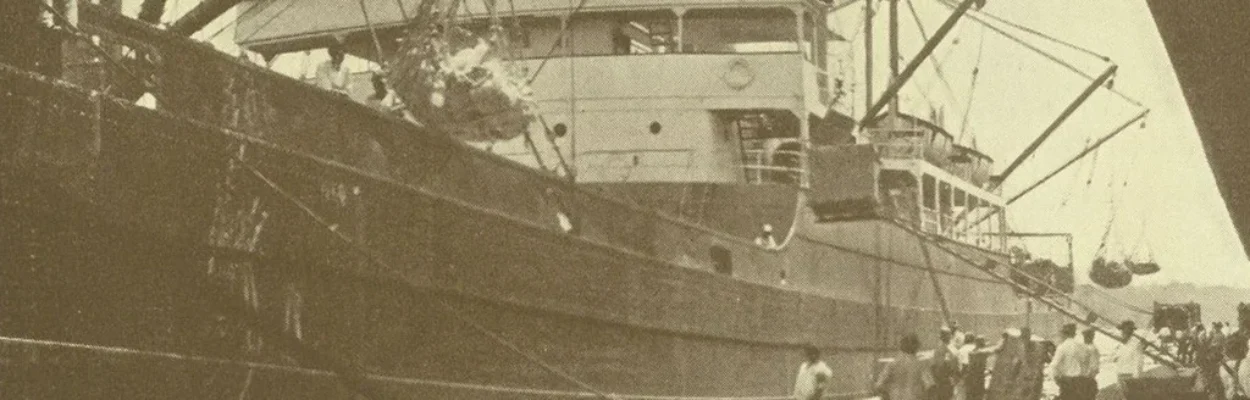
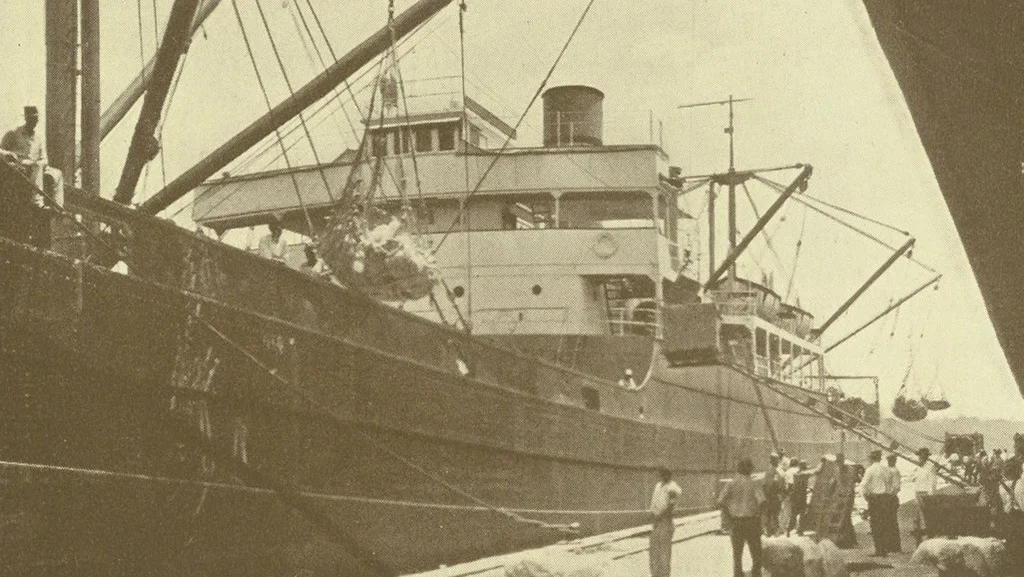
The loading of fresh citrus for export in 1929. At the time, the principal commodities exported at Jacksonville were rosin, turpentine, scrap steel, iron and rail, pine lumber, mixed lumber, manufactured iron and steel, citrus fruits, autos and parts, machinery, sulphur, canned grapefruit, beet pulp, pine logs, flour and meal and crushed oyster shells.
4. Riverfront terminals

The Merchants and Miners Transportation Co. (top) and Clyde Line (bottom) terminals along Downtown’s riverfront.
Jacksonville Today thanks our sponsors. Become one.
5. Municipal Docks

A 1930 aerial of the Municipal Docks and Terminal Co. The Municipal Docks and Terminal Co. was established in 1916 after the Board of Port Commissioners approved its construction in 1914. Located on Talleyrand Avenue, between 9th and 18th Streets, the property had previously been used as the Old Soldiers Home. Located 21 miles from the Atlantic Ocean, today this facility is known as JAXPORT’s Talleyrand Marine Terminal.
6. Union Station and railyard

The Jacksonville Terminal Co.’s Union Station and railroad yards in LaVilla in 1930. The $2.5 million terminal quietly opened its doors one minute after midnight on November 17, 1919. During its heyday, the Jacksonville Terminal was the largest passenger railroad station in the South and served as an official gateway to worldwide travelers entering Downtown, handling as many as 20,0000 passengers and 200 trains each day.
7. Municipal Docks

Steamers being unloaded at the Municipal Docks in 1930. Labor supply at Jacksonville was considered plentiful and adaptable. All steamship agents at the port used the open shop plan for employment of labor. Customary work day aboard ship and on shore was 10 hours with one-half hour for lunch. The rate of pay ranged between 25 cents and 50 cents per hour.
8. Lumber shipping

Lumber was loaded at the Municipal Docks in 1930. Jacksonville was the largest lumber port on the Atlantic Seaboard. During 1929, a total of 109,903,360 feet of lumber was handled through the port.
9. Commodore’s Point

An aerial view of Commodore’s Point in 1930. The Commodore’s Point Terminal Co. covered 135 acres, with deep water berthing space available for 15 average steamers at once. It included a network of railroad tracks served by the Atlantic Coast Line and Seaboard Air Line railroads.
10. Imports galore

Cargo was unloaded from the Pacific coast at Commodore’s Point in 1930. The principal commodities imported at Jacksonville in 1929 were petroleum products, fertilizer, nitrate of soda, potash, creosote, green coffee, goat manure, news print paper, sulphur, bone metal, manufactured iron and steel, canned beef, asbestos products, burlap bags and cotton waste.
11. 79 wharves

There were 79 wharves at the port in 1930. Of these, the city of Jacksonville owned or occupied four, which were built and operated by the City Commission, through the commissioner in charge of public utilities. Railroads owned or occupied 15 wharves and piers, the U.S. Government owned and operated two. The remainder, including the Commodore’s Point terminal shown here, were owned by various private interests.
12. Ford Motor Co. plant

Expanded four years earlier, Jacksonville’s Ford Motor Co. assembly plant employed over 800 workers and produced 200 Model A automobiles each day. Its construction between 1924 and 1926 was a major event in Florida history. The arrival of the world’s largest automobile manufacturer was a sign of the city and state’s growing economic importance.
The plant, at 1901 Hill St., remained operational until 1932 and subsequently was used as a parts warehouse until 1968. Today, Jacksonville Machine and Repair, LLC operates a ship repair, mechanical, machining and welding business at the former auto assembly plant site, which was razed in 2023.
13. Crowley’s predecessor: Atlantic Coast Line Railroad terminals

The Atlantic Coast Line Railroad export terminals were located near Talleyrand Avenue, south of Deer Creek. Today, the Crowley Maritime Corp.’s Talleyrand Terminal is located on the site of the former Atlantic Coast Line Railroad export terminals. Founded in 1892, Jacksonville-based Crowley Maritime Corp. is primarily a family- and employee-owned company that provides transportation and logistics services in U.S. and international markets by means of six operating lines of business: Puerto Rico/Caribbean Liner Services, Latin America Liner Services, Logistics Services, Petroleum and Chemical Transportation, Petroleum Distribution and Contract Services and Technical Services.
14. Performing Arts Center site

The Seaboard Air Line Railway terminals were located on the north side of the St. Johns River, in the heart of the city, just west of Hogan Street. At the time, the terminals were operated by McGriffin & Co. Today, this former Downtown railyard is the site of the Jacksonville Center for the Performing Arts.
15. The poop deck

Today, the Riverfront Music Garden is a transformed waterfront destination that celebrates Jacksonville’s longstanding influence in music in a location where Seaboard once unloaded fertilizer from ships.
16. Union Terminal Warehouse

The Eastside’s Union Terminal Warehouse Co. was a busy scene of industrial activity in 1930. When it opened in 1913, it was the largest commercial building to be constructed in Florida. Now the state’s largest Historic Tax Credit rehabilitation project by square footage, the warehouse is home to 228 apartment units, 20,233-square-feet of community commercial space, 24,607 square feet of maker/artist space, and 4,205 square feet dedicated to food and beverage operators.
17. Eppinger & Russell wood treatment plant

The Eppinger & Russell Creosoting Works was located immediately to the south of JEA’s electric plant. Eppinger and Russell Co. was formed in New York on December 30, 1904. Eppinger and Russell was in the business to purchase wood, treat it with preservatives, largely creosote, and sell it as telephone poles, railroad ties, piles and similar products.
This property was first used as a wood treating plant by Eppinger and Russell from 1909 to 1962. Eppinger and Russell deeded the Talleyrand Avenue property to Bernuth Lembcke Co., Inc. Bernuth operated creosote storage facilities on the property until 1966. JEA acquired the property by condemnation from Southern Regional Industrial Realty, Inc. in 1977.
18. Growing the fertilizer biz

Aerial of Talleyrand Avenue looking south towards the American Agricultural Co.’s phosphate works. Jacksonville was one of the most important fertilizer manufacturing and shipping points in the South and had nine fertilizer factories located on the waterfront, which produced 75% of the fertilizer manufactured annually in the State of Florida.
19. Out of the box

The American Agricultural Company’s Talleyrand phosphate works opened in 1919. In 1938, it was replaced by a National Container Corp. paper mill. National Container had become America’s third-largest box maker by the time it was purchased by Owens-Illinois in 1956. Under court order to divest, Owens-Illinois sold the Talleyrand mill to Alton Box Board Co. in 1965. In 1981, Jefferson Smurfit completed their takeover of the Alton Box Board Co.
The merger of Jefferson Smurfit and Stone Container in 1998 would be the downfall of the mill. The merger resulted in the removal of 1.1 million tons of capacity from company operations. The Jacksonville containerboard mill, along with mills in Circleville, OH, Alton, IL and Port Wentworth, GA were indefinitely shut down by the end of 1998. The former mill site was converted into a major industrial marine and bulk material shipping terminal operated by Keystone Properties, LLC. in 2011.
20. Jacksonville Municipal Electric Light Plant

The Jacksonville Municipal Electric Light Plant was constructed in 1910 near the intersection of Talleyrand Avenue and East 30th Street on the banks of the St. Johns River. The electric plant was called Talleyrand Generating Station until the 1960s, when it was renamed for J. Dillion Kennedy, a former city commissioner who was instrumental in growing what is now the JEA. Both this plant and the paper mill next door burned high-sulphur fuel oil and rained black soot down on the city from time to time. Although the JEA Kennedy Generating Station is still in operation, the original plant building was demolished in 2007.
Jacksonville’s Gullah Geechee Heritage
A Community Story. A Cultural Record. A Call to Remember.
Jacksonville’s Gullah Geechee Heritage is a new book by Ennis Davis and Adrienne Burke.

Jacksonville’s Gullah Geechee history lives in the land, the water, the neighborhoods, and the memories passed down through generations. Jacksonville’s Gullah Geechee Heritage brings those stories forward, rooted in place, shaped by community, and preserved for the future.
Order your copy of Jacksonville’s Gullah Geechee Heritage, available in hard and soft cover.