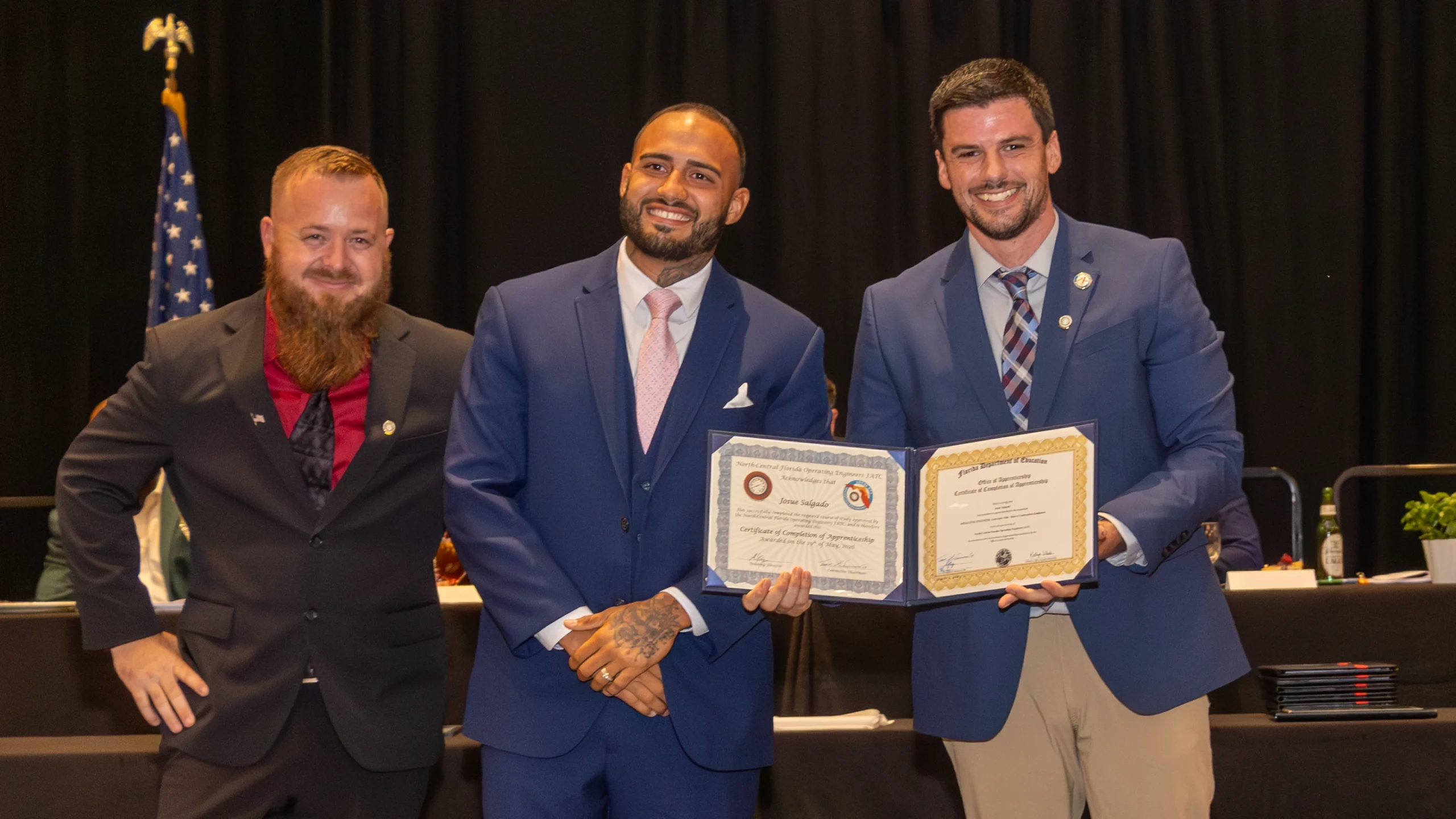
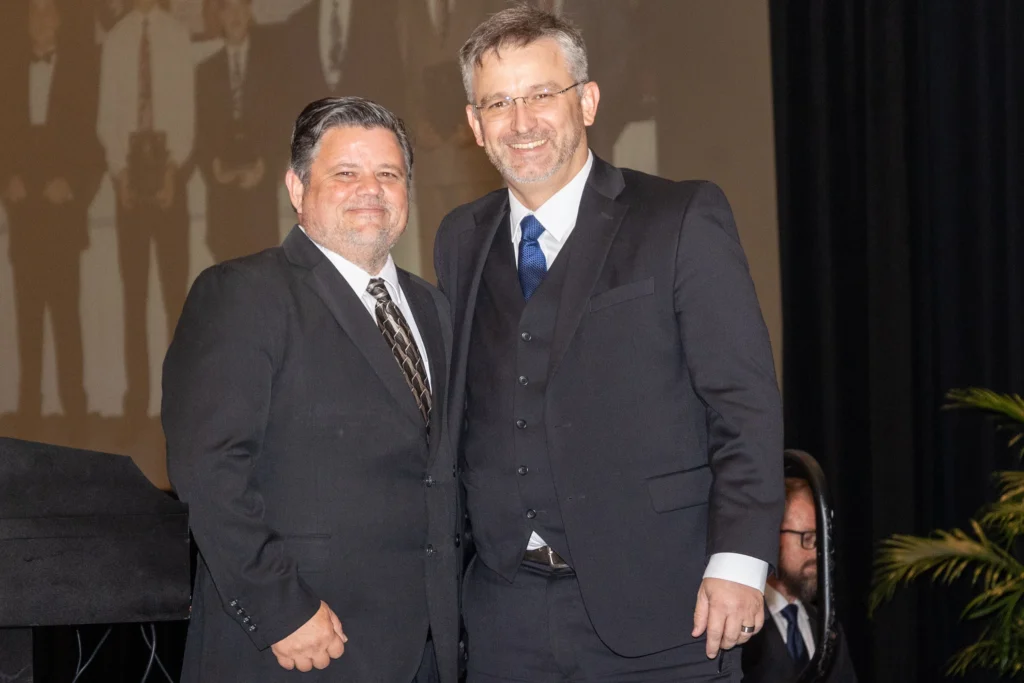
Josue Salgado, center, received his certification as an operating engineer during the 75th Jacksonville General Apprenticeship Association graduation and awards ceremony on Friday, May 29, 2026. Salgado is flanked by Michael Joyner, left, vice president of the International Union of Operating Engineers Local 673, and Local 673 Treasurer Andrew Slager. | Will Brown, Jacksonville Today
Published on June 5, 2026 at 9:49 am
Free local news and info, in your inbox at 6 a.m. M-F. Sign up for the Jacksonville Today newsletter.
Josue Salgado’s life changed once he joined the family profession.
Salgado traded his career as an emergency medical technician in Connecticut for the financial stability of a career as an operating engineer in Jacksonville.
Jacksonville Today thanks our sponsors. Become one.
“It’s opened so many doors for me and my family, financially,” Salgado says. “As a first responder, it was a great job, but it didn’t pay what this field pays. When you show up a job site, you’re the star of the show. I was able to grow and I’m so grateful.”
Foundation for growth
Florida desperately needs more people in its skilled trades like operating engineers, plumbers and more. The shortage has garnered the attention of Northeast Florida elected officials at both the congressional and municipal levels.
The Florida Legislature allocated $20 million for its Pathways to Career Opportunities Grant Program as part of the $114.5 billion budget it passed May 29. Some of those funds will be distributed through the Florida Department of Education to provide apprenticeship opportunities here and throughout the peninsula.

Jacksonville Today thanks our sponsors. Become one.
Jobs for Jacksonville
Kirk Barras, president of the Jacksonville General Apprenticeship Association, says the city’s blue-collar roots are part of the blossoming of other local industries.
Development at JAXPORT and Northeast Florida military instillations in addition to EverBank Stadium renovations as well as Downtown development means there is a need for professionals in the building trades.
“The buildings that come here, we have worked at Fidelity (National Financial headquarters) and the Jaguars stadium Downtown as well. All that work is something we do,” Barras says. “That money stays here locally. These apprentices, who are working into journeyman status, are investing money back into the system. That money stays here locally without student loan debt.”
Skilled professionals live and work throughout Jacksonville. A gas station at the edge of Brooklyn and Riverside is often awash with craftsmen who are electricians and plumbers, roofers and HVAC professionals.
In the mornings, dozens are there fueling up before a day at their outdoor office while others are hydrating in preparation for the sunshine. Afternoons often feature people securing a snack before heading home for the day.
Finding Florida’s future workforce
Danny Van Sickle, training director for the Electrical Training Alliance of Jacksonville, explains tuition for the trades professionals that are part of the Jacksonville General Apprenticeship Association are funded through collective bargaining between labor unions and management.
State funding provides materials for electricians, plumbers, sheet metal apprentices, carpenters and operating engineers like Salgado.
Operating engineers are the people who operate cranes, bulldozers, graders, dredges, drills and more on a construction site. Salgado’s brothers are certified operating engineers. They encouraged him to become one as well.
“It’s a skill you’re not going to lose once you learn it,” Salgado says. “They can’t take what you learn from you. AI can take most people’s jobs, but it can’t take mine.”
Salgado was among the 135 people who were recognized by the Jacksonville General Apprenticeship Association on May 29 for becoming skilled trade professionals. This year’s cohort featured seven operating engineers, 12 sheet metal craftsmen, 45 plumbers and pipefitters, and 70 electricians.
More than 260 people started in the apprenticeship program that concluded last month. Throughout their years learning their trade –it can range between four and five years — there are at least 5,000 on-site working hours as well as more than 100 hours of annual in-class study.
Not everyone makes it.
Jacksonville City Council member Mike Gay says he would like for apprenticeship programs to provide the option for virtual classes. Doing so would provide flexibility for workers to take coursework at night and on weekends.
Gay completed an apprenticeship with the Northeast Florida Builders Association in the 1980s. He has owned M Gay Constructors since 1991.
“One of my companies, that’s one of the things that’s a hinderance with putting some workers in class is because they can’t attend it like they need,” Gay says. “Having that virtual would open up that door. Some of the other programs that we’re involved in, they have their classes on Saturdays so (workers) can attend.
“I think we’ll get there. It’s just everybody realizing what we need to do and see how we can alter, change and adapt to where we can get more workers in.”
When the City Council approved EverBank Stadium renovations in 2024, Gay was the only person to vote against the $1.4 billion project.
Gay did support an initiative where the stadium would serve as an apprenticeship sponsor. The EverBank Stadium legislation reserved 10% of the project’s positions in electrical, mechanical and plumbing work for apprentices.
Barton Malow is the construction firm that is renovating EverBank Stadium alongside AECOM. Larry Arndt, Barton Malow’s Florida office leader, says labor is the firm’s most pressing issue in the Florida marketplace.
Arndt adds that a nationwide template will be less successful than local skilled trades solutions.
“When someone comes out of a trade school or apprenticeship program ready to contribute from day one, it strengthens the entire project team, and that shows up in schedule and quality,” Arndt wrote in a statement. “Strong relationships with local training programs matter because we’re not just filling roles; we’re helping build the workforce that Florida’s construction industry will depend on for many years ahead.”
The need may expand in the years ahead. This spring, an analysis from commercial real estate firm JLL Research concluded as many as 2.1 million trades positions could go unfilled by 2030.
Open for work
One of the culprits is a shrinking workforce.
Over the past 35 years, Duval County’s live birth rate has declined by 37 percentage points, according to data from the Florida Department of Health. In that same period, Florida’s birth rate, though lower than Duval’s, has also declined 37 percentage points.
In 1990, 19.1 of every 1,000 Duval County residents and 15.3 of every 1,000 Floridians had children. The local birth rate reached its 21st century zenith in 2006 when 16.3 of every 1,000 people welcomed children.
Since that peak two decades ago, the local birthrate has steadily declined. The declining number of adults comes as the last of the baby boom generation reaches retirement age.
Working hard for the money
The dearth of skilled trades professionals is more than a theoretical policy question. Arndt says Barton Malow answers it by developing a pipeline that connects the company with trade programs, universities and workforce pipelines.
“We need enough skilled, qualified tradespeople to complete projects within the timelines our clients require. Access to skilled, available people is foundational to Barton Malow’s ability to deliver,” Arndt wrote in a statement. “Without that pipeline, everything else — schedule, quality, client relationships — suffers. This isn’t a challenge unique to Barton Malow; it’s the defining constraint facing construction firms across the country right now.”
Barras, the apprenticeship association president, has observed more applicants who have earned associate’s and bachelor’s degrees have sought to join a building trade over the last decade.
Barras, who became a plumber’s apprentice in 2001 after a decade in the Navy, says the average age for a starting apprentice is in their late 20s.
Keith Bryan started as an electrical apprentice when he was 41. He worked with direct current sources during a previous automotive career. He wanted to learn a new skill.
“The process of learning something new, being able to share what I’ve learned and being able to help somebody with it, I guess you could say, that’s always been one of my biggest rewards,” Bryan says.
Bryan was named the Jacksonville Electrical Outstanding Apprentice of the Year last month at the 75th annual Jacksonville General Apprenticeship Association graduation celebration.
“Dirty hands do not mean you are an idiot, by any means” Bryan says. “Mike Rowe, he went around the country, proving that these jobs are big money (opportunities). There’s a lot of money to be made in the electrical field. But you’re going to get your hands dirty if you’re in it — no doubt about it.”
The Bureau of Labor Statistics indicated that the median pay for an electrician was $62,000 a year. Gay, a longtime electrician before he won elected office, says a local skilled electrician can earn between $83,000 and $104,000.
“This is a gateway into the middle class,” Barras says of building trades. “It’s an entrepreneurial opportunity and a pretty neat evolution to watch. To watch someone come into the trades, whether they are 18 or 28, learn their craft, then start their own business or work their way up … it’s a career and not a job.”