
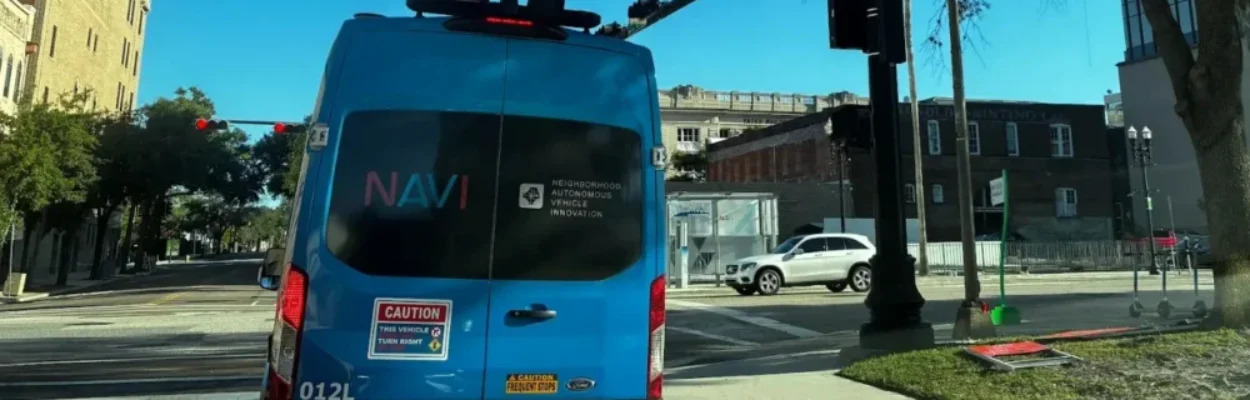
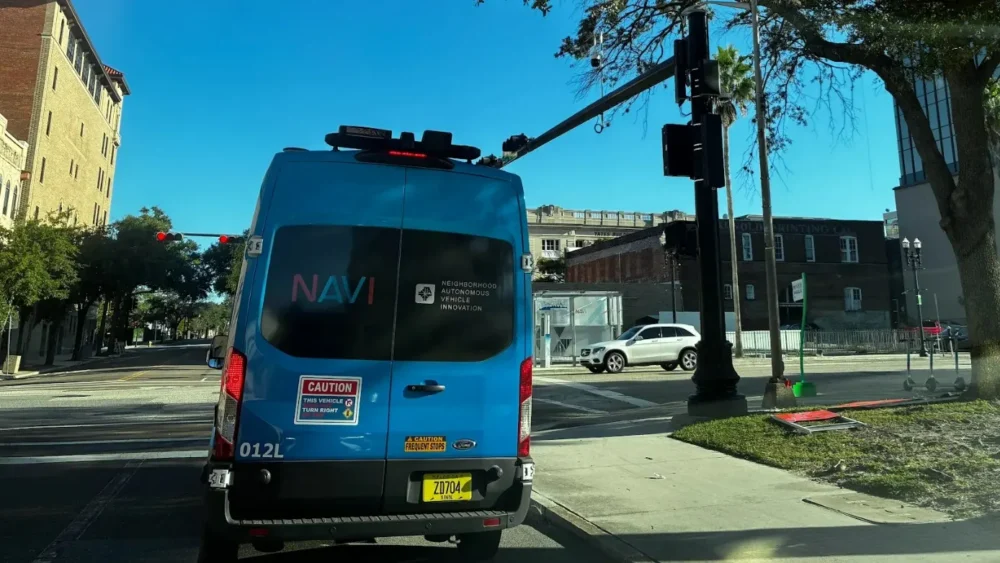
One of JTA's NAVI autonomous shuttles waits to turn right onto Bay Street. | Jessica Palombo, Jacksonville Today
Published on October 25, 2026 at 12:10 pm
Jacksonville Today seeks to include a diverse set of perspectives that add context or unique insight to the news of the day. Regular opinion columnists are independent contractors who are not involved in news decisions. Want to submit your own column on a matter of public interest? Email pitches to jessica@jaxtoday.org.
Jacksonville has fumbled the bag for decades when it comes to its development of mass transit.
It really started at Consolidation, six decades ago.
The city had a golden opportunity to establish light rail similar to the T in Boston, BART in San Francisco, or the Metro in the DMV. The Southside was rural in a way newcomers can’t imagine (Baymeadows and San Jose were two lane roads for a long time, and the Town Center was pasture land).
Jacksonville Today thanks our sponsors. Become one.
The development patterns lent themselves nicely to starting a light-rail system in the Urban Core, then expanding it as outgrowth inevitably happened.
That didn’t happen, of course.
Instead, the city bet on useless technology, when it bet at all.
Consider the Skyway. Forty years ago, it looked like the future to city planners.


Jacksonville Today thanks our sponsors. Become one.
And JTA still describes it as such on its website. It “redefines urban travel with climate-controlled, eco-friendly trains ensuring a seamless journey across Jacksonville” and it allows riders, such as they are, to “connect effortlessly with key urban spots—work, shop, or explore with ease.”
But from jump, it was ill-conceived. A piddly little 2.5 mile route a few stops connecting Downtown and the Southbank, with no thought toward where the population growth in the 918.5-square-mile county was going.
The schedule has been cut back to 12 hours a day already. And it will, by Nov. 2, be cut to 0 hours a day.
Much like the Peloton you bought during the pandemic, it’s on pause.
The Skyway was a tragicomic failure, but it was one JTA didn’t learn from, as we saw with a second boondoggle: the Neighborhood Autonomous Vehicle Innovation system.
Seen as part of what JTA calls the “Ultimate Urban Circulator” system, that experiment is already headed toward the dustbin of mass transit history. Ridership is low — in my various walks to and from WJCT Studios to my home on the Westside, I never once saw anyone using it or waiting for it, presumably because there’s no intuitive way to know how it works for most people.
In a city where gridlock dominates on every bridge for much of the day, JTA answered the transportation challenges of a rapidly growing metropolis by creating an endless ouroboros from one nowhere to the next.
The best part: It’s a subscription service.
The software package runs out at the end of the year. JTA isn’t planning to pay to renew.
And the kicker? It’s being touted as saving money. The $487,000 monthly charge should go a long way toward wiping out the nearly $40M acknowledged deficit.
You may be asking yourself in this context about the buses. If JTA is so deep in the hole, they should be running on time and effectively, right?
Nope. Not even.
As someone who actually takes the bus when headed Downtown, I can tell you the schedule reliability is … less than ideal. Sometimes the bus is early. Sometimes late. Sometimes it doesn’t arrive at all.
This is bad enough for someone like me, whose schedule is largely pegged to political events I happen to be covering, and who can afford to Uber when needed. As an elderly political journalist, I have a certain amount of prerogative and agency. And let’s be real: If I miss an event, I can get the principle on the phone and get my questions answered.
Most people don’t have that privilege.
Imagine needing the bus five days a week to get to a job where a manager is just itching to put you on a performance improvement plan for tardiness.
In the words of a Redditor who I can’t link to because the title of their post has an obscenity: “I just need to vent really quick, I usually don’t like to talk a lot of [doo doo] about Jacksonville I try to bring some positivity to the chat but today but bus n.3 is running very late this morning. It’ll usually be here between 6:50 and 7:00 am, no earlier rides than that, now it’s 7:20 and I’m stuck out here in the cold and to make it even worse I’m going to be late. I have no clue why it has to be this delayed but it’s very inconveniencing and hella annoying, I know that I just simply need to start saving for a car so I won’t have to deal with buses anymore but damn why do we have to suffer lol.”
LOL is right.
These are the people who are jobbed out by JTA. People who work grunt jobs with no security, no connections to the political class, and no recourse beyond “saving for a car,” which itself is a quagmire of capital investment into an instantly depreciating asset.
I remember my year in Leadership Jacksonville for a few reasons, but one of them was an exercise we did in which we imagined being someone who had to use buses to get from one part of town to another for a job, while juggling child care issues. Long story short, some of the best and brightest minds in the city couldn’t figure out the logistics of it.
I’ve forgotten most of that program, but that stuck with me as an illustrative failure of public policy: The people who make decisions on how these programs work (two of the current JTA board members were in my cohort) have no real skin in the game when it comes to operation. It’s an intellectual exercise to them. And a resume builder.
So we get multi-decade catastrophes like JTA. Professional gladhander Nat Ford ran the agency into the ground for what feels like 50 years, and he’s on his way out of town to run Dallas’ system in the next few days.
Ironically, he will be inheriting a functional operation of “light rail, Trinity Railway Express, regional rail, bus routes, GoLink on-demand service, and paratransit, moving more than 171,000 passengers daily across a 700-square-mile, 12-city region.”
He couldn’t do that here, or even come close.
JTA and the 2027 mayor race
It’s inevitable that JTA’s failings will take center stage in 2027’s mayoral race. Mayor Donna Deegan has been completely out of touch with the systemic rot at the heart of the local mass transit operation, alternately supporting Ford and noting that JTA is really a state agency with gubernatorial appointees on the board — raising questions as to why she never once talked to Gov. Ron DeSantis about it.
Beyond Deegan’s disconnect, there’s the reality of journalist turned political consultant Emily Turner working for Republican Wyman Duggan, the only serious challenger to the incumbent. She spent years digging into issues at the agency. Rest assured, ads about those issues will be coming to digital buys or mailboxes near you between now and May.
But is there any reason to believe Duggan would “fix” JTA in a way that creates a user experience comparable to what peer cities rely on? Not likely.
Here’s my modest proposal for people who want to be in city government, on the JTA Board, or leading JTA as the next CEO.
Spend a month exclusively using the bus to get from home to work to whatever leisure time activities you do. During that time, breathe deeply and take in the evocative, robust aromas of vehicles last deep-cleaned during COVID.
Talk to your fellow passengers. Find out what they think of the service. How they might improve it. How service failures have adversely affected them.
In doing so, I guarantee they will learn much more about how the city works — or doesn’t work — than they would in a lifetime of community conversations, charrettes or town halls.
Go ahead. In the words of Pulp, live like common people. Do whatever common people do.
Find out what it’s like.
And maybe all those pretty words about servant leadership will finally have some ballast when you find out what it’s like to be a slave to a system that commodifies your needs, fails to deliver, shuffles the crony chairs on the cruise ship deck, and restarts the pitiful cycle all over again with no path toward delivering for the people.