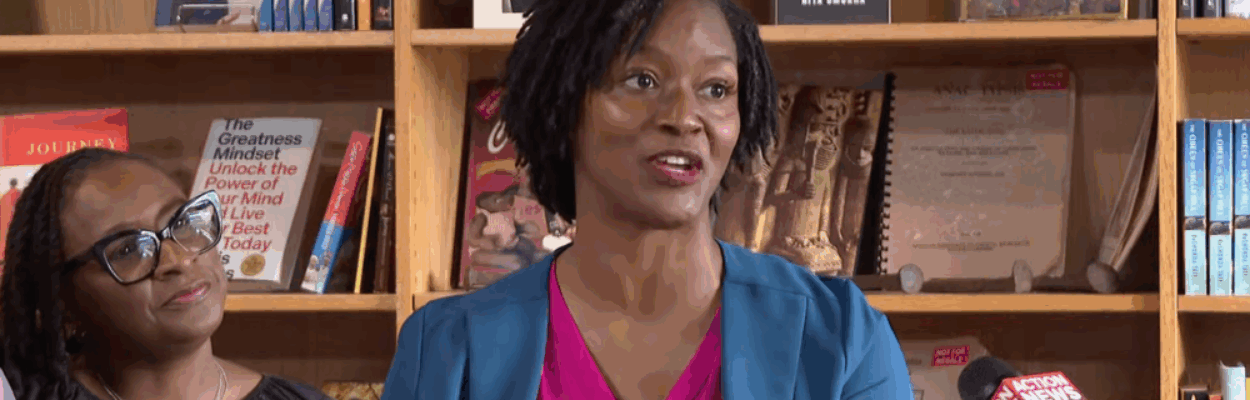
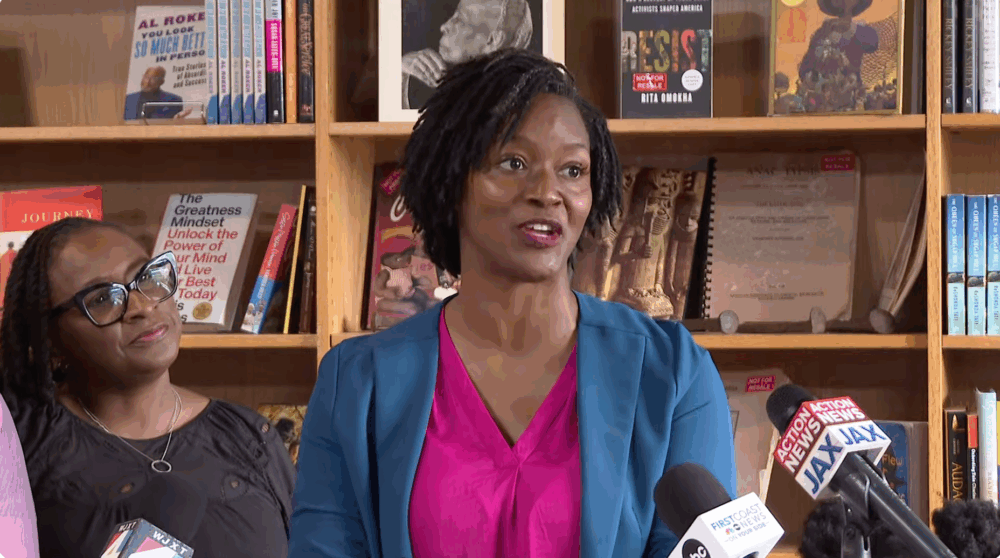
Angie Nixon speaks at her Cafe Resistance on Oct. 5, 2026. | First Coast News via YouTube
Published on October 11, 2026 at 3:00 pm
Jacksonville Today seeks to include a diverse set of perspectives that add context or unique insight to the news of the day. Regular opinion columnists are independent contractors who are not involved in news decisions. Want to submit your own column on a matter of public interest? Email pitches to jessica@jaxtoday.org.
Angie Nixon’s Cafe Resistance has become, arguably, the most high-profile bookstore in the entire city since the state legislator earned the Democratic Senate nomination back in August.
Less than a month remains before voters decide whether she will replace Republican incumbent Ashley Moody in Washington. If Nixon scores the upset, it will take a perfect storm of voter disgust with Republican government combined with independents turning out overwhelmingly for her.
Jacksonville Today thanks our sponsors. Become one.
Stranger things have happened, and polls say it’s close: a recent YouGov survey says Nixon is down by just 5 points, which basically is within the margin of error.
It’s remarkable that even in this political environment, she is doing so well.
The campaign cycle has been an H-Bomb of oppo, with researchers digging through everything from her 2024 divorce filing that has since been rescinded to her income statements. The Democratic establishment, which wanted Alex Vindman, hasn’t been much help. The argument is that she’s a “socialist.” The reality is that she is too Jacksonville for them.


Jacksonville Today thanks our sponsors. Become one.
But the abiding image of the campaign, at least for this column, won’t be any of the political machinations, but instead, a press conference held at Cafe Resistance that was about education but devolved into a referendum on her business model and the necessity for stores like hers, setting her up as a defender of the kind of western intellectual tradition that was once valued across the political spectrum until this era of official censorship.
Asked about book banning in local schools, Nixon was blunt.
“There’s a lot of books that are being banned simply because it’s making people uncomfortable about learning true and accurate history. I’m sorry if your ancestors treated my ancestors horribly. But just because that’s making you uncomfortable, how do you think I feel? Because my people went through it. And so we need to be really thoughtful when these things are happening,” she said.
Then, when she was asked by a tracker about various figures, including Angela Davis, Assata Shakur, George Jackson and Mumia Abu-Jamal on the wall of the bookstore, Nixon framed the showcasing of people convicted for various crimes as being “about a lot of Black history” including controversial figures.
This led to her defense of the Black Panther Party as having “started a free breakfast program” and having responded to a health care crisis by erecting “free health clinics because the government was failing to ensure that people had a safety net.”
One of the great tragedies of this campaign cycle has been the complete lack of debates. No one debated in the gubernatorial or Senate races, and this column isn’t the place to rehash that history. But a Nixon/Moody debate seemingly would have given the former Attorney General and judge a golden opportunity to defend the status quo.
As it is, Moody is giving scripted remarks and doing friendly media while Nixon is having to debate her hirelings at her own business. And she has used the humble Northwest Jacksonville bookshop as a symbol of all that is wrong with her opponent.
“Socialist Angie Nixon repeatedly quotes cop killers. Her ‘Cafe Resistance’ bookstore celebrates them. To every LEO and their family, I will ALWAYS support you,” Moody said on social media recently.
The idea of reading in and of itself is increasingly radical.
Many young people don’t get around to it anymore because they don’t have to. Artificial Intelligence and the ADHD age of the cellphone offer ample distractions. Reading comprehension questions on the SAT have been shrunk to as few as 25 words. And role models of the modern age, like influencer Alix Earle, brag about never having read books.
In that sense, simply ignoring a bookstore with radical, challenging texts ironically may be the best way forward, since people are being socialized not to bother reading at all. And through that socialization, they will learn never to challenge the status quo. Never to question a corporatist, authoritarian framing of history. Never to imagine anything different than subjugation.
My lived experience is not that of Angie Nixon’s. But I can speak to how books shaped me and gave me refuge from environments that made me feel unrepresented, that stripped me of history and identity. If it hadn’t been for my public library when I was younger and bookstores that carried material that people wanted banned for various reasons, I wouldn’t have become the person I am today.
Whether that’s a net positive or not is for others to decide. But the reality is that people, especially those for whom society is not tailored, need to have the stories of their ancestors and predecessors told.
There are likely many salient reasons for people who don’t want to vote for Nixon to cast a ballot for Moody or skip the whole thing. I don’t endorse candidates and wouldn’t presume to shape anyone’s decision in that regard.
But when we turn a political campaign into a debate about which discourse is admissible because it threatens no paradigms and which must be banned for some big government vision of the public good, we do a disservice – to the past and the present.
And the future that emerges will be one where people lack the vocabulary or the critical thinking skills to affect meaningful change, and will end up consigned to a serfdom that will lead to the end of the American experiment.