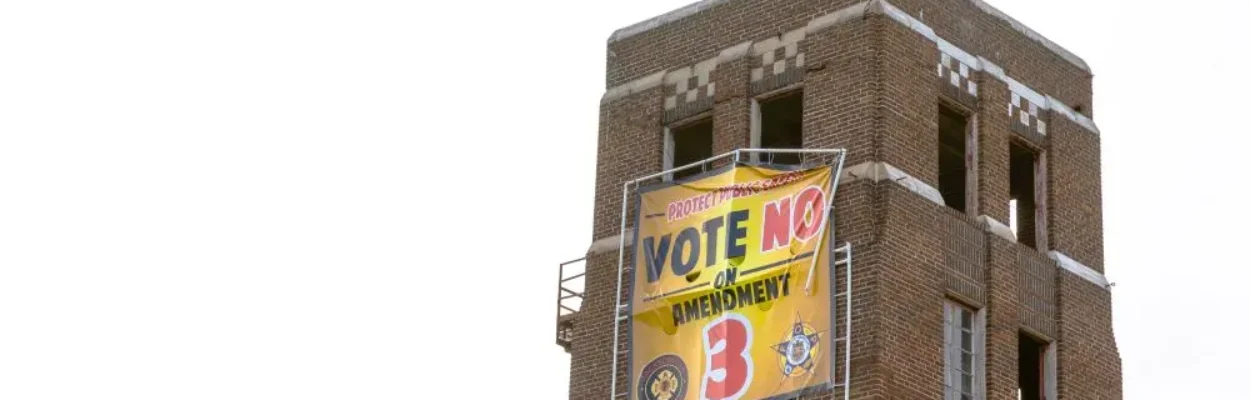
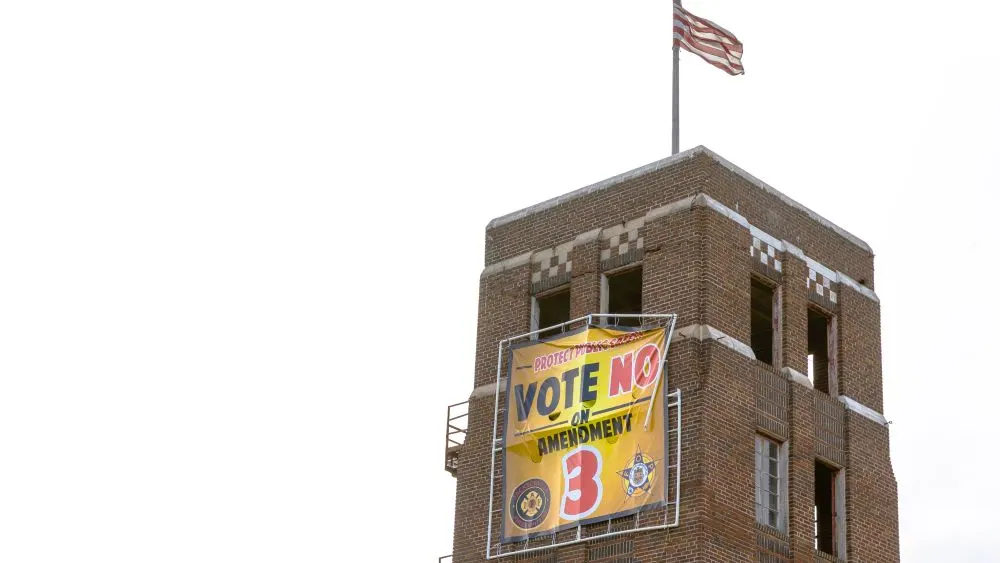
A banner posted atop the Jacksonville Fire and Rescue Department's former training tower off I-10 shows opposition to Amendment 3 by the local Fraternal Order of Police and Jacksonville Association of Fire Fighters unions. | Will Brown, Jacksonville Today
Published on September 28, 2026 at 5:00 am
Free local news and info, in your inbox at 6 a.m. M-F. Sign up for the Jacksonville Today newsletter.
A majority of Florida homeowners are more concerned about property insurance in the state than they are about property taxes, according to the latest poll from the Public Opinion Research Lab (PORL) at the University of North Florida.
The poll numbers released Monday show that respondents were almost twice as concerned about insurance, which is consistently listed among voters’ top issues, along with housing costs and property taxes.
Jacksonville Today thanks our sponsors. Become one.
The poll comes as a growing list of organizations openly oppose Constitutional Amendment 3, a controversial property tax relief measure that will be on the statewide Nov. 3 election ballot. Locally, the latest group to urge Floridians to vote no the property tax cut is the Jacksonville Civic Council.
The poll surveys were completed online from July 16 through 31 among 1,511 Florida homeowners with property insurance who live in the state, said Sean Freeder, research lab faculty director and associate professor of political science.
“This is remarkable given the amount of attention that has been spent this year discussing property tax reform, especially with Amendment 3 on the ballot,” Freeeder said in a news release. “Even in a rhetorical environment that would otherwise prime Floridians to think heavily about property tax, nearly two in three still said property insurance was the greater concern. This sentiment was essentially uniform across partisanship and region of the state.”
Jacksonville Today thanks our sponsors. Become one.
The poll was conducted in conjunction with the Orlando Sentinel and South Florida Sun Sentinel. Respondents were screened out of the survey results if their primary residence was not in Florida, they did not own their home, or they did not currently have a property insurance policy. The poll’s margin of error is about 3%.
Insurance reform vs. Amendment 3
UNF pollsters surveyed homeowners with about three months to go before voters make a decision on Amendment 3. If approved, it would increase the homestead property tax exemption from $50,000, to $150,000 in 2027, then rise to $250,000 in 2028.
But in the past few months, police and fire leaders have voiced major concerns about the strain that Amendment 3 would place on public safety and government services.
That opposition includes a banner from the local Fraternal Order of Police and Jacksonville Association of Fire Fighters unions atop the Jacksonville Fire and Rescue Department’s former training tower off Interstate 10.
The Civic Council, a group of about 100 regional CEOs, has also warned that the amendment could lead to longer police and fire response times, and hamper city park, library, road and drainage services.
When asked to choose between property taxes or property insurance, 63% of poll respondents said they are more concerned about insurance, while 36% indicated greater concern about taxes. Concern over property taxes was higher among registered Republicans than among Democrats or independents. A majority of respondents in each group indicated greater concern over property insurance.
Worry over housing costs in general has increased significantly in recent years. About 2% of Florida voters indicated it as the most important problem facing Florida in the spring of 2022, rising to 26% in the fall of 2023, the poll said.
Since early 2025, property insurance has consistently been among the top issues for voters, along with housing costs and property taxes.
Fifty-four percent of respondents said they have changed primary insurers at least once in the past five years, and 33% said they have done so twice or more in that time.
A total of 47% said they were dropped by a private insurer, 12%, while 25% said that Citizens Property Insurance – Florida’s property insurer of last resort – cut their policy. According to the survey, 10% said their previous insurer no longer operates in Florida.
Among the respondent sample, 25% said that they were dropped from their insurance at least once in the past five years.
Only a small number of respondents said they had filed a claim with their insurance company in the past five years. But among the 261 who did, 45% said their claim was initially denied. And 47% of respondents said their annual insurance premium increased by at least 50% in the past five years.
According to a 2024 national Consumer Reports survey referenced by PORL, 19% said their premium increased by that amount in the past year, compared to just 2% nationwide.
“About a third of homeowners in our sample had to change at least twice over the last five years,” Freeder said. “Of those who did change at least once, nearly half had to do so because they were simply dropped by their insurer. This speaks to a persistent high degree of instability in Florida’s property insurance market. Not only that, but a solid majority relied upon an insurance company that operates only out of the state of Florida.”
When asked who they feel has benefited the most from insurance reforms, a strong majority (69%) of poll respondents pointed to the insurance industry, with 16% saying consumers have benefited the most, and 9% said trial lawyers.
Among registered Republicans, perceived benefit shifts more toward consumers at 28%. Still, 57% of this group said they believe insurance companies benefit the most from policy reforms.
“Florida homeowners are overwhelmingly negative in their assessment of not just the property insurance market, but also government efforts to overhaul it,” Freeder said. “Only about one in 10 Democrats and Independents, and one in four Republicans, see signs of improvement, which is remarkable. ”
Freeder also explained why the results were released over two months after the survey was done. He said, because the poll was commissioned by the newspapers, the results were contractually embargoed until the outlets released their story on Sunday. Normally, UNF polls are released within a few days after questions are asked and tabulated, he said.
PORL will have a pre-election poll this fall, to be conducted just a few weeks before the election. The results will be released in mid-to late October, Freeder said. It will contain “head-to-heads on the governor and senate races, as well as the attorney general race and vote intentions on Amendment 3,” he said.