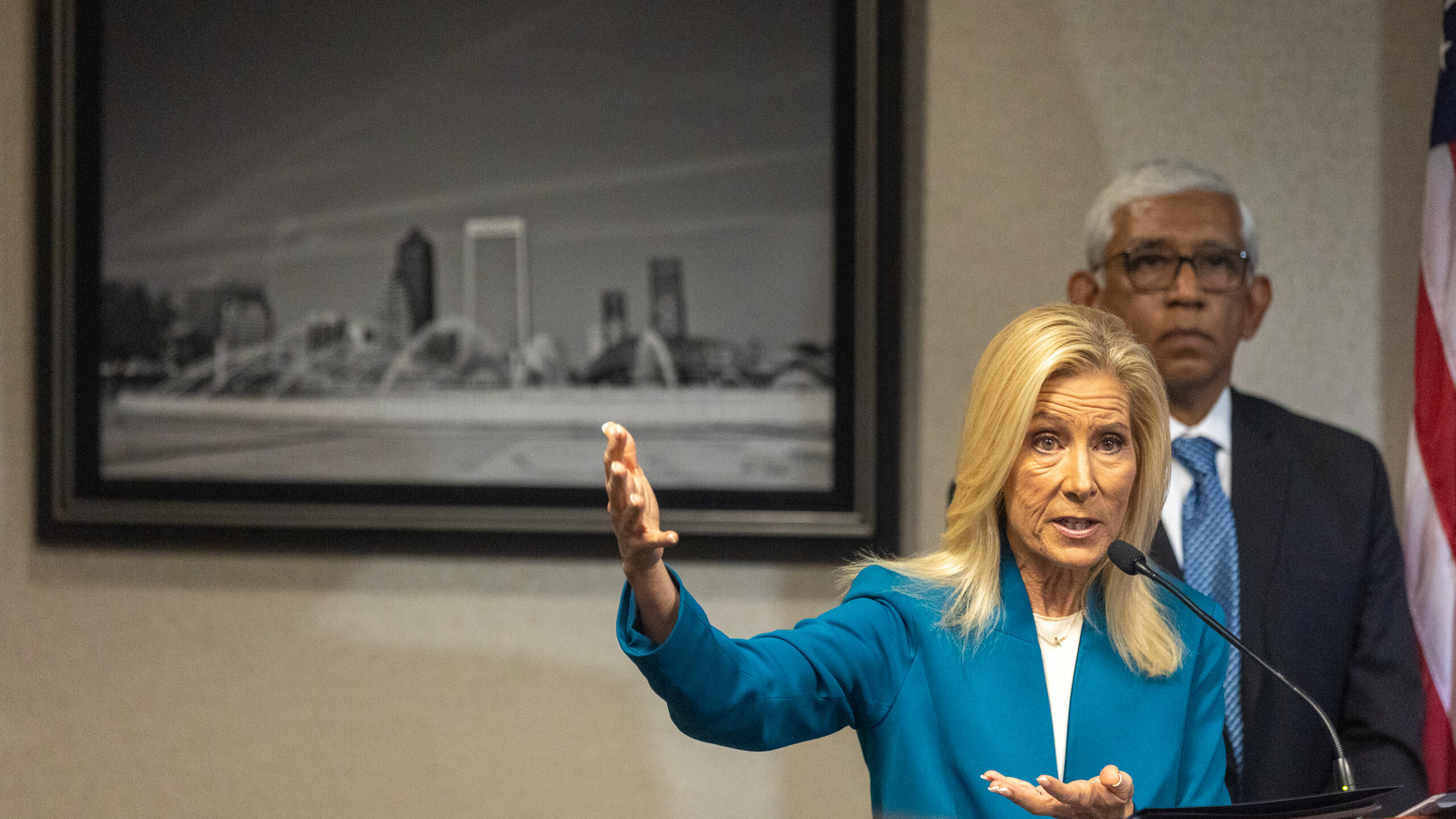
Jacksonville Mayor Donna Deegan presents State of Jax, a data analysis portal she hopes will reduce politics in policymaking. Deegan and the city's chief of analytics, Parvez Ahmed, announced the project Aug. 5, 2025, at City Hall. | Will Brown, Jacksonville Today
Published on June 1, 2026 at 4:40 pm
Free local news and info, in your inbox at 6 a.m. M-F. Sign up for the Jacksonville Today newsletter.
As Florida lawmakers return to Tallahassee to debate Gov. Ron DeSantis’ property tax cut proposal, Jacksonville city leaders could be staring at a loss that exceeds $300 million for city services.
DeSantis called the Legislature back into a special session that began Monday to vet his plan to place a constitutional amendment on the November ballot to redesign the state property tax code. His plan would raise the homestead property tax exemption for a homeowner’s primary residence from $50,000 to $150,000 in 2027 and up to $250,000 by 2028.
Jacksonville Today thanks our sponsors. Become one.
DeSantis says this would eliminate property taxes for 60% of Florida homeowners — a longtime priority of the term-limited governor. Under the proposal, the Legislature would draft a plan to eventually raise the exemption to $500,000.
But local government officials statewide, including in Jacksonville, say this could mean big losses in revenue to city and county governments a little more than a year from now.
In an email Friday to Jacksonville Today, City Council Auditor Philip Peterson said he’s provided city lawmakers an initial analysis that shows a $250,000 homestead exemption would likely hit city revenues by more than $300 million beginning in January 2027.

Jacksonville Today thanks our sponsors. Become one.
That’s factoring increases in property values by that time, he says.
Mayor Donna Deegan said Monday that’s a big hit to a city like Jacksonville that already has the lowest city property tax millage rate of all major Florida metros.
“I feel like, in a way, (it) punishes places like us. We’re so large and yet we have existed on really a bare-bones property tax that doesn’t even cover for us … our police and fire,” Deegan said. “So my big concern is the auditors are telling us this is going to be a $300 million hit in just the first year. That kind of takes your breath away when you’re just talking about core services.”
RELATED: Lawmakers tweak DeSantis’ property tax cut ahead of floor votes
When Peterson based his projections on 2025 property values, he says the city would lose $250 million and $280 million.
The auditor told Jacksonville Today that the cost of the property tax cut will likely be deeper. His assessment does not take into account the proposal’s reduction in the annual nonhomestead and commercial property assessment cap, which the governor’s proposal reduces from 10% to 5%.
Peterson says that would add to his $300 million estimated revenue loss, but it’s unclear by how much.
“This portion of the analysis is more complex and will require additional data from the Property Appraiser’s Office. If the proposal is approved during next week’s special session, we will conduct a deeper analysis to provide Council with more detailed information,” Peterson said in the email on Friday.
Before the council auditor assessed the governor’s plan, Peterson told Jacksonville Today that because many homestead properties in Duval County are valued below the proposed $250,000 exemption, “the impact will be significant.”
“The average assessed value of homesteaded single-family homes in 2025 was $235,993. The median assessed value of homesteaded single-family homes in 2025 was $193,236,” Peterson said in an email Wednesday. “Increasing the homestead exemption to $250,000 would impact a lot of homes in Duval County.”
RELATED: Read the tax cut legislation
DeSantis’s proposal would create a trust fund where local governments can apply for grants to backfill the lost revenue “to assist with the continuations of core local services.”
It’s not guaranteed that the property tax proposal will go into effect. It will take 60% of lawmakers’ approval to place the amendment on the ballot and 60% of voters will have to say yes.
But Deegan says she’s worried about the speed at which Tallahassee officials are moving on the governor’s proposal.
“I don’t understand the need to move so fast. We need to understand what the impacts are going to be, and I don’t think we fully understand that yet,” Deegan said.
“If they’re telling us the solution is to go and ask the state for money every year, then I’m not sure why any of us are elected,” she said. “They talk a lot about big government, but the truth is that’s as big government as it gets to take away the power of your elected officials at the local level, at the level that is closest to the people, and say you’re going to have to come to the state to make your cities go.”
Conservative City Council member Rory Diamond was quick last week to endorse the property tax cuts and defend state involvement in social media posts.
“Local politicians will never cut government. They don’t have the spine for it. The only way to save homeowners is to force the cuts,” Damond wrote Sunday on X. “Starve the beast.”
Jax council and property taxes
Council Finance Committee Chair Joe Carlucci will have a workshop after the committee’s regular meeting Tuesday to hear from Peterson and discuss the proposal’s effect on city coffers, departments and programs.
Carlucci, a Republican who will also start his one-year term as council vice president at the end of June, says it’s still early in the process and he wants to have preliminary discussions about the effects on revenue.
If the governor’s plan is approved by the Legislature and electorate, the city would see revenue loss in the 2027-28 budget year.
“Time is on our side right now,” Carlucci told Jacksonville Today. “We just want to use that to our advantage and just kind of get questions answered that everyone is asking right now.”
He says, in addition to the lost revenue, the council needs to know what the Jacksonville property appraisers and tax collector’s offices would need to handle the code change.
Carlucci says council wants tax relief for residents but called the auditor’s projection “a significant number.”
“It’s definitely a noticeable impact,” Carlucci said. “But we want to know what our total budget number is going to be for police and fire and schools — just kind of look at all the buckets and then figure out is a $300 million hit even doable staying the course, or do we have to have additional conversations.”
City Council’s Finance Committee is responsible for analyzing, changing and approving the mayor’s proposed annual city budget, which last year came in at $2.06 billion plus a $559.12 million capital improvement plan.
The city budget funds the Jacksonville Sheriff’s Office, Jacksonville Fire and Rescue and other city departments, economic development incentives, youth and workforce development projects, nonprofit grants among other council and mayoral priorities.
The capital plan pays for roads, bridges, parks and other city infrastructure projects.
Carlucci says since the property tax changes would not go into effect until 2027, the budget that the mayor submits in July and the council approves in September will be part of a “normal budget year.”
He said in November, city lawmakers would start taking a deeper look at what would need to be cut or if the city would need to raise revenue through other taxes and fees.
“There’s only so many places you can cut from. It’s not like we have inventory or anything. It’s very limited — probably five or six things we could entertain to cut,” he said. “But we’re going to be mindful of the possibility. We don’t want to make large recurring contract extensions and stuff like that without having clawbacks. That’s what we’re doing right now. We’re not trying to get too over our skis on it. We’re just trying to get all of the information we have available right now, and that’s all we can do.”
Carlucci says, for him, how much of the $300 million the city tries to backfill with local fees would depend on the vote margin in November. He said, hypothetically, if the property tax cuts see 70% voter support, that would be “a very clear message.”
“There’s definitely levers that the city can pull to replenish those dollars if we needed to. But we just have to wait and see. I don’t want to get too far ahead and say, ‘This is what we’re cutting. This is how we’re going to replenish all of it,’” Carlucci said. “We do want there to be some tax relief for people. That is the whole thing.”
NE Florida governments concerned
On Monday, officials in Clay County warned of “widespread impacts” to services if the state property tax law change goes through.
In a news release, Clay County said there would be a reduction in first responders and longer response times for fire pressure and law enforcement.
Officials said other Clay County services would see reductions including road and park maintenance; fewer animal control officers; community programs; library and public building hours and employees; recreational facilities support; and local health services.
“Should the bill pass, the Board of County Commissioners will prioritize reductions through the normal budget process through public meetings,” the news release said.
In February, St. Augustine city officials warned that different property tax cut proposals, which died during the regular legislative session, would have resulted in a cut to local services.
Deegan said Monday that her administration plans to reach out to Duval County residents directly to show how a $300 million revenue cut could affect local services.
During Jacksonville’s 2025-26 budget debate last year, the mayor held a series of town hall meetings to show her spending priorities and push back against what was inevitably a successful effort by council to cut the city’s property tax millage rate by ⅛-mill.
The Sheriff’s Office and Fire and Rescue made up half of the city’s $2.06 billion general operating fund budget in this year’s budget. By comparison, the city’s total property tax revenue in 2025-26, which includes commercial and residential tax collection, was $1.218 billion.
“I think this is just another way in which Tallahassee, once again, has decided that they know better and they want to take control away from local governments,” Deegan said. “It’s not good for our city, for sure, and I’d think most of the cities in the state would feel the same way.”